Even small moments of friction at checkout can reduce conversion. For example, if shoppers need to leave the checkout to find and apply a promo code, many simply abandon the purchase. We see this across high-intent e-commerce funnels, where one extra step can change the outcome.
Meta’s Highlight your promotionsfeature helps remove that friction by surfacing promo codes directly inside the in-app browser. Shoppers see the offer when it matters most—during the purchase flow—and in some cases, the Meta promo code can auto-apply. For teams running automated Meta campaigns, the challenge is managing promo codes efficiently. Birch (formerly Revealbot) simplifies promo setup and testing, making it easier to apply codes across ads and campaigns without slowing down execution.
This article explores how experienced marketers evaluate lift, where surfacing or auto-applying promo codes delivers the strongest impact, and how to use creative, campaign structure and Advantage+ sales campaigns to maximize ROI.
Key takeaways
Surfacing promo codes inside the in-app browser removes checkout friction. It’s often more impactful than adding discount messaging in your creative.
Auto-apply works best for broad, simple offers. Surface-only still adds value when promotions are more targeted or complex.
Seasonal events, loyalty audiences, cart abandoners, and mobile-first funnels tend to see the strongest lift.
Tracking promo usage rate alongside CPP or ROAS helps confirm whether the offer is influencing completion, not just attracting clicks.
Using Birch speeds up promo experimentation. It lets you manage promo codes in bulk across ads and ad sets—and there’s no need to restructure campaigns.
What is Highlight your promotions, and how does it work?
Highlight your promotions is part of Meta’s promotional ads suite. It makes discount codes easier to access inside the in-app browser during checkout. The feature is globally available and eligible for sales campaigns optimized for website conversions.
There are two key behaviors:
Auto-surfacing: The in-app browser displays the discount so that shoppers quickly recognize the offer within the experience.
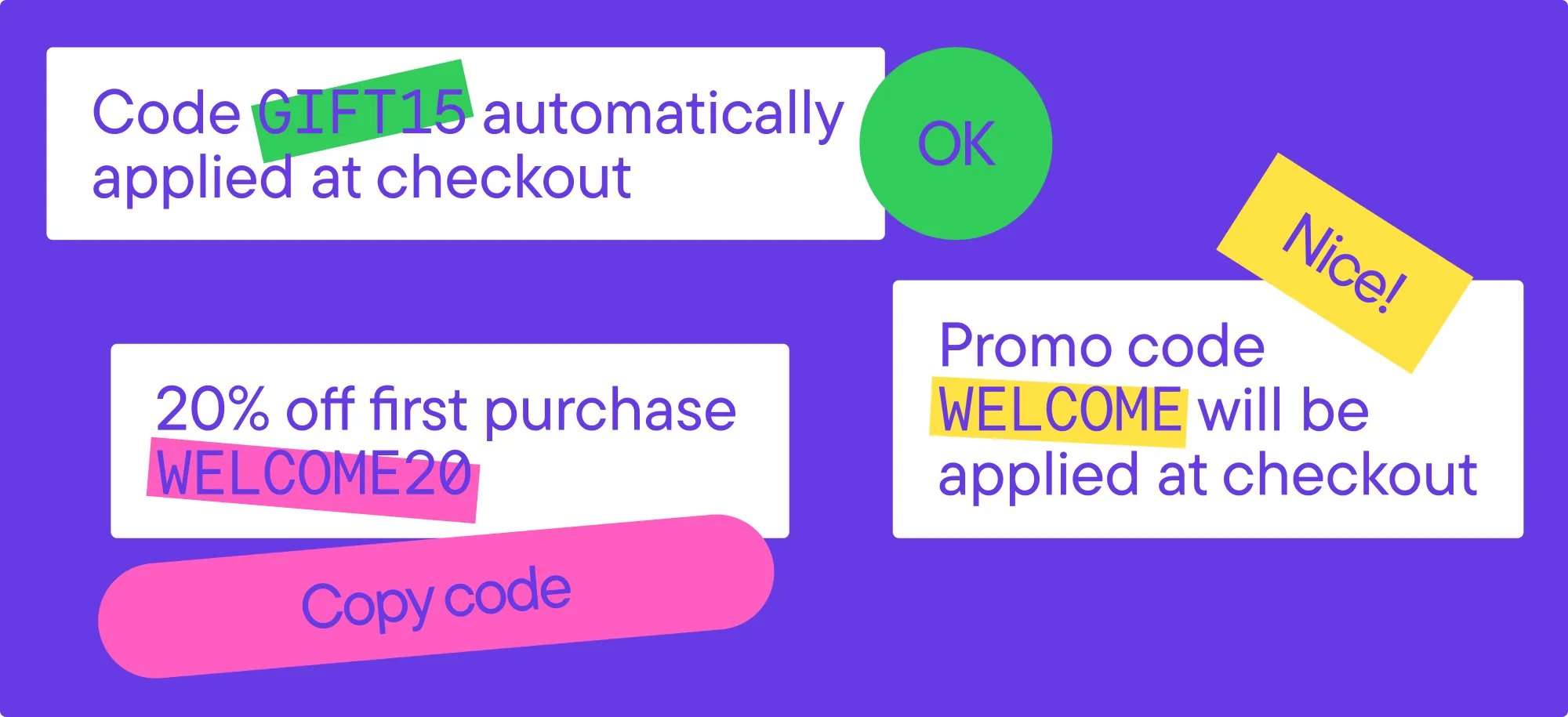
Auto-apply vs. manual apply:When the website and checkout flow support automatic discount injection, the code can apply automatically. This is more common for simple or sitewide offers and standard e-commerce checkouts.
Seeing the offer inside the browser is more actionable than relying on promo language in creative. It reduces effort at the moment of purchase and can increase completion rates.
Note: If your setup is more complex—such as product-specific rules, login requirements, or custom cart logic—the shopper can still see the promo in the browser but may need to apply it manually.
Why promo surfacing improves conversion rates
Promo visibility inside the in-app browser keeps the purchasing journey uninterrupted. Shoppers don’t pause to second-guess their purchase by searching for better offers elsewhere, leading to higher completion rates.
This matters even more in mobile-first ecommerce, where small interruptions are more likely to break the flow.
Meta testing suggests that surfacing promo codes inside the in-app browser improves checkout performance. Internal results showed a median 9% reduction in cost per purchase and a 10% lift in conversion rate, while a randomized experiment across 675,000 promo-enabled ads found an average 4.6% increase in conversions among small and medium advertisers.
These findings indicate that simplified promo usage can benefit a wide range of budgets and funnel structures. However, actual performance can depend on margin structure, offer relevance, attribution windows, and checkout compatibility.
In many cases, higher promo usage correlates with stronger ROAS and CPP because the purchase experience requires fewer shopper decisions.
Even modest increases at checkout can compound over time, especially in automated campaigns where incremental volume reinforces performance.
Using Highlight your promotions inside Birch
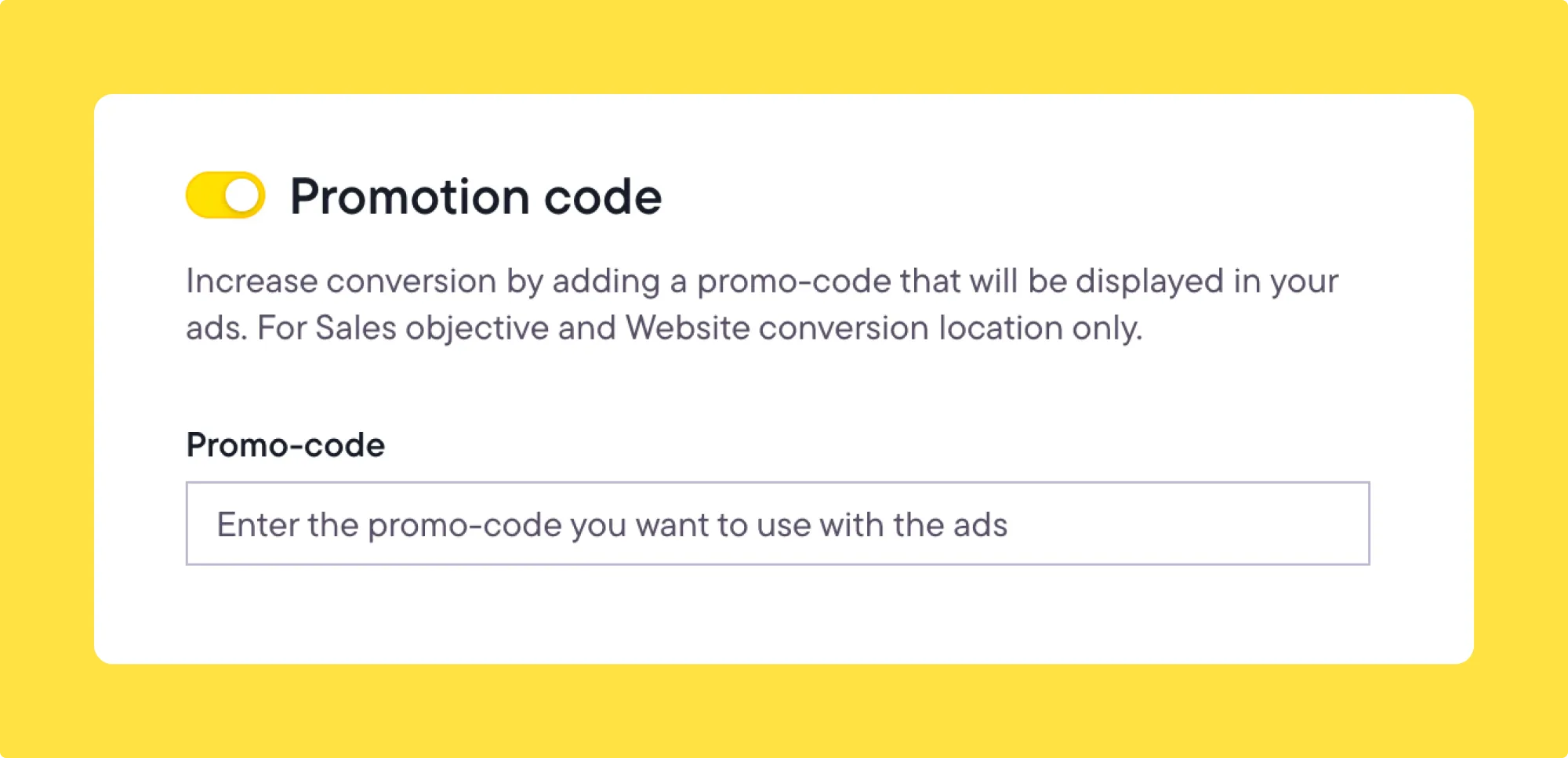
Managing promo codes inside Meta can feel slow when you need to test multiple offers or duplicate ads at scale. Each ad typically supports only one code at a time. For teams running broader catalog tests or seasonal events, this can add unnecessary operational overhead.
With Birch, you can manage promo codes in bulk. Assign the same code to multiple ad sets or ads, or create unique codes for different audiences or product groups without repeating manual setup.
Birch promo code setup for multiple ads
This flexibility helps teams test faster, maintain consistency across creatives, and validate which code structure drives stronger usage or conversion lift.
Birch lets teams control promo structure without touching campaign architecture, making it easy to run a single shared offer or tailor promotions by ad set as testing evolves.
Pro tip: When running seasonal or multi-product events, duplicating creatives with their promo codes helps keep tests aligned and avoids rebuilding ads individually in Meta.
When to use (and not use) Highlight your promotions
The advantages are most obvious in these situations:
Seasonal or sitewide sales: when discounts reinforce urgency during high-intent buying periods
Retention or loyalty audiences: where shoppers already recognize the brand and need minimal reassurance
Cart-abandoner remarketing: when surfacing the offer removes friction at the final step
Mobile-first or direct-to-consumer funnels: especially when a large share of purchases happens inside the in-app browser
If pricing is already very competitive and discounts are not part of normal buyer behavior, promo surfacing may not meaningfully influence outcomes. The feature also plays a smaller role when purchases occur outside the in-app browser or in native apps, where browser-level visibility is limited.
Different setups can support different behaviors:
Auto-apply: best for broad offers such as sitewide discounts, peak-season campaigns, or large catalog events, as it removes another decision point
Surface-only: useful for more selective offers such as category-specific or product-limited promotions, where automatically applying a discount to every order isn’t always desirable
To understand the feature’s influence, many advertisers monitor promo usage rate alongside CPP or conversion rate.
High usage usually signals clarity and relevance. When usage is low, the constraint may be related to offer eligibility, funnel visibility, or checkout compatibility rather than creative or targeting.
How to integrate Highlight your promotions into your campaign structure
The feature works smoothly within Advantage+ sales campaigns and aligns with Meta’s automation. Because the discount is surfaced during the checkout experience rather than through manual audience controls, you don’t typically need to restructure existing campaigns to take advantage of it.
Most advertisers can enable promo surfacing without changing targeting, budget distribution, or audience logic. Since ASC prioritizes automation, surfacing a discount is another signal that can help improve funnel completion rates, as the funnel already adapts to buyer intent.
Structural changes are rarely necessary—unless you’re comparing different offers across product sets or landing pages and need clean isolation.
At the creative level, promo messaging is optional. Some teams keep ads simple and let the in-browser discount do the work. Others use a light reference to set expectations before the click.
While most lift happens at checkout, creative still helps shape intent upstream.
Lead with product clarity: Product-first creative drives higher-value intent, while checkout surfacing closes conversion.
Use gentle pricing cues when relevant:Strike-through or contextual price anchoring can strengthen recognition during short promotional windows.
Lean into mobile-first formats:Mobile-first assets work well with automation, especially inside ASC, where delivery scales quickly.
Keep variations simple:You can keep creative variation simple when testing multiple offers. Clarity at checkout matters more than aggressive discount framing.
Pro tip: When testing multiple offers, isolating them at the ad set level can make it easier to evaluate promo usage and performance—mainly when product categories or margins differ.
How advanced advertisers evaluate performance
Advanced teams look beyond headline metrics and evaluate how promo access influences the ad to cart → checkout → purchase flow.
CVR and CPP remain central, but promo usage rate provides valuable context. It shows whether shoppers see and redeem the offer inside the browser, so you don’t need to make assumptions about intent.
Note: In Meta Ads Manager, promo usage appears as an additional signal, though interpreting it may require extra filtering or manual comparison. Usage sometimes appears within custom columns or reporting layers rather than as a single consolidated metric. This is why external reporting environments can speed up interpretation.
Separating creative-driven lift from promo-driven lift is a key part of analysis. Creative can improve click-through and attention, while promo surfacing typically influences behavior later in the funnel. Evaluating lift at the purchase level makes that distinction easier.
When interpreting performance, you can use a few simple cues:
If promo usage rises and CPP improves, increasing delivery can make sense even without major creative updates.
If usage is low and conversion is flat, targeting is rarely the issue. It’s more often related to offer clarity, funnel visibility, or checkout compatibility.
If usage is rising but CPP remains unchanged, the offer is being recognized—but it’s not compelling enough to shift purchase behavior.
If usage is high but CPP worsens, the discount may be eroding margins faster than it’s improving funnel completion.
Before restructuring campaigns or changing audiences, it makes sense to review whether visibility, relevance, or offer strength is driving these signals.
Promo surfacing in practice: examples from brands
Advertisers use promo surfacing in different ways, but we typically see the same outcome: making the offer visible at checkout often drives more lift than emphasizing discounts in the ad.
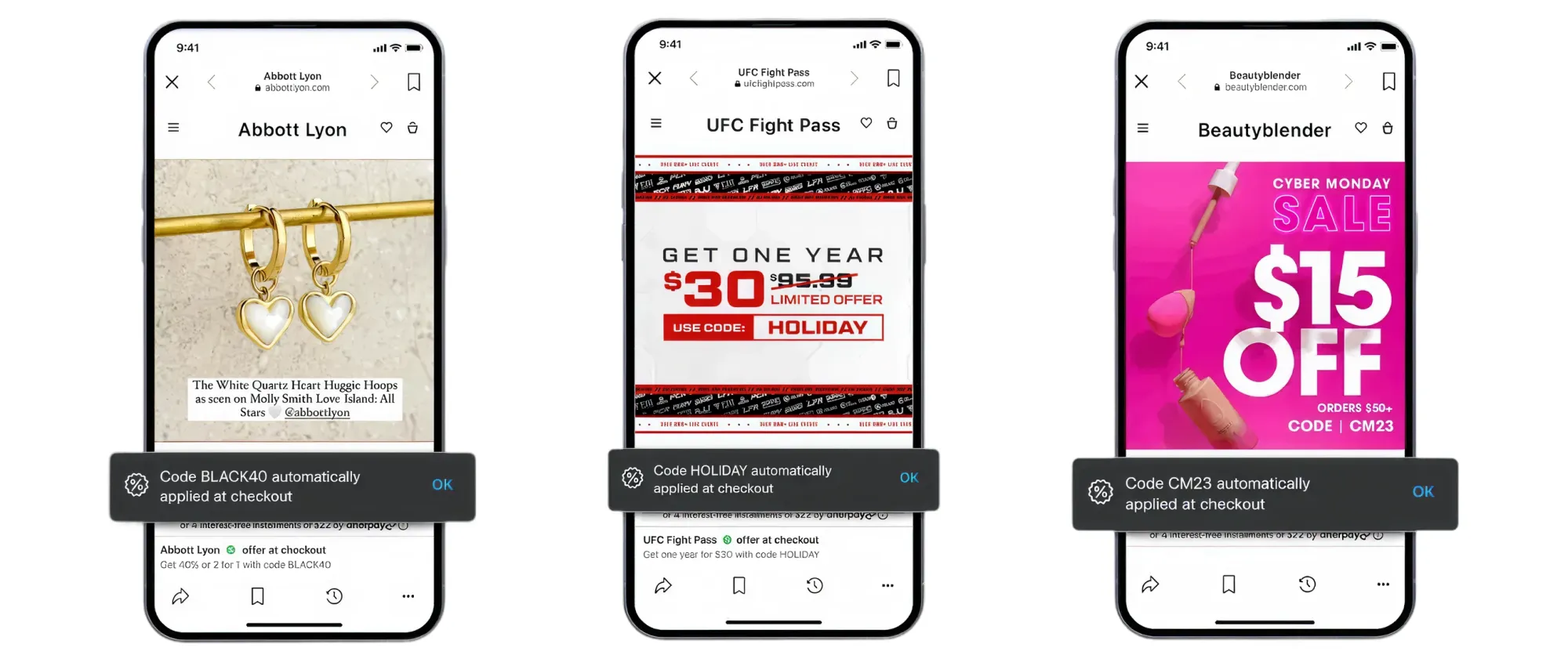
Beauty Blender used promo surfacing during Cyber Week to reinforce the offer inside the checkout flow.
Browser-level visibility helped convert high-intent users without additional creative pressure.
With Advantage+ and mobile-first formats, they saw a 51% decrease in CPA, a +137% increase in click-through conversion, and a +22% increase in ROAS.
UFC Fight Pass auto-applied a promotional incentive after the click and compared performance against a control with identical creative and placements.
The promo-enabled setup delivered a 300% conversion rate lift, a 28.5% decrease in CPA, and a +13% conversion lift versus the control during a short holiday window.
Broad and lookalike targeting extended reach, while browser-level application reduced steps and supported completion.
Abbott Lyon enabled promo surfacing to scale during a competitive period without restructuring audiences.
Incremental lift in performance came from improved checkout completion, not from new targeting logic. The brand saw +12% ROAS, +11% CTR, and an 18% decrease in CPM.
Product-led creative attracted higher-value customers, and promo visibility at checkout helped increase conversion without relying on heavy discount messaging.
Common mistakes to avoid
Promotional surfacing appears to be effective for many advertisers, but several recurring issues can hinder performance.
While each issue may seem minor on its own, they tend to compound when consumer intent is high and the checkout experience has the greatest impact.
Frequent pitfalls include:
Misaligned offers: Discounts that don’t match product value or customer expectations often lead to low usage, even when surfaced at checkout.
Over-reliance on promo creative: Heavy discount messaging in ads can draw attention, but completion usually depends on clarity inside the browser, not aggressive framing in the ad.
Promo overload: Running too many overlapping offers can dilute perceived value and create fatigue, especially in high-frequency environments.
Checkout compatibility gaps: If auto-apply isn’t supported in some environments, results may vary. Performance interpretation may become harder.
Tracking or reporting blind spots: When usage, lift, and funnel signals aren’t visible in a single view, it’s easier to misattribute performance to creative or targeting.
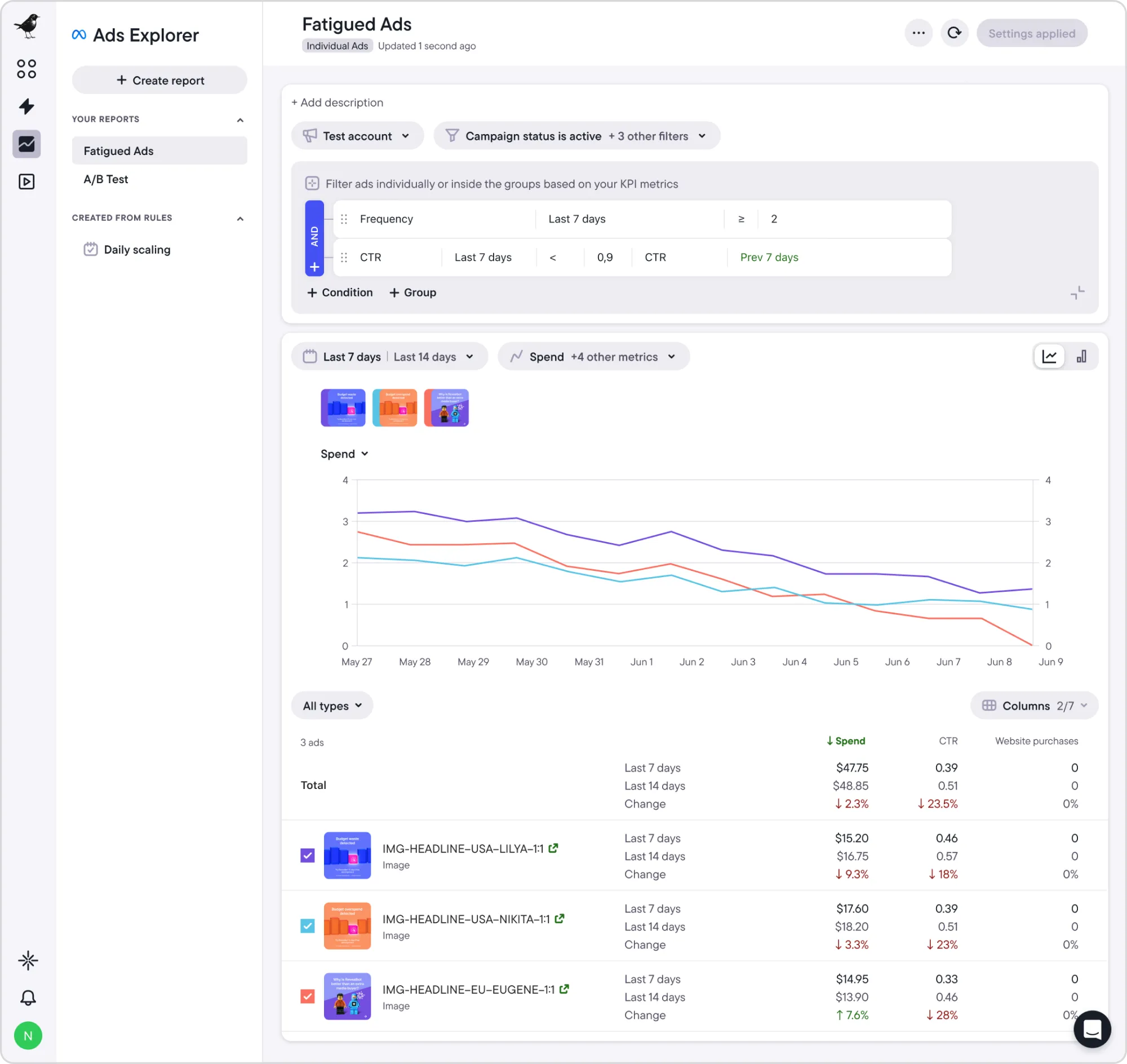
Ads Explorer by Birch
Maximize the impact of Highlight your promotions
Highlight your promotions is most effective when it reinforces intent at checkout rather than adding complexity to campaign structure. Clear, relevant offers that surface inside the in-app browser tend to deliver more predictable lift than relying on heavy discount messaging in creative.
As performance patterns emerge, tracking promo usage rate alongside CPP or ROAS helps validate whether the offer is influencing completion rather than just driving clicks. When usage and conversion improve together, promo surfacing becomes a reliable way to strengthen automated environments without audience restructuring.
For teams running broader experimentation or managing multiple offers, Birch makes it easier to compare promo behavior across ads and ad sets through flexible bulk workflows—without changing your existing setup.
Explore Birch with a 14-day free trial
Even small moments of friction at checkout can reduce conversion. For example, if shoppers need to leave the checkout to find and apply a promo code, many simply abandon the purchase. We see this across high-intent e-commerce funnels, where one extra step can change the outcome.
Meta’s Highlight your promotionsfeature helps remove that friction by surfacing promo codes directly inside the in-app browser. Shoppers see the offer when it matters most—during the purchase flow—and in some cases, the Meta promo code can auto-apply. For teams running automated Meta campaigns, the challenge is managing promo codes efficiently. Birch (formerly Revealbot) simplifies promo setup and testing, making it easier to apply codes across ads and campaigns without slowing down execution.
This article explores how experienced marketers evaluate lift, where surfacing or auto-applying promo codes delivers the strongest impact, and how to use creative, campaign structure and Advantage+ sales campaigns to maximize ROI.
Key takeaways
Surfacing promo codes inside the in-app browser removes checkout friction. It’s often more impactful than adding discount messaging in your creative.
Auto-apply works best for broad, simple offers. Surface-only still adds value when promotions are more targeted or complex.
Seasonal events, loyalty audiences, cart abandoners, and mobile-first funnels tend to see the strongest lift.
Tracking promo usage rate alongside CPP or ROAS helps confirm whether the offer is influencing completion, not just attracting clicks.
Using Birch speeds up promo experimentation. It lets you manage promo codes in bulk across ads and ad sets—and there’s no need to restructure campaigns.
What is Highlight your promotions, and how does it work?
Highlight your promotions is part of Meta’s promotional ads suite. It makes discount codes easier to access inside the in-app browser during checkout. The feature is globally available and eligible for sales campaigns optimized for website conversions.
There are two key behaviors:
Auto-surfacing: The in-app browser displays the discount so that shoppers quickly recognize the offer within the experience.
Auto-apply vs. manual apply:When the website and checkout flow support automatic discount injection, the code can apply automatically. This is more common for simple or sitewide offers and standard e-commerce checkouts.
Seeing the offer inside the browser is more actionable than relying on promo language in creative. It reduces effort at the moment of purchase and can increase completion rates.
Note: If your setup is more complex—such as product-specific rules, login requirements, or custom cart logic—the shopper can still see the promo in the browser but may need to apply it manually.
Why promo surfacing improves conversion rates
Promo visibility inside the in-app browser keeps the purchasing journey uninterrupted. Shoppers don’t pause to second-guess their purchase by searching for better offers elsewhere, leading to higher completion rates.
This matters even more in mobile-first ecommerce, where small interruptions are more likely to break the flow.
Meta testing suggests that surfacing promo codes inside the in-app browser improves checkout performance. Internal results showed a median 9% reduction in cost per purchase and a 10% lift in conversion rate, while a randomized experiment across 675,000 promo-enabled ads found an average 4.6% increase in conversions among small and medium advertisers.
These findings indicate that simplified promo usage can benefit a wide range of budgets and funnel structures. However, actual performance can depend on margin structure, offer relevance, attribution windows, and checkout compatibility.
In many cases, higher promo usage correlates with stronger ROAS and CPP because the purchase experience requires fewer shopper decisions.
Even modest increases at checkout can compound over time, especially in automated campaigns where incremental volume reinforces performance.
Using Highlight your promotions inside Birch
Managing promo codes inside Meta can feel slow when you need to test multiple offers or duplicate ads at scale. Each ad typically supports only one code at a time. For teams running broader catalog tests or seasonal events, this can add unnecessary operational overhead.
With Birch, you can manage promo codes in bulk. Assign the same code to multiple ad sets or ads, or create unique codes for different audiences or product groups without repeating manual setup.
Birch promo code setup for multiple ads
This flexibility helps teams test faster, maintain consistency across creatives, and validate which code structure drives stronger usage or conversion lift.
Birch lets teams control promo structure without touching campaign architecture, making it easy to run a single shared offer or tailor promotions by ad set as testing evolves.
Pro tip: When running seasonal or multi-product events, duplicating creatives with their promo codes helps keep tests aligned and avoids rebuilding ads individually in Meta.
When to use (and not use) Highlight your promotions
The advantages are most obvious in these situations:
Seasonal or sitewide sales: when discounts reinforce urgency during high-intent buying periods
Retention or loyalty audiences: where shoppers already recognize the brand and need minimal reassurance
Cart-abandoner remarketing: when surfacing the offer removes friction at the final step
Mobile-first or direct-to-consumer funnels: especially when a large share of purchases happens inside the in-app browser
If pricing is already very competitive and discounts are not part of normal buyer behavior, promo surfacing may not meaningfully influence outcomes. The feature also plays a smaller role when purchases occur outside the in-app browser or in native apps, where browser-level visibility is limited.
Different setups can support different behaviors:
Auto-apply: best for broad offers such as sitewide discounts, peak-season campaigns, or large catalog events, as it removes another decision point
Surface-only: useful for more selective offers such as category-specific or product-limited promotions, where automatically applying a discount to every order isn’t always desirable
To understand the feature’s influence, many advertisers monitor promo usage rate alongside CPP or conversion rate.
High usage usually signals clarity and relevance. When usage is low, the constraint may be related to offer eligibility, funnel visibility, or checkout compatibility rather than creative or targeting.
How to integrate Highlight your promotions into your campaign structure
The feature works smoothly within Advantage+ sales campaigns and aligns with Meta’s automation. Because the discount is surfaced during the checkout experience rather than through manual audience controls, you don’t typically need to restructure existing campaigns to take advantage of it.
Most advertisers can enable promo surfacing without changing targeting, budget distribution, or audience logic. Since ASC prioritizes automation, surfacing a discount is another signal that can help improve funnel completion rates, as the funnel already adapts to buyer intent.
Structural changes are rarely necessary—unless you’re comparing different offers across product sets or landing pages and need clean isolation.
At the creative level, promo messaging is optional. Some teams keep ads simple and let the in-browser discount do the work. Others use a light reference to set expectations before the click.
While most lift happens at checkout, creative still helps shape intent upstream.
Lead with product clarity: Product-first creative drives higher-value intent, while checkout surfacing closes conversion.
Use gentle pricing cues when relevant:Strike-through or contextual price anchoring can strengthen recognition during short promotional windows.
Lean into mobile-first formats:Mobile-first assets work well with automation, especially inside ASC, where delivery scales quickly.
Keep variations simple:You can keep creative variation simple when testing multiple offers. Clarity at checkout matters more than aggressive discount framing.
Pro tip: When testing multiple offers, isolating them at the ad set level can make it easier to evaluate promo usage and performance—mainly when product categories or margins differ.
How advanced advertisers evaluate performance
Advanced teams look beyond headline metrics and evaluate how promo access influences the ad to cart → checkout → purchase flow.
CVR and CPP remain central, but promo usage rate provides valuable context. It shows whether shoppers see and redeem the offer inside the browser, so you don’t need to make assumptions about intent.
Note: In Meta Ads Manager, promo usage appears as an additional signal, though interpreting it may require extra filtering or manual comparison. Usage sometimes appears within custom columns or reporting layers rather than as a single consolidated metric. This is why external reporting environments can speed up interpretation.
Separating creative-driven lift from promo-driven lift is a key part of analysis. Creative can improve click-through and attention, while promo surfacing typically influences behavior later in the funnel. Evaluating lift at the purchase level makes that distinction easier.
When interpreting performance, you can use a few simple cues:
If promo usage rises and CPP improves, increasing delivery can make sense even without major creative updates.
If usage is low and conversion is flat, targeting is rarely the issue. It’s more often related to offer clarity, funnel visibility, or checkout compatibility.
If usage is rising but CPP remains unchanged, the offer is being recognized—but it’s not compelling enough to shift purchase behavior.
If usage is high but CPP worsens, the discount may be eroding margins faster than it’s improving funnel completion.
Before restructuring campaigns or changing audiences, it makes sense to review whether visibility, relevance, or offer strength is driving these signals.
Promo surfacing in practice: examples from brands
Advertisers use promo surfacing in different ways, but we typically see the same outcome: making the offer visible at checkout often drives more lift than emphasizing discounts in the ad.
Beauty Blender used promo surfacing during Cyber Week to reinforce the offer inside the checkout flow.
Browser-level visibility helped convert high-intent users without additional creative pressure.
With Advantage+ and mobile-first formats, they saw a 51% decrease in CPA, a +137% increase in click-through conversion, and a +22% increase in ROAS.
UFC Fight Pass auto-applied a promotional incentive after the click and compared performance against a control with identical creative and placements.
The promo-enabled setup delivered a 300% conversion rate lift, a 28.5% decrease in CPA, and a +13% conversion lift versus the control during a short holiday window.
Broad and lookalike targeting extended reach, while browser-level application reduced steps and supported completion.
Abbott Lyon enabled promo surfacing to scale during a competitive period without restructuring audiences.
Incremental lift in performance came from improved checkout completion, not from new targeting logic. The brand saw +12% ROAS, +11% CTR, and an 18% decrease in CPM.
Product-led creative attracted higher-value customers, and promo visibility at checkout helped increase conversion without relying on heavy discount messaging.
Common mistakes to avoid
Promotional surfacing appears to be effective for many advertisers, but several recurring issues can hinder performance.
While each issue may seem minor on its own, they tend to compound when consumer intent is high and the checkout experience has the greatest impact.
Frequent pitfalls include:
Misaligned offers: Discounts that don’t match product value or customer expectations often lead to low usage, even when surfaced at checkout.
Over-reliance on promo creative: Heavy discount messaging in ads can draw attention, but completion usually depends on clarity inside the browser, not aggressive framing in the ad.
Promo overload: Running too many overlapping offers can dilute perceived value and create fatigue, especially in high-frequency environments.
Checkout compatibility gaps: If auto-apply isn’t supported in some environments, results may vary. Performance interpretation may become harder.
Tracking or reporting blind spots: When usage, lift, and funnel signals aren’t visible in a single view, it’s easier to misattribute performance to creative or targeting.
Ads Explorer by Birch
Maximize the impact of Highlight your promotions
Highlight your promotions is most effective when it reinforces intent at checkout rather than adding complexity to campaign structure. Clear, relevant offers that surface inside the in-app browser tend to deliver more predictable lift than relying on heavy discount messaging in creative.
As performance patterns emerge, tracking promo usage rate alongside CPP or ROAS helps validate whether the offer is influencing completion rather than just driving clicks. When usage and conversion improve together, promo surfacing becomes a reliable way to strengthen automated environments without audience restructuring.
For teams running broader experimentation or managing multiple offers, Birch makes it easier to compare promo behavior across ads and ad sets through flexible bulk workflows—without changing your existing setup.
Highlight your promotions tends to perform best when intent is already high—for example, with seasonal sales, loyalty audiences, cart abandoners, and mobile-first funnels where checkout happens in the in-app browser.
Does promo surfacing replace promo messaging in creative?
Not necessarily. Creative can still reference the offer, but the strongest lift usually comes from visibility and simplicity at checkout—not from heavy discount framing in the ad.
When does auto-apply work vs. manual apply?
Auto-apply works when the website and checkout flow support automatic discount injection—usually for simple or sitewide offers. If the setup is more complex, shoppers can still access the code in the browser and apply it manually without leaving the flow.
Does Highlight your promotions require campaign restructuring?
Highlight your promotions doesn’t typically require campaign structuring. Most advertisers can enable promo surfacing within existing Advantage+ structures without changing audiences, budget, or bidding.
Which metrics matter most when evaluating lift?
Promo usage rate is a helpful supporting signal alongside CPP, ROAS, and CVR. High usage confirms visibility and relevance. Flat usage can point to a need for clarity, funnel visibility, or compatibility issues rather than audience fit.
Can I manage multiple promo codes efficiently in Meta?
Meta’s UI supports one promo code per ad at build time, which can limit testing or seasonal execution speed. Birch helps streamline this by allowing bulk promo setup across multiple ads or ad sets without rebuilding campaigns.
What happened to Revealbot?
Revealbot has a new look and a new name—we’re now Birch! The change highlights our focus on bringing together the best of automation and creative teamwork.
Ana Siu
is a content marketing expert and writer specializing in marketing, technology, and social change. She is a contributor to the Birch Blog and has a background in advertising, journalism, and SaaS.