As digital advertising evolves and marketers focus on value optimization, it’s harder to tell which efforts are truly driving conversions.
While traditional marketing attribution takes the customer’s journey into account based on their behavior and time-based windows, it doesn’t address the simple question “Which conversions actually happened because of our ads?”
Last year, Meta launched incremental attribution—an advanced model that estimates which conversions wouldn’t happen without ads, making it easier to prove real ROI and measure performance data.
Incremental attribution is quickly becoming the standard for understanding performance marketing and scaling campaigns fast—especially as it works hand in hand with value optimization.
In this article, we’ll break down how Meta’s incremental attribution works, how to set it up, and how to use it to guide value-based optimization decisions.
Key takeaways
- Meta’s incremental attribution is an advanced model that shows which conversions and revenue are truly driven by ads, not organic demand.
- The model uses three main elements—holdout testing, modeling, and cohort analysis—to analyze groups that come across ads versus those that don’t. It then measures the difference in results.
- Incremental attribution differs from standard attribution in that it uses controlled testing to measure impact, rather than assigning credit based on predefined rules.
- Because incremental attribution only measures lift within the Meta platform, it doesn’t provide a complete view of cross-platform marketing impact.
- Advanced performance marketing teams use Bïrch to connect insights from Meta with performance data, operational workflow, and automation logic.
What is Meta’s incremental attribution?
Meta’s incremental attribution is a measurement model designed to estimate how many conversions are actually driven by ads, not just credited to them.
In other words, it answers the question: “Would I be seeing these results if it weren’t for my ad?”
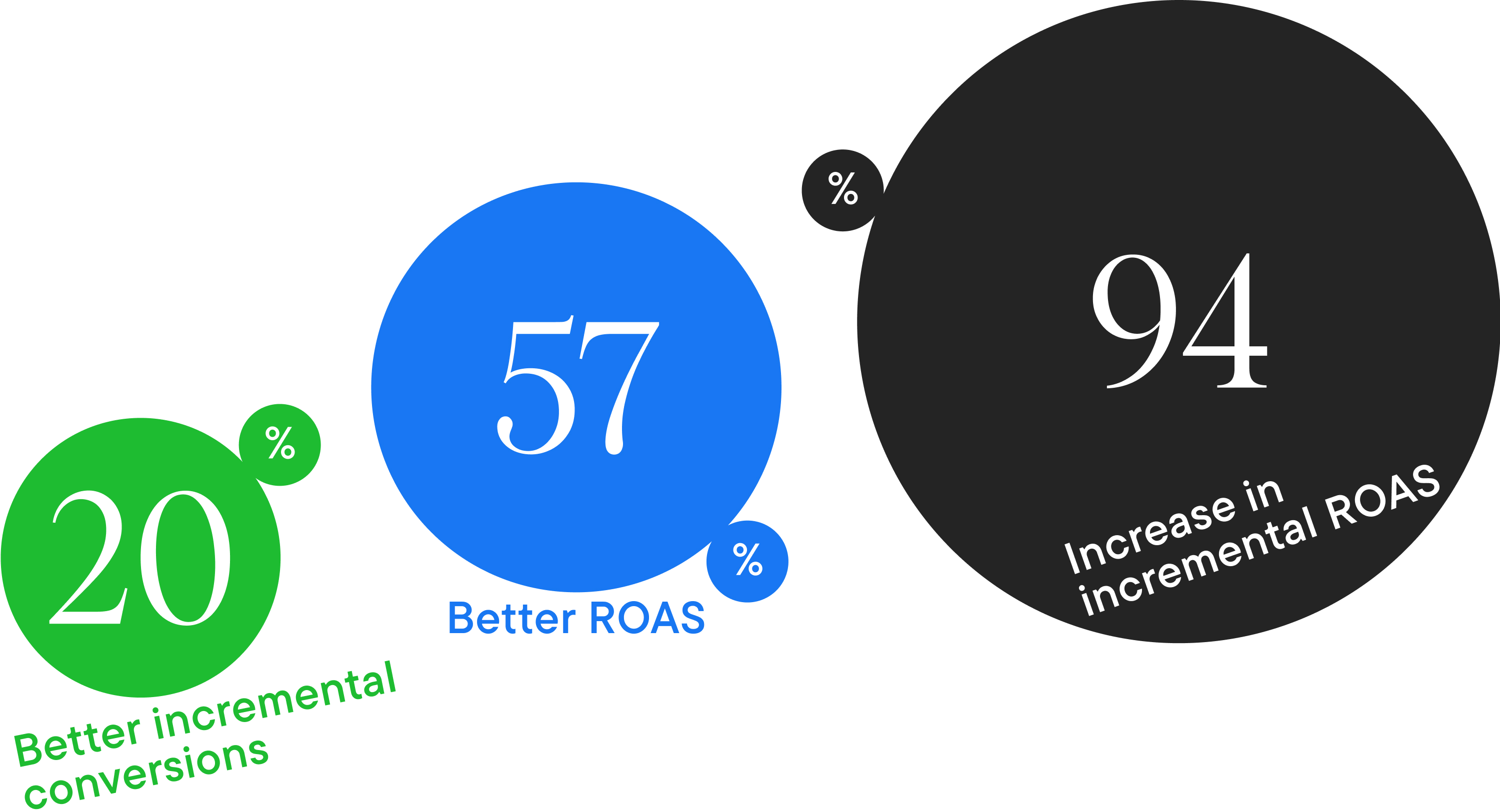
According to third-party analyses published by Three Chapter Media and Bark London, early implementations of incremental attribution have shown:
- 20%+ better incremental conversions
- 57% better ROAS in early tests
- 94% increase in incremental ROAS
For value-focused performance teams, this shifts the focus from credited conversions to real value creation—making it easier to optimize and scale.
How incremental attribution works
Meta’s incremental attribution combines three core elements: holdout testing, modeling, and cohort analysis.
First, Meta splits the audience into two groups:
- A test group (users who see the ad)
- A holdout group (users prevented from seeing the ad)
Then, it compares conversion behavior between these two groups and measures the difference. That’s the incremental lift.
Meta’s AI is trained on massive data that comes from users’ past behaviors. The model uses this insight to estimate how likely conversions would have happened in the absence of ad exposure. This separates baseline demand from ad-driven actions and allows the system to optimize ads toward segments that are most likely to drive incremental conversions.
Meta also applies cohort analysis to observe how different groups behave over time. Analyzing conversion patterns and comparing exposed versus non-exposed audiences reveals insights into which actions were genuinely driven by ads.
This shift toward incrementality is happening alongside a broader change in how Meta campaigns are built and delivered. Advantage+ is still at the center of Meta’s ad delivery system, while incremental attribution and value optimization tools have improved the way advertisers measure real impact.
When to use incremental attribution vs standard attribution
When creating an ad set in Meta Ads Manager, you can choose between two attribution models: standard and incremental.
Standard attribution follows traditional marketing rules, optimizing delivery based on time windows and user behaviors. Incremental attribution looks beyond time windows and optimizes delivery based on predictions of whether a conversion is caused by an ad.
Standard attribution works best when you are:
- Launching or testing new creatives, audiences, or formats
- Monitoring short-term performance trends
- Running lower-spend or short-flight campaigns
- Optimizing delivery and creative iteration
Incremental attribution is most useful when you want to understand true lift and business value impact. Prioritize it if you are:
- Scaling budget and want to confirm the additional spend is driving conversions
- Optimizing for conversion value, not just volume
- Running always-on campaigns where organic and paid demand overlap
- Evaluating campaigns that have strong ROAS, but don’t fully translate into revenue growth
Why Meta incremental attribution is essential for value optimization
Value optimization only works if the signals it relies on reflect real business impact. Think about it like this: without incremental attribution, value-optimized campaigns risk learning from conversions and revenue that would have happened anyway. This might cause inflated performance metrics and distorted decision-making.
Incremental attribution determines the true impact of your Meta ads and maximizes your campaign ROI. It allows for the calculation of true incremental ROI (iROI) and return on ad spend (iROAS), providing a real picture of marketing profitability.
This approach also reveals which channels and campaigns are driving growth, showing you how to make smarter decisions around budget allocation.
Incremental attribution also gives you a competitive edge in privacy-first advertising, allowing you to measure causal impact without relying on user-level tracking. As cookies disappear and attribution windows shrink, modeled lift provides a more resilient way to evaluate performance when traditional attribution starts to break down.
How to set up incremental attribution in Meta Ads Manager
Before we get started with setting up incremental attribution in Ads Manager, it’s a good idea to check these prerequisites are in place:
- Make sure the Meta Pixel code is installed in the <head> section of every page of your website.
- Your primary conversion events should be properly configured and firing correctly in Events Manager.
- Incremental measurement relies on statistical comparison, so check there’s sufficient data volume. Campaigns with very low volume might not generate enough data for reliable lift estimation.
- Aim for stable campaign structure. Avoid strict structural changes (such as constantly switching objectives or audiences) during measurement periods, as this can introduce noise into the results.
You can create a campaign using incremental attribution in Meta Ads Manager following these simple steps:
- Click Create.
- Define your objective goal (Sales, Engagement, or Leads).
- Review campaign settings and click on Next.
- In your ad set, choose Website or Website and App as your conversion location.
- Under Conversion goals, select one of the following:
Maximize number of conversions
or Maximize value of conversions
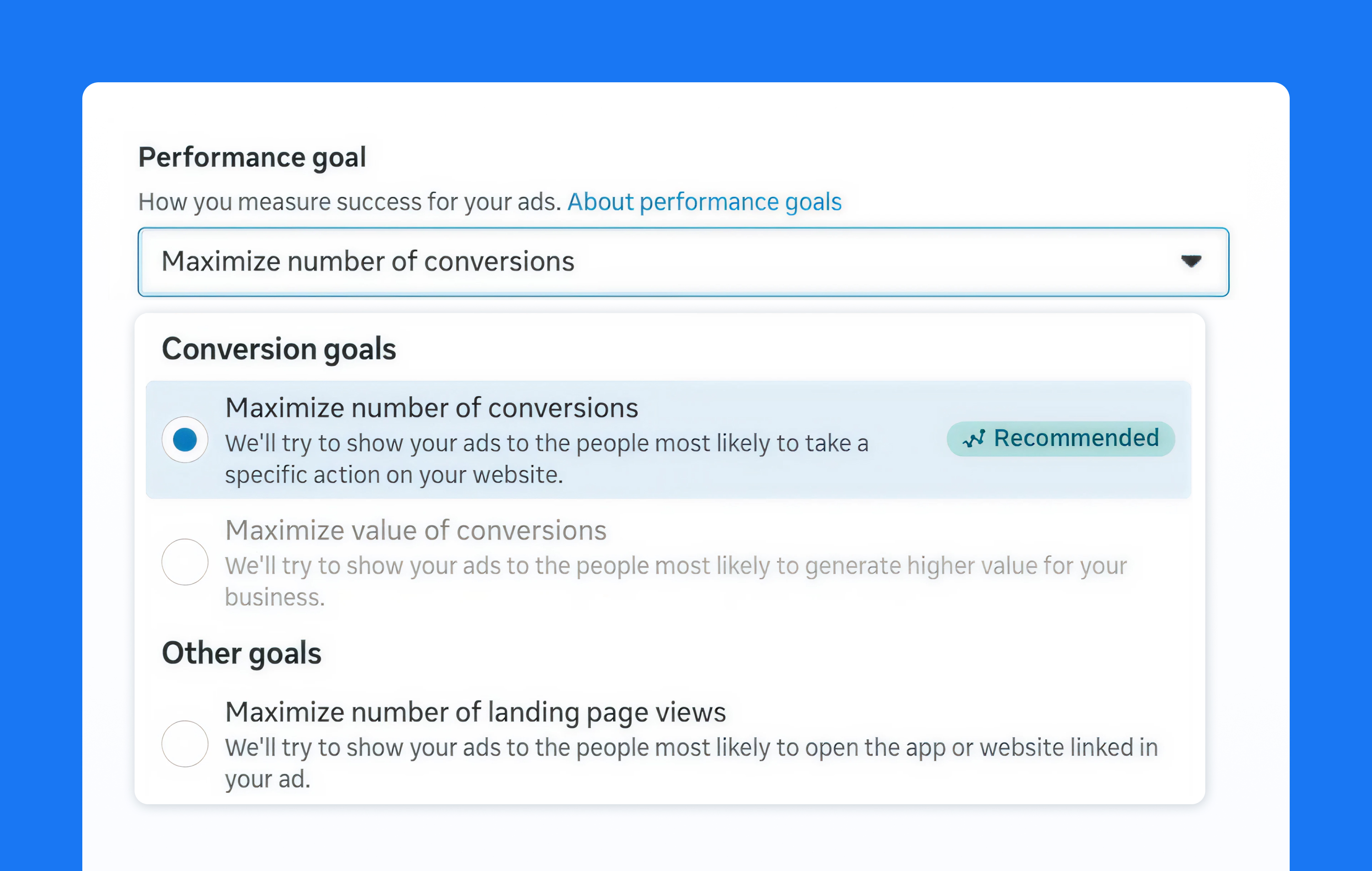
Under the Attribution model, click Edit and select Incremental.
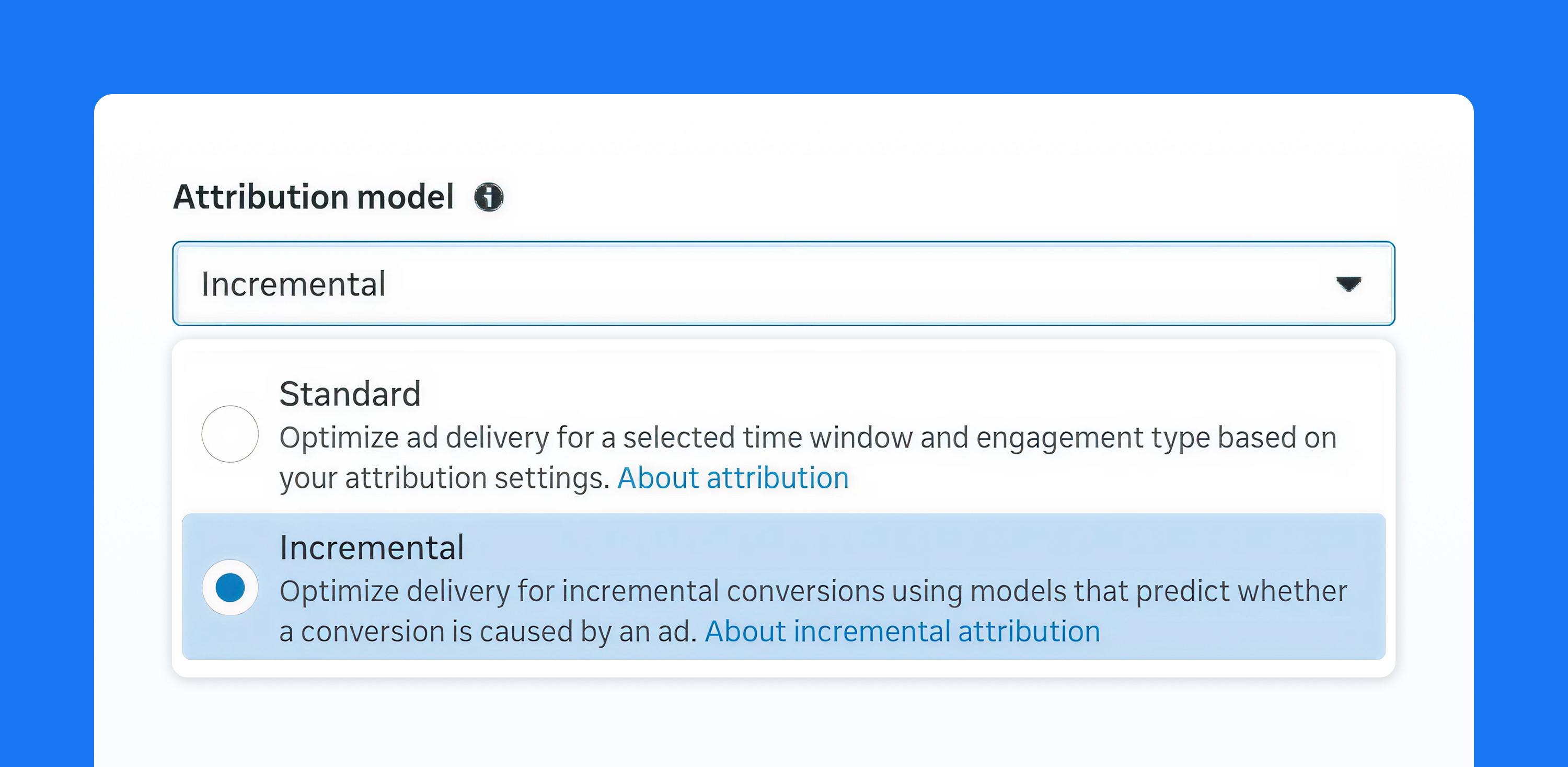
Note: Incremental attribution may not be available to all accounts. Access depends on account eligibility and meeting Meta’s minimum volume requirements.
Complete your ad setup as usual. Recheck all settings and publish the campaign.
Measuring and interpreting incremental lift data
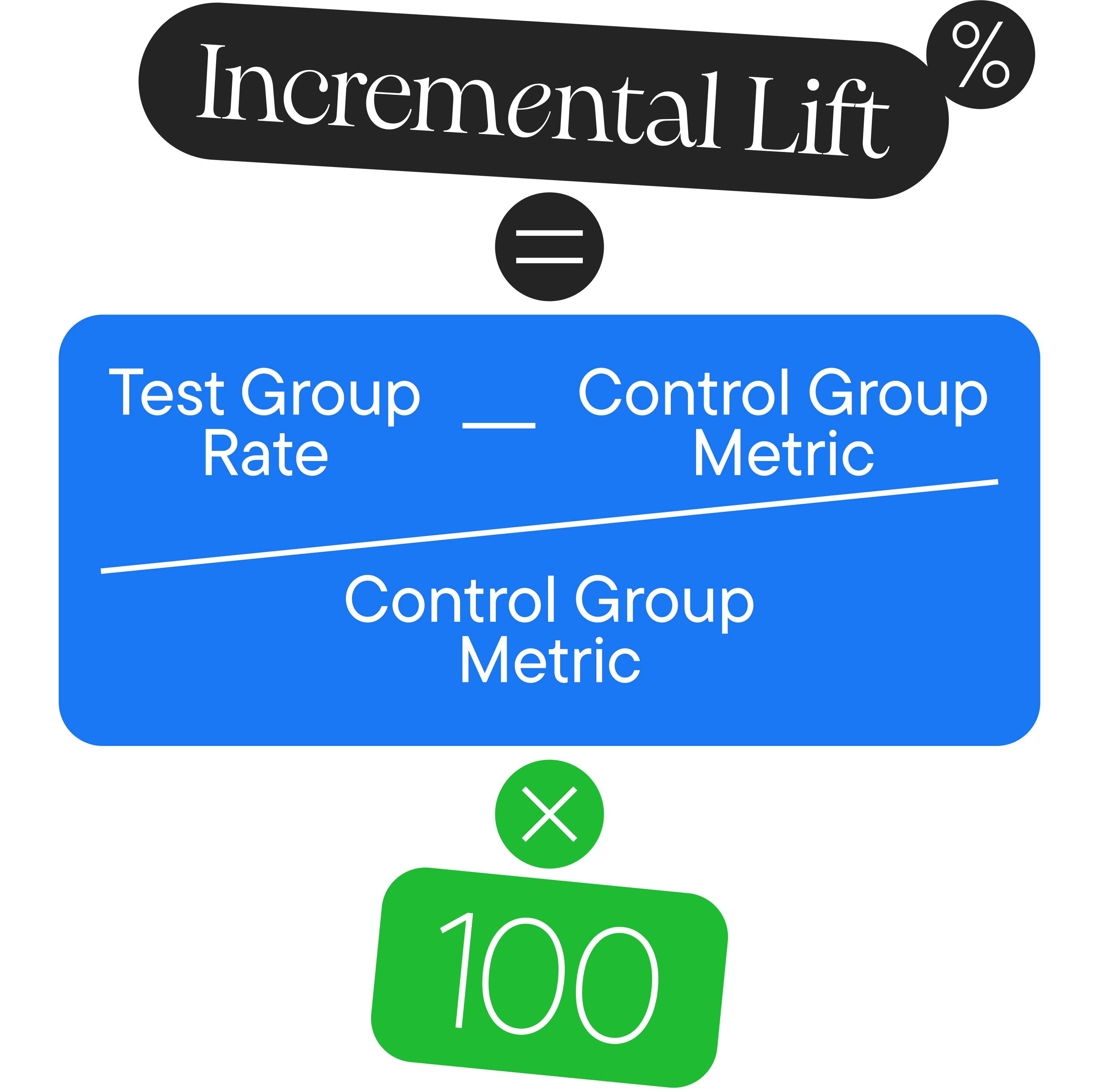
The formula to measure incremental lift is:
Incremental lift (%) = [(performance of test group − performance of control group) / performance of control group] * 100
In this formula:
- The test group is users who are exposed to the ads being measured.
- The group control is users who are intentionally prevented from seeing those ads.
You can compare results with other attribution models in Ads Manager by following these steps:
- Go to Ads Manager.
- Click the Columns: Performance dropdown menu.
- Scroll down and find Compare attribution models.
- Select Incremental.
- Click Apply.
Actionable strategies to maximize incremental ROI
Using the insights from incremental attribution is the smartest way to drive higher iROI. Focus on these best practices:
- Scale high-performers aggressively: Increase budgets on ad sets showing strong incremental ROAS and clear lift in conversations or revenue.
- Pause or reduce underperformers: Cut spend on campaigns or ad sets with low or no incremental lift to reallocate budget where it creates true value.
- Prioritize winning elements: Double down on the audiences, creatives, and placements that consistently deliver measurable incremental conversions.
- Run structured A/B tests: Experiment with new creatives, targeting options, bidding strategies, or messaging to identify what adds additional lift.
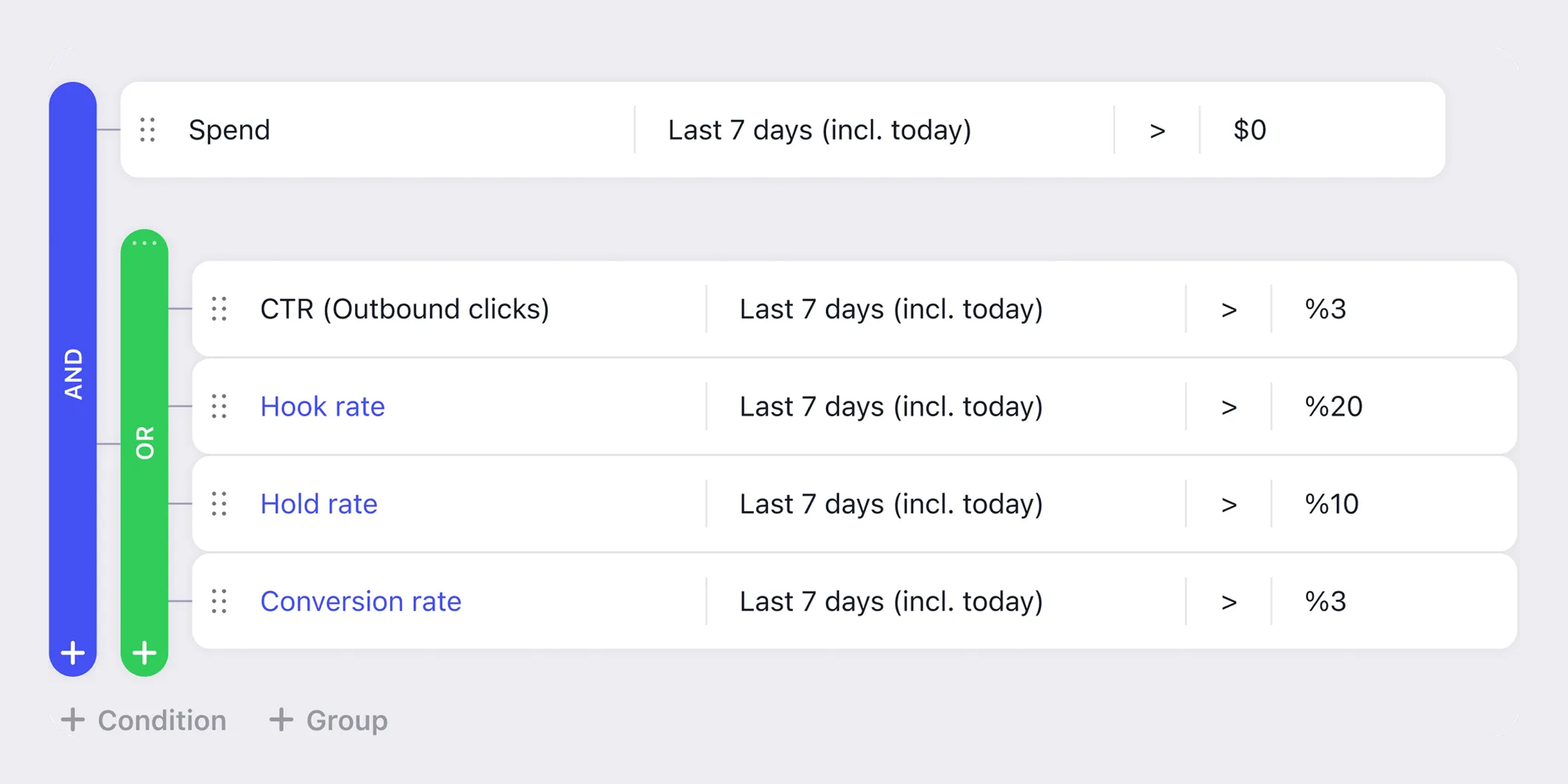
At scale, it can be tricky to act on these signals manually. This is where Bïrch Rules fit naturally into the workflow.
By automating actions such as scaling, pausing, or duplicating campaigns based on incremental performance conditions, teams can apply the same optimization logic consistently across campaigns and accounts. No need for constant manual monitoring.

Overcoming challenges and advanced considerations
Incremental attribution is designed to measure lift within Meta. This makes it extremely useful for optimizing Meta campaigns—but it’s not a complete view of total marketing impact.
Results are modeled, directional, and platform-bound. They don’t explain how conversions move through your wider funnel or how other channels influence outcomes.
Here are some of the ways advanced teams treat incrementality as a decision input and overcome limitations:
Use incrementality to guide scaling decisions.
Incremental lift is most meaningful when evaluated over stable time windows. Short-term swings are normal, especially in always-on accounts where paid and organic activity overlap. Reacting to every fluctuation undermines the purpose of lift measurement.
Keep campaign structure stable while measuring lift.
Incrementality depends on controlled comparisons. Frequent changes to objectives, audiences, budgets, or creatives introduce noise and reduce confidence in the lift estimate. Stability improves signal quality.
Treat results as directional, not absolute.
Incremental attribution answers whether a campaign is adding value relative to a control group—not how much total revenue Meta “deserves.” Use it to compare strategies, creative approaches, and budget levels, rather than as a single source of truth.
Layer incrementality with broader measurement models.
To understand full-funnel and cross-channel impact, advanced teams combine Meta’s platform-level lift with.
- Multi-touch attribution to understand contribution across touchpoints
- Media mix modeling to assess longer-term, cross-channel effectiveness
Incrementality validates causal impact on Meta. MTA and MMM provide context beyond the platform.
For teams running cross-channel campaigns, tools like Bïrch let you combine platform-level incrementality with cross-channel performance data, custom KPIs, and third-party attribution inputs. This makes it easier to evaluate performance without relying on a single platform interpretation or lift, and turn insights into action through automation.
Integrate incremental attribution with value optimization
Incremental attribution has become an important addition to Meta’s measurement features, helping advertisers better evaluate ROAS. It is changing the way we view performance marketing, upgrading the way we analyse ads, and helping marketers understand when ads hit the mark with the right audience.
Used as a validation layer, incremental attribution lets you pressure-test performance, confirm where value optimization is genuinely driving additional revenue, and make smart decisions around scaling, testing, and budget allocation.
Advanced teams use tools like Bïrch to operationalize this approach—connecting incremental performance signals with automation logic and optimization workflows, so insights lead directly to action.
FAQs
As digital advertising evolves and marketers focus on value optimization, it’s harder to tell which efforts are truly driving conversions.
While traditional marketing attribution takes the customer’s journey into account based on their behavior and time-based windows, it doesn’t address the simple question “Which conversions actually happened because of our ads?”
Last year, Meta launched incremental attribution—an advanced model that estimates which conversions wouldn’t happen without ads, making it easier to prove real ROI and measure performance data.
Incremental attribution is quickly becoming the standard for understanding performance marketing and scaling campaigns fast—especially as it works hand in hand with value optimization.
In this article, we’ll break down how Meta’s incremental attribution works, how to set it up, and how to use it to guide value-based optimization decisions.
Key takeaways
- Meta’s incremental attribution is an advanced model that shows which conversions and revenue are truly driven by ads, not organic demand.
- The model uses three main elements—holdout testing, modeling, and cohort analysis—to analyze groups that come across ads versus those that don’t. It then measures the difference in results.
- Incremental attribution differs from standard attribution in that it uses controlled testing to measure impact, rather than assigning credit based on predefined rules.
- Because incremental attribution only measures lift within the Meta platform, it doesn’t provide a complete view of cross-platform marketing impact.
- Advanced performance marketing teams use Bïrch to connect insights from Meta with performance data, operational workflow, and automation logic.
What is Meta’s incremental attribution?
Meta’s incremental attribution is a measurement model designed to estimate how many conversions are actually driven by ads, not just credited to them.
In other words, it answers the question: “Would I be seeing these results if it weren’t for my ad?”

According to third-party analyses published by Three Chapter Media and Bark London, early implementations of incremental attribution have shown:
- 20%+ better incremental conversions
- 57% better ROAS in early tests
- 94% increase in incremental ROAS
For value-focused performance teams, this shifts the focus from credited conversions to real value creation—making it easier to optimize and scale.
How incremental attribution works
Meta’s incremental attribution combines three core elements: holdout testing, modeling, and cohort analysis.
First, Meta splits the audience into two groups:
- A test group (users who see the ad)
- A holdout group (users prevented from seeing the ad)
Then, it compares conversion behavior between these two groups and measures the difference. That’s the incremental lift.
Meta’s AI is trained on massive data that comes from users’ past behaviors. The model uses this insight to estimate how likely conversions would have happened in the absence of ad exposure. This separates baseline demand from ad-driven actions and allows the system to optimize ads toward segments that are most likely to drive incremental conversions.
Meta also applies cohort analysis to observe how different groups behave over time. Analyzing conversion patterns and comparing exposed versus non-exposed audiences reveals insights into which actions were genuinely driven by ads.
This shift toward incrementality is happening alongside a broader change in how Meta campaigns are built and delivered. Advantage+ is still at the center of Meta’s ad delivery system, while incremental attribution and value optimization tools have improved the way advertisers measure real impact.
When to use incremental attribution vs standard attribution
When creating an ad set in Meta Ads Manager, you can choose between two attribution models: standard and incremental.
Standard attribution follows traditional marketing rules, optimizing delivery based on time windows and user behaviors. Incremental attribution looks beyond time windows and optimizes delivery based on predictions of whether a conversion is caused by an ad.
Standard attribution works best when you are:
- Launching or testing new creatives, audiences, or formats
- Monitoring short-term performance trends
- Running lower-spend or short-flight campaigns
- Optimizing delivery and creative iteration
Incremental attribution is most useful when you want to understand true lift and business value impact. Prioritize it if you are:
- Scaling budget and want to confirm the additional spend is driving conversions
- Optimizing for conversion value, not just volume
- Running always-on campaigns where organic and paid demand overlap
- Evaluating campaigns that have strong ROAS, but don’t fully translate into revenue growth
Why Meta incremental attribution is essential for value optimization
Value optimization only works if the signals it relies on reflect real business impact. Think about it like this: without incremental attribution, value-optimized campaigns risk learning from conversions and revenue that would have happened anyway. This might cause inflated performance metrics and distorted decision-making.
Incremental attribution determines the true impact of your Meta ads and maximizes your campaign ROI. It allows for the calculation of true incremental ROI (iROI) and return on ad spend (iROAS), providing a real picture of marketing profitability.
This approach also reveals which channels and campaigns are driving growth, showing you how to make smarter decisions around budget allocation.
Incremental attribution also gives you a competitive edge in privacy-first advertising, allowing you to measure causal impact without relying on user-level tracking. As cookies disappear and attribution windows shrink, modeled lift provides a more resilient way to evaluate performance when traditional attribution starts to break down.
How to set up incremental attribution in Meta Ads Manager
Before we get started with setting up incremental attribution in Ads Manager, it’s a good idea to check these prerequisites are in place:
- Make sure the Meta Pixel code is installed in the <head> section of every page of your website.
- Your primary conversion events should be properly configured and firing correctly in Events Manager.
- Incremental measurement relies on statistical comparison, so check there’s sufficient data volume. Campaigns with very low volume might not generate enough data for reliable lift estimation.
- Aim for stable campaign structure. Avoid strict structural changes (such as constantly switching objectives or audiences) during measurement periods, as this can introduce noise into the results.
You can create a campaign using incremental attribution in Meta Ads Manager following these simple steps:
- Click Create.
- Define your objective goal (Sales, Engagement, or Leads).
- Review campaign settings and click on Next.
- In your ad set, choose Website or Website and App as your conversion location.
- Under Conversion goals, select one of the following:
Maximize number of conversions
or Maximize value of conversions

Under the Attribution model, click Edit and select Incremental.

Note: Incremental attribution may not be available to all accounts. Access depends on account eligibility and meeting Meta’s minimum volume requirements.
Complete your ad setup as usual. Recheck all settings and publish the campaign.
Measuring and interpreting incremental lift data
The formula to measure incremental lift is:
Incremental lift (%) = [(performance of test group − performance of control group) / performance of control group] * 100
In this formula:
- The test group is users who are exposed to the ads being measured.
- The group control is users who are intentionally prevented from seeing those ads.

You can compare results with other attribution models in Ads Manager by following these steps:
- Go to Ads Manager.
- Click the Columns: Performance dropdown menu.
- Scroll down and find Compare attribution models.
- Select Incremental.
- Click Apply.
Actionable strategies to maximize incremental ROI
Using the insights from incremental attribution is the smartest way to drive higher iROI. Focus on these best practices:
- Scale high-performers aggressively: Increase budgets on ad sets showing strong incremental ROAS and clear lift in conversations or revenue.
- Pause or reduce underperformers: Cut spend on campaigns or ad sets with low or no incremental lift to reallocate budget where it creates true value.
- Prioritize winning elements: Double down on the audiences, creatives, and placements that consistently deliver measurable incremental conversions.
- Run structured A/B tests: Experiment with new creatives, targeting options, bidding strategies, or messaging to identify what adds additional lift.
At scale, it can be tricky to act on these signals manually. This is where Bïrch Rules fit naturally into the workflow.
By automating actions such as scaling, pausing, or duplicating campaigns based on incremental performance conditions, teams can apply the same optimization logic consistently across campaigns and accounts. No need for constant manual monitoring.

Overcoming challenges and advanced considerations
Incremental attribution is designed to measure lift within Meta. This makes it extremely useful for optimizing Meta campaigns—but it’s not a complete view of total marketing impact.
Results are modeled, directional, and platform-bound. They don’t explain how conversions move through your wider funnel or how other channels influence outcomes.
Here are some of the ways advanced teams treat incrementality as a decision input and overcome limitations:
Use incrementality to guide scaling decisions.
Incremental lift is most meaningful when evaluated over stable time windows. Short-term swings are normal, especially in always-on accounts where paid and organic activity overlap. Reacting to every fluctuation undermines the purpose of lift measurement.
Keep campaign structure stable while measuring lift.
Incrementality depends on controlled comparisons. Frequent changes to objectives, audiences, budgets, or creatives introduce noise and reduce confidence in the lift estimate. Stability improves signal quality.
Treat results as directional, not absolute.
Incremental attribution answers whether a campaign is adding value relative to a control group—not how much total revenue Meta “deserves.” Use it to compare strategies, creative approaches, and budget levels, rather than as a single source of truth.
Layer incrementality with broader measurement models.
To understand full-funnel and cross-channel impact, advanced teams combine Meta’s platform-level lift with.
- Multi-touch attribution to understand contribution across touchpoints
- Media mix modeling to assess longer-term, cross-channel effectiveness
Incrementality validates causal impact on Meta. MTA and MMM provide context beyond the platform.
For teams running cross-channel campaigns, tools like Bïrch let you combine platform-level incrementality with cross-channel performance data, custom KPIs, and third-party attribution inputs. This makes it easier to evaluate performance without relying on a single platform interpretation or lift, and turn insights into action through automation.
Integrate incremental attribution with value optimization
Incremental attribution has become an important addition to Meta’s measurement features, helping advertisers better evaluate ROAS. It is changing the way we view performance marketing, upgrading the way we analyse ads, and helping marketers understand when ads hit the mark with the right audience.
Used as a validation layer, incremental attribution lets you pressure-test performance, confirm where value optimization is genuinely driving additional revenue, and make smart decisions around scaling, testing, and budget allocation.
Advanced teams use tools like Bïrch to operationalize this approach—connecting incremental performance signals with automation logic and optimization workflows, so insights lead directly to action.
FAQs
Meta incremental attribution is an advanced optimization setting that uses machine learning to measure conversions that wouldn’t have happened organically. It compares users who have seen ads with those who haven’t.
Value optimization relies on conversion signals to train Meta’s delivery system. Incremental attribution helps validate whether those signals represent real, ad-driven value or conversions that would have happened anyway, making optimization decisions more reliable.
Incremental attribution is most useful when advertisers want to understand true lift rather than attributed performance. This includes scenarios such as scaling budgets, running always-on campaigns, or evaluating performance in accounts where organic and paid demand overlap and standard ROAS no longer tells the full story.
Yes, but with limitations. Without incremental attribution, value-optimized campaigns may overestimate performance by optimizing toward baseline demand. Incrementality acts as a validation layer to confirm whether the optimized value is actually incremental.
Incremental results detect the next strategies marketers should use, depending on the scenario. Ad sets with strong incremental ROAS or lift can be scaled easily, while those showing limited incremental impact may require changes, even if their standard attribution metrics appear strong.