The right amount of budget to start with for Facebook ads depends on the average cost-per-purchase of your products, your risk tolerance, and your total advertising budget.
Facebook ad costs have shifted significantly in recent years. Automation now handles more decisions, competition continues to rise, and privacy updates keep reshaping how Meta models conversions.
The result is a rapidly changing cost environment. CPMs move with auction pressure, CPA varies by vertical, and the budget needed for consistency often depends more on signal quality than audience size.
If you’re planning your Meta ads budget for 2026, it’s natural to wonder what Facebook ads should cost.
This guide explains what influences Facebook ad costs today, how to think about budgeting, and what realistic benchmarks look like in 2025–2026. It also includes practical ways to estimate your own costs using Bïrch’s Facebook ad cost calculator, alongside guidance on how Advantage+ automation affects efficiency.
Key takeaways
Facebook ad costs shift based on auction pressure, optimization goals, seasonality, and creative performance.
CPM, CPC, and CPA benchmarks are useful for directional guidance, but budgeting formulas give you the clearest spending targets.
Stable performance usually requires enough volume for Meta to model conversions—about 50 per week.
A phased budget strategy (testing, validation, and scaling) prevents overspending and keeps performance predictable.
Advantage+ automation influences how budgets behave, especially as you scale.
Bïrch helps teams manage pacing, budgets, and creative updates more efficiently without changing campaign structure.
What you actually pay for on Meta ads
Meta charges you for winning opportunities in the auction. The final cost reflects three realities: how competitive the auction is, how strong your creative appears to the system, and how confidently Meta predicts your optimization event.
Most teams track three cost signals because each reveals something different about auction behavior:
CPM is a direct read on auction pressure and predicted relevance. Spikes usually point to increased competition or lower expected value.
CPC tells you how efficiently your creative moves people to the next step. Mobile-friendly formats and fresh assets usually keep CPC lower, while fatigue tends to push it higher.
CPA/CPP is the real indicator of sustainability. CPA rises when the system can’t reliably model conversions—often because budgets are too low, funnels introduce friction, or the optimization event doesn’t have enough data.
These three signals explain how Facebook ad costs behave. CPM reflects auction pressure, CPC shows how people respond to your creative, and CPA tells you whether the system has enough confidence to optimize toward your goal.
How Facebook’s ad auction works in 2025–2026
Meta’s auction has changed in terms of what it prioritizes. The system now leans far more on real-time prediction than on manual targeting or bid inputs, especially inside Advantage+ environments.
Instead of focusing on who you target, the auction increasingly evaluates how likely your setup is to generate a successful outcome. Clean conversion events, stable optimization goals, and consistently strong creative give Meta clearer patterns to model, which improves efficiency.
The mechanics haven’t changed, but the weighting behind the mechanics has. Prediction now drives more of the cost outcomes than bidding and targeting alone.
What drives Facebook ad costs
Every account is different—but there are a few consistent patterns that tend to explain most cost swings:
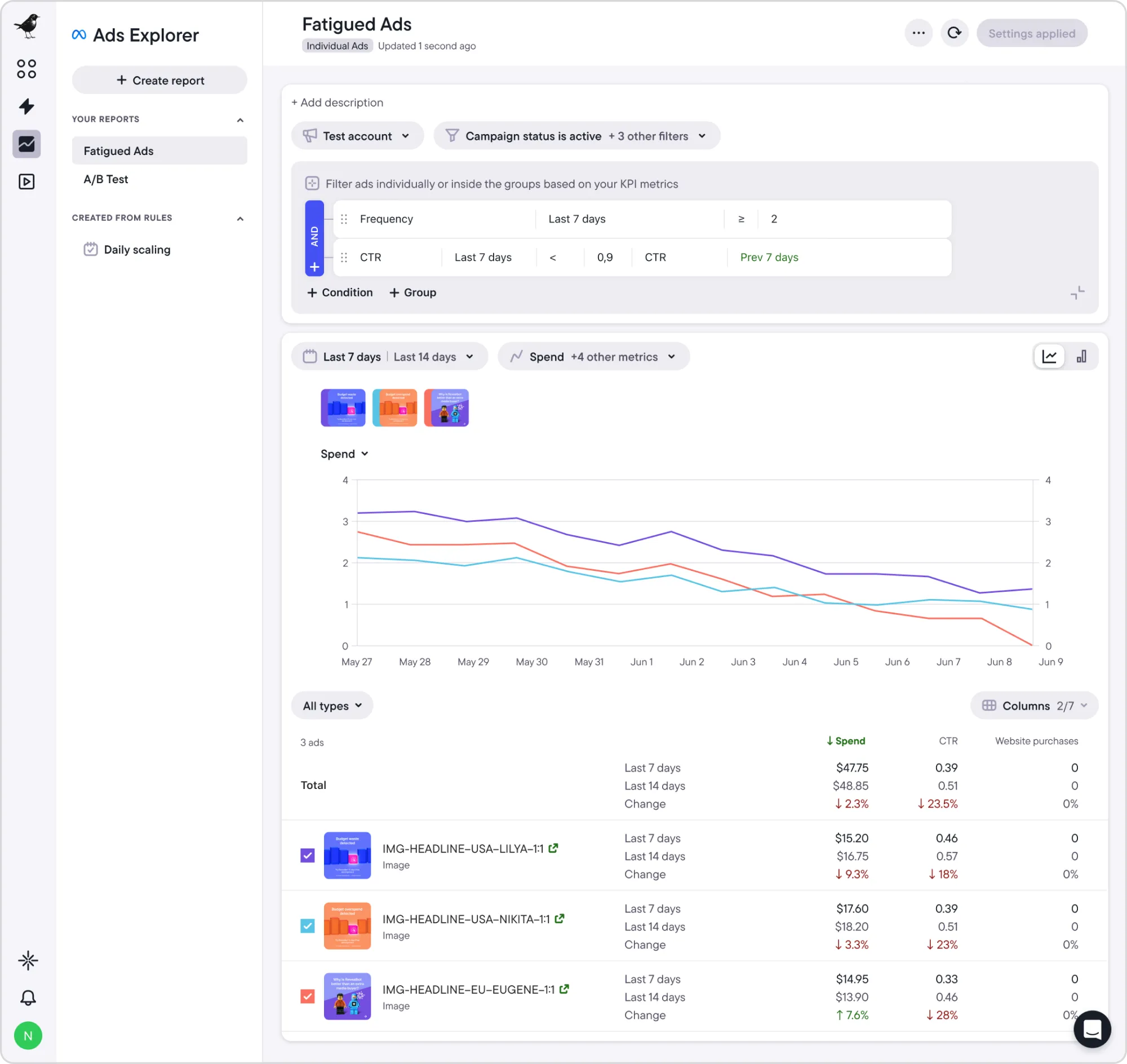
Creative is usually the first lever to move costs:When the ad is fresh and relevant, CPC stays low, and conversion rates hold. When fatigue sets in, CPC climbs quickly, and CPAs follow.
Competition sets the tone: During high-demand periods like Q4 or in crowded verticals, CPM can rise sharply even if nothing changes on your end. Broad targeting eases this pressure—but not entirely.
Optimization stability matters: Purchase-optimized campaigns perform well when they receive steady conversion volume. But performance becomes unpredictable when tracking noise creeps in, or the system doesn’t see enough events for reliable modeling.
The post-click experience still counts: Slow load times, unclear pricing, and checkout hurdles all reduce conversion likelihood. Meta must then spend more impressions to find qualified buyers.
These cost dynamics make more sense when you view them alongside other ad platforms. The systems aren’t directly comparable, but advertisers often notice differences in how each channel prices attention and optimizes for conversions.
Google Search usually shows higher CPCs because intent is stronger and competition clusters around bottom-funnel queries.
TikTok tends to offer lower CPMs, but CPA can swing more widely since performance depends heavily on fresh creatives and mature audiences.
YouTube often leans toward higher CPMs and longer conversion paths, particularly for direct-response goals.
Meta tends to sit in the middle on cost and near the top on efficiency for purchase-optimized campaigns. It won’t always win on CPM or CPC, but its mix of scale, data, and predictive modeling frequently gives you a more stable cost per purchase—especially for mobile-first ecommerce.
Facebook ad cost benchmarks for 2025–2026
Benchmarks remain useful—but it’s best to treat them as directional ranges, not fixed expectations.
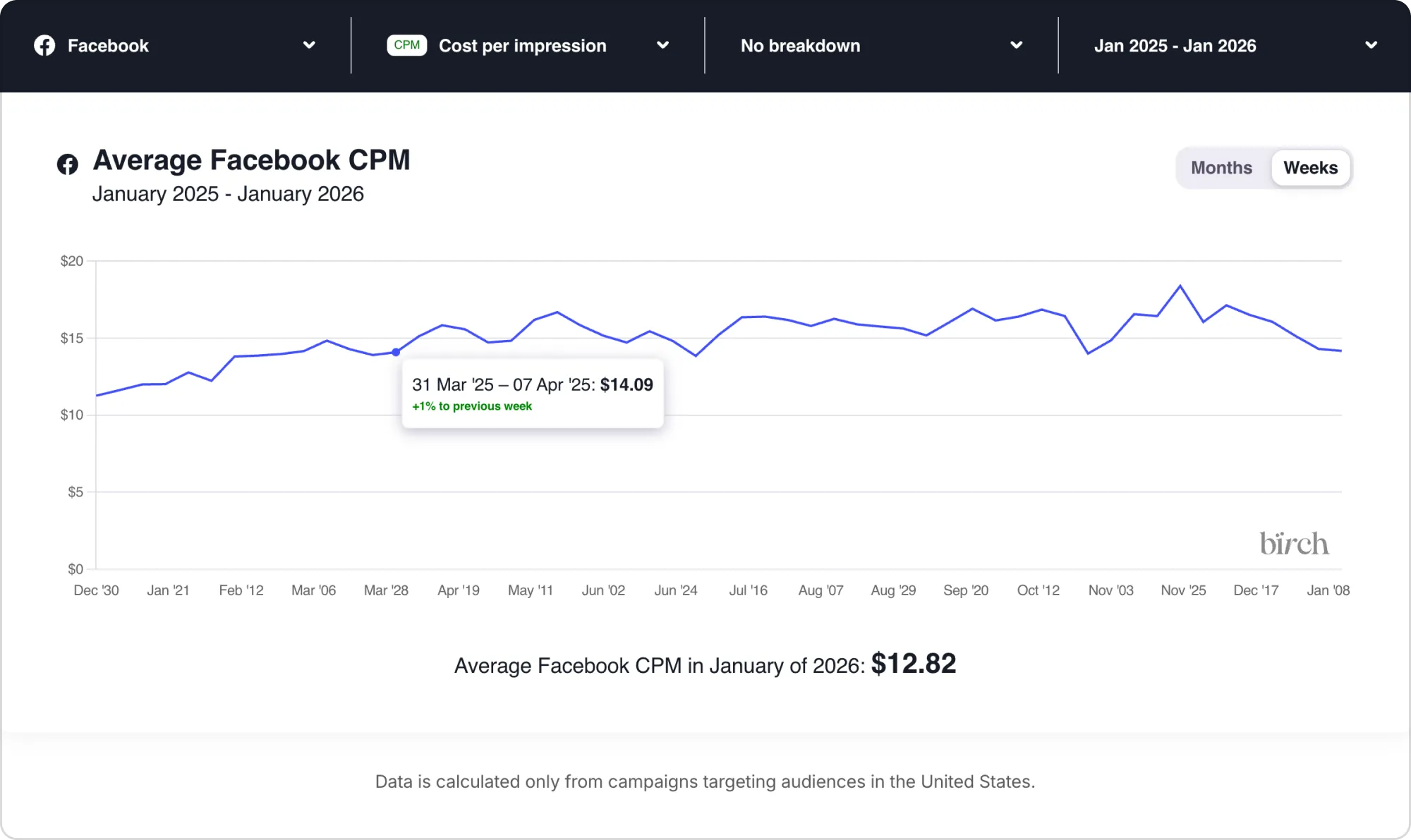
Across 2024–2025, advertisers have generally seen CPMs settle in the low teens, with predictable spikes during competitive periods like Q4.CPC often ranges from under $1 to around $2 for mobile-first ecommerce campaigns, influenced heavily by creative quality and seasonality.
CPA shows the widest variation, ranging from tens of dollars to the low hundreds. It reflects both product price and overall funnel health.
These ranges won’t apply uniformly across every account, but they give you a realistic starting point when sizing your Meta ads budget and estimating how much you may need to spend for stable delivery.
If you want a clearer benchmark for your specific goal and time period, you can use Bïrch’s Facebook Ad Cost Calculator.
The tool pulls aggregated performance data from US advertisers to show typical CPM, CPC, and CPA ranges for objectives such as purchases, leads, and traffic. It’s a quick way to understand what costs commonly look like today—and what to expect as you plan spend.
Try the Facebook ad cost calculator
How much should you spend on Facebook ads?
Most marketers ask, “What’s the minimum budget for Facebook ads?” and “What is a good daily budget?”
But the more useful question is: “How much do I need to spend for the algorithm to learn and deliver consistent results?”
There’s no one-size-fits-all answer. However, you can estimate how much you should spend on Facebook ads by looking at your CPA, your goals, and how quickly you want Meta to stabilize delivery.
Thinking in three stages—testing, validation, scaling—is a practical way to plan your budget.
1. Testing: finding early signals
Early on, the goal is to give Meta enough conversion volume to understand who converts.
A simple starting point is to set your daily budget at roughly 1.5–2× your target CPA. Budgets set far below this often struggle to leave the learning phase because the system doesn’t receive enough conversions to model.
If your target CPA is $30, a practical testing budget usually falls around $45–$60/day. At this level, you can start seeing early patterns but not enough for Meta’s delivery system to optimize reliably. That’s why $100/day often comes up as a benchmark. It’s fine for a short test, but not enough to produce stable performance.
Pro tip: As budgets move out of testing, operational complexity increases quickly. Tools like Bïrch can help teams manage pacing, creative refreshes, and budget changes consistently as volume grows—without restructuring campaigns.
2. Validation: confirming the signal
Once early results look steady, the next step is confirming that the pattern holds as volume increases.
Meta generally stabilizes when a campaign drives 7–10 conversions per day (about 50 per week), so your budget needs to support that. A simple sizing rule: daily budget ≈ CPA × 7–10.
If your CPA is $40, your validation budget is around $280–$400/day. That’s usually enough for the system to exit learning and deliver consistently.
This is often where your Facebook advertising budget starts to feel more predictable because the system has enough signal to deliver consistently.
3. Scaling: growing volume responsibly
Scale rarely happens in big jumps. Meta’s automation tends to respond more predictably when budgets grow gradually. This might be 20–30% per 2 to 3 days if the performance is stable. Many teams transition to campaign-level budgets at this stage so that the system can allocate spend across audiences and placements without artificial constraints. Some teams also use cost caps to help maintain efficiency as budgets rise, though results vary by account and vertical.
Building your Facebook ads budget
Once you know the phase your account is in—testing, validation, or scaling—you can translate that into a yearly or quarterly budget that supports predictable performance.
It’s useful to build your budget around three inputs:
Your target CPA
The conversion volume you want to achieve each week
How quickly you want to scale
A simple way to plan spending is to start with your monthly goals. For example, if you need 300 purchases per month and your target CPA is $35, your working budget is: 300 × $35 = $10,500/month.
From there, you can adjust your budget based on expected seasonality and where your vertical typically experiences higher auction pressure. Some keep daily spend consistent. Others front-load spend early in the month to exit learning faster and let automation stabilize.
It also helps to set clear thresholds that guide budget decisions:
When CPA is stable, maintain pacing.
When CPA improves, scale gradually.
When the signal drops, pause, refresh creative, or consolidate campaigns.
And for teams planning quarterly budgets, this simple formula often works well: quarterly spend = monthly target CPA × expected conversions × 3.
This structure keeps you aligned with your business goals while building enough buffer for testing new creatives, offers, or audiences when performance starts to soften.
How to optimize your Facebook ad spend with Bïrch
Meta’s automation handles delivery, but day-to-day decisions—how you pace budgets, refresh creative, and respond to performance signals—still benefit from structure. Bïrch helps teams make those decisions faster, with greater clarity.
See pacing trends sooner and act on them with less friction.
Performance moves—sometimes slowly, sometimes all at once. When CPA rises or spend drifts from your targets, you often need to update budgets across multiple campaigns. Doing this in Meta Ads Manager isn’t always straightforward.
You’ll know immediately when something shifts, and budget adjustments across campaigns happen in a single, smooth workflow. This helps keep delivery stable and reduces the chances of campaigns slipping back into the learning phase.
Refresh creatives quickly to keep costs from increasing.
Bïrch makes it easy to rotate creatives. You can refresh assets across campaigns at once, keep variations aligned, and scale strong performers before results taper off. Faster updates help maintain cleaner signals and more predictable CPC and CPA.
Spot scaling opportunities with unified reporting.
Jumping between tabs to check pacing, spend, and performance makes it harder to see the bigger picture.
Bïrch brings everything into one view, so it’s easier to spot when CPA drifts, identify when a slight budget increase could unlock more conversions, or determine whether underperformance is simply a lack of signal. Decisions that usually require multiple steps can be completed much more quickly.
Together, these workflows support a steadier cost per purchase and a more predictable return on your Facebook advertising budget.
Pro tip: Group campaigns with similar goals under shared pacing rules. This makes it easier to spot meaningful trends and act on them before they get expensive.
Mastering Facebook ad costs to scale in 2026
Scaling Meta campaigns in 2026 will be less about chasing the lowest CPM and more about creating an environment where the algorithm can work reliably.
With consistent conversion signals, your creative gives Meta something strong to optimize toward. Your budgets are set with enough room for learning, costs tend to stabilize, and scaling becomes more predictable.
A practical budgeting model helps with that. It gives you a sense of how much to invest at different stages, when to spend more, and how to adapt when performance shifts.
Creative also plays its part. Formats that hold attention and stay fresh tend to preserve CPC and CPA even as competition rises. And having clearer visibility into pacing makes it easier to spot small adjustments that improve efficiency over time.
That’s where tools like Bïrch can support your workflow—helping teams apply these principles more consistently as performance shifts. By centralizing pacing, budgets, and creative updates in one place, Bïrch reduces the operational drag that often makes cost control harder at scale.
If you’re testing new budgeting approaches or want a smoother way to manage changes across campaigns, try Bïrch for free to see how it can make day-to-day decisions easier.
Explore Bïrch with a 14-day free trial
FAQs
Facebook ad costs have shifted significantly in recent years. Automation now handles more decisions, competition continues to rise, and privacy updates keep reshaping how Meta models conversions.
The result is a rapidly changing cost environment. CPMs move with auction pressure, CPA varies by vertical, and the budget needed for consistency often depends more on signal quality than audience size.
If you’re planning your Meta ads budget for 2026, it’s natural to wonder what Facebook ads should cost.
This guide explains what influences Facebook ad costs today, how to think about budgeting, and what realistic benchmarks look like in 2025–2026. It also includes practical ways to estimate your own costs using Bïrch’s Facebook ad cost calculator, alongside guidance on how Advantage+ automation affects efficiency.
Key takeaways
Facebook ad costs shift based on auction pressure, optimization goals, seasonality, and creative performance.
CPM, CPC, and CPA benchmarks are useful for directional guidance, but budgeting formulas give you the clearest spending targets.
Stable performance usually requires enough volume for Meta to model conversions—about 50 per week.
A phased budget strategy (testing, validation, and scaling) prevents overspending and keeps performance predictable.
Advantage+ automation influences how budgets behave, especially as you scale.
Bïrch helps teams manage pacing, budgets, and creative updates more efficiently without changing campaign structure.
What you actually pay for on Meta ads
Meta charges you for winning opportunities in the auction. The final cost reflects three realities: how competitive the auction is, how strong your creative appears to the system, and how confidently Meta predicts your optimization event.
Most teams track three cost signals because each reveals something different about auction behavior:
CPM is a direct read on auction pressure and predicted relevance. Spikes usually point to increased competition or lower expected value.
CPC tells you how efficiently your creative moves people to the next step. Mobile-friendly formats and fresh assets usually keep CPC lower, while fatigue tends to push it higher.
CPA/CPP is the real indicator of sustainability. CPA rises when the system can’t reliably model conversions—often because budgets are too low, funnels introduce friction, or the optimization event doesn’t have enough data.
These three signals explain how Facebook ad costs behave. CPM reflects auction pressure, CPC shows how people respond to your creative, and CPA tells you whether the system has enough confidence to optimize toward your goal.
How Facebook’s ad auction works in 2025–2026
Meta’s auction has changed in terms of what it prioritizes. The system now leans far more on real-time prediction than on manual targeting or bid inputs, especially inside Advantage+ environments.
Instead of focusing on who you target, the auction increasingly evaluates how likely your setup is to generate a successful outcome. Clean conversion events, stable optimization goals, and consistently strong creative give Meta clearer patterns to model, which improves efficiency.
The mechanics haven’t changed, but the weighting behind the mechanics has. Prediction now drives more of the cost outcomes than bidding and targeting alone.
What drives Facebook ad costs
Every account is different—but there are a few consistent patterns that tend to explain most cost swings:
Creative is usually the first lever to move costs:When the ad is fresh and relevant, CPC stays low, and conversion rates hold. When fatigue sets in, CPC climbs quickly, and CPAs follow.
Competition sets the tone: During high-demand periods like Q4 or in crowded verticals, CPM can rise sharply even if nothing changes on your end. Broad targeting eases this pressure—but not entirely.
Optimization stability matters: Purchase-optimized campaigns perform well when they receive steady conversion volume. But performance becomes unpredictable when tracking noise creeps in, or the system doesn’t see enough events for reliable modeling.
The post-click experience still counts: Slow load times, unclear pricing, and checkout hurdles all reduce conversion likelihood. Meta must then spend more impressions to find qualified buyers.
These cost dynamics make more sense when you view them alongside other ad platforms. The systems aren’t directly comparable, but advertisers often notice differences in how each channel prices attention and optimizes for conversions.
Google Search usually shows higher CPCs because intent is stronger and competition clusters around bottom-funnel queries.
TikTok tends to offer lower CPMs, but CPA can swing more widely since performance depends heavily on fresh creatives and mature audiences.
YouTube often leans toward higher CPMs and longer conversion paths, particularly for direct-response goals.
Meta tends to sit in the middle on cost and near the top on efficiency for purchase-optimized campaigns. It won’t always win on CPM or CPC, but its mix of scale, data, and predictive modeling frequently gives you a more stable cost per purchase—especially for mobile-first ecommerce.
Facebook ad cost benchmarks for 2025–2026
Benchmarks remain useful—but it’s best to treat them as directional ranges, not fixed expectations.
Across 2024–2025, advertisers have generally seen CPMs settle in the low teens, with predictable spikes during competitive periods like Q4.CPC often ranges from under $1 to around $2 for mobile-first ecommerce campaigns, influenced heavily by creative quality and seasonality.
CPA shows the widest variation, ranging from tens of dollars to the low hundreds. It reflects both product price and overall funnel health.
These ranges won’t apply uniformly across every account, but they give you a realistic starting point when sizing your Meta ads budget and estimating how much you may need to spend for stable delivery.
If you want a clearer benchmark for your specific goal and time period, you can use Bïrch’s Facebook Ad Cost Calculator.
The tool pulls aggregated performance data from US advertisers to show typical CPM, CPC, and CPA ranges for objectives such as purchases, leads, and traffic. It’s a quick way to understand what costs commonly look like today—and what to expect as you plan spend.
Try the Facebook ad cost calculator
How much should you spend on Facebook ads?
Most marketers ask, “What’s the minimum budget for Facebook ads?” and “What is a good daily budget?”
But the more useful question is: “How much do I need to spend for the algorithm to learn and deliver consistent results?”
There’s no one-size-fits-all answer. However, you can estimate how much you should spend on Facebook ads by looking at your CPA, your goals, and how quickly you want Meta to stabilize delivery.
Thinking in three stages—testing, validation, scaling—is a practical way to plan your budget.
1. Testing: finding early signals
Early on, the goal is to give Meta enough conversion volume to understand who converts.
A simple starting point is to set your daily budget at roughly 1.5–2× your target CPA. Budgets set far below this often struggle to leave the learning phase because the system doesn’t receive enough conversions to model.
If your target CPA is $30, a practical testing budget usually falls around $45–$60/day. At this level, you can start seeing early patterns but not enough for Meta’s delivery system to optimize reliably. That’s why $100/day often comes up as a benchmark. It’s fine for a short test, but not enough to produce stable performance.
Pro tip: As budgets move out of testing, operational complexity increases quickly. Tools like Bïrch can help teams manage pacing, creative refreshes, and budget changes consistently as volume grows—without restructuring campaigns.
2. Validation: confirming the signal
Once early results look steady, the next step is confirming that the pattern holds as volume increases.
Meta generally stabilizes when a campaign drives 7–10 conversions per day (about 50 per week), so your budget needs to support that. A simple sizing rule: daily budget ≈ CPA × 7–10.
If your CPA is $40, your validation budget is around $280–$400/day. That’s usually enough for the system to exit learning and deliver consistently.
This is often where your Facebook advertising budget starts to feel more predictable because the system has enough signal to deliver consistently.
3. Scaling: growing volume responsibly
Scale rarely happens in big jumps. Meta’s automation tends to respond more predictably when budgets grow gradually. This might be 20–30% per 2 to 3 days if the performance is stable. Many teams transition to campaign-level budgets at this stage so that the system can allocate spend across audiences and placements without artificial constraints. Some teams also use cost caps to help maintain efficiency as budgets rise, though results vary by account and vertical.
Building your Facebook ads budget
Once you know the phase your account is in—testing, validation, or scaling—you can translate that into a yearly or quarterly budget that supports predictable performance.
It’s useful to build your budget around three inputs:
Your target CPA
The conversion volume you want to achieve each week
How quickly you want to scale
A simple way to plan spending is to start with your monthly goals. For example, if you need 300 purchases per month and your target CPA is $35, your working budget is: 300 × $35 = $10,500/month.
From there, you can adjust your budget based on expected seasonality and where your vertical typically experiences higher auction pressure. Some keep daily spend consistent. Others front-load spend early in the month to exit learning faster and let automation stabilize.
It also helps to set clear thresholds that guide budget decisions:
When CPA is stable, maintain pacing.
When CPA improves, scale gradually.
When the signal drops, pause, refresh creative, or consolidate campaigns.
And for teams planning quarterly budgets, this simple formula often works well: quarterly spend = monthly target CPA × expected conversions × 3.
This structure keeps you aligned with your business goals while building enough buffer for testing new creatives, offers, or audiences when performance starts to soften.
How to optimize your Facebook ad spend with Bïrch
Meta’s automation handles delivery, but day-to-day decisions—how you pace budgets, refresh creative, and respond to performance signals—still benefit from structure. Bïrch helps teams make those decisions faster, with greater clarity.
See pacing trends sooner and act on them with less friction.
Performance moves—sometimes slowly, sometimes all at once. When CPA rises or spend drifts from your targets, you often need to update budgets across multiple campaigns. Doing this in Meta Ads Manager isn’t always straightforward.
You’ll know immediately when something shifts, and budget adjustments across campaigns happen in a single, smooth workflow. This helps keep delivery stable and reduces the chances of campaigns slipping back into the learning phase.
Refresh creatives quickly to keep costs from increasing.
Bïrch makes it easy to rotate creatives. You can refresh assets across campaigns at once, keep variations aligned, and scale strong performers before results taper off. Faster updates help maintain cleaner signals and more predictable CPC and CPA.
Spot scaling opportunities with unified reporting.
Jumping between tabs to check pacing, spend, and performance makes it harder to see the bigger picture.
Bïrch brings everything into one view, so it’s easier to spot when CPA drifts, identify when a slight budget increase could unlock more conversions, or determine whether underperformance is simply a lack of signal. Decisions that usually require multiple steps can be completed much more quickly.
Together, these workflows support a steadier cost per purchase and a more predictable return on your Facebook advertising budget.
Pro tip: Group campaigns with similar goals under shared pacing rules. This makes it easier to spot meaningful trends and act on them before they get expensive.
Mastering Facebook ad costs to scale in 2026
Scaling Meta campaigns in 2026 will be less about chasing the lowest CPM and more about creating an environment where the algorithm can work reliably.
With consistent conversion signals, your creative gives Meta something strong to optimize toward. Your budgets are set with enough room for learning, costs tend to stabilize, and scaling becomes more predictable.
A practical budgeting model helps with that. It gives you a sense of how much to invest at different stages, when to spend more, and how to adapt when performance shifts.
Creative also plays its part. Formats that hold attention and stay fresh tend to preserve CPC and CPA even as competition rises. And having clearer visibility into pacing makes it easier to spot small adjustments that improve efficiency over time.
That’s where tools like Bïrch can support your workflow—helping teams apply these principles more consistently as performance shifts. By centralizing pacing, budgets, and creative updates in one place, Bïrch reduces the operational drag that often makes cost control harder at scale.
If you’re testing new budgeting approaches or want a smoother way to manage changes across campaigns, try Bïrch for free to see how it can make day-to-day decisions easier.
Your daily Facebook ad budget depends on your CPA target and how quickly you want to progress from the learning process. Many advertisers use a simple guideline: daily budget ≈ CPA × 7–10 conversions/day. If your CPA target is $30, that usually means $210–$300/day for stable delivery.
What is the minimum daily budget for Facebook ads?
Meta offers very low minimums (around $1–$5/day, depending on the objective). Campaigns optimized for purchases generally require more. A budget that supports several conversions per day tends to deliver more consistent results.
How much do Meta ads cost in 2025–2026?
For most advertisers, CPMs often range from $6–$20 and CPCs from about $0.80–$2.50, depending on vertical, seasonality, and creative. CPA varies more widely but generally improves once campaigns produce steady conversion signals.
What is a good budget for Facebook ads?
An effective budget aligns with your CPA goals and provides the system with enough volume to learn. Some teams use a tiered approach—validation, stability, growth, and scale—to determine how much to invest at each stage.
How do I calculate my Facebook ads budget?
A standard method is to start with your target CPA and work backward. For example: Target CPA: $40 Desired conversions/day: 7–10 Estimated daily budget: $280–$400
How can Bïrch help manage Facebook ad budgets?
Bïrch gives teams a clearer view of pacing, performance shifts, and creative fatigue. You can set alerts based on your own CPA or ROAS thresholds and make updates across campaigns in fewer steps. Many advertisers use it to maintain a more predictable CPA without changing their campaign structure.
What happened to Revealbot?
Revealbot has a new look and a new name—we’re now Bïrch! The change highlights our focus on bringing together the best of automation and creative teamwork.
Ana Siu
is a content marketing expert and writer specializing in marketing, technology, and social change. She is a contributor to the Birch Blog and has a background in advertising, journalism, and SaaS.