You probably fall into one of two camps. You’re either trying to build your own software with AI, or you’re reading posts about other people who are building their software with AI.
It’s exciting, it’s noisy, everyone is scared, people are posting pics of MRR as if they’re birthday photos and nobody knows what is happening.
So, to find out what it actually takes to successfully build and market an AI-powered product, I spoke with Liliya Roshchenko, a Product Marketing Manager at Semrush.
Liliya has eight years of marketing experience, and has led the go-to-market strategy and growth for their AI content generation tool within their Content Toolkit. Liliya has been at the forefront of research, positioning, and launching an AI-powered product to an audience where some users were initially cautious about AI, making her the perfect person to share all her product marketing struggles, successes and secrets. We like secrets.
Key takeaways
Authenticity beats speed: Marketers are highly protective of their brand voice. AI tools need to offer control and authenticity, not just fast content generation.
AI is becoming a baseline skill: The industry has shifted from skepticism to daily application. AI is no longer an experiment. It's becoming an expected part of the standard content creation workflow.
Position around performance, not replacement: When launching an AI-powered marketing product, avoid the “replace your X” or “fast and cheap” narratives. Focus on how AI supports human expertise and drives measurable results.
Treat pricing as a strategic initiative: Don't leave monetization to the end of your launch. Treat pricing research and testing with the same priority as feature development from day one.
Uncovering the audience & the AI mindset
I’m a sucker for a good story and so that means taking things back to the very beginning. I wanted to explore the initial research phase, product validation and understanding the differences between how engineers view AI and how marketers actually feel about using it. Here is what Liliya had to share on the topic.
Scott: When you first started researching the market for this AI content generation tool, what did you discover about marketers' true attitudes toward AI?
Liliya: When our team started building our AI content tool, this was pre-ChatGPT hype. AI wasn't a must-have yet. Semrush had strong content optimization tools for years, but generating articles with AI was a new direction.
The overall attitude I heard from marketers was curious but, in some cases, cautious. Most feedback about AI was consistent: short-form content like headlines or product descriptions was usable, but long-form content often lacked depth, included irrelevant information, or required heavy editing. Trust in AI tools was low, especially when accuracy and brand voice were at stake.
For the initial research and product validation, I teamed up closely with the Product Owner and UX designer. We used a structured validation framework to prioritize updates based on patterns rather than opinions. Working on interviews together was especially valuable. It meant that product, UX, and marketing were aligned from the beginning, making planning feature updates and future launches much smoother.
Scott: During those early conversations or research processes, were there specific fears or misconceptions about AI content creation that genuinely surprised you?
Liliya: What became clear early on was that one of the biggest concerns around AI wasn’t speed or even quality — it was sameness. Many users felt that once you start using AI, content begins to sound generic and indistinguishable. That was a real risk, especially for small business owners and solopreneurs whose brand voice is a key differentiator.
Several users told me they avoided AI tools because they didn’t want their content to lose its uniqueness. They weren’t rejecting AI itself — they were rejecting the idea of sounding like everyone else.
It was important for us to address that directly. Instead of expecting users to adapt to AI, we built a Brand Voice feature that allows them to upload their own writing samples. The AI then learns their tone, vocabulary, and stylistic nuances.
One influencer who tested the feature was genuinely surprised that the tool picked up specific phrases he frequently uses. That reaction confirmed we were solving the right problem — helping users scale content without sacrificing identity.
Brand Voice feature by Semrush
Scott: How have you seen your audience's mindset shift regarding AI from over the last year? How do you think attitudes will evolve over the next year?
Liliya: Before late 2022, AI adoption was cautious. Even in 2024, our research, Think Big with AI, showed that 31% of marketers were concerned about originality, and 30% questioned the quality of AI-generated content. Legal risks and ranking concerns were also common objections.
After generative AI tools became publicly accessible, the mindset shifted quickly. Curiosity began to replace hesitation. Business owners were openly experimenting and sharing new use cases. AI became part of the everyday workflow for numerous businesses.
The biggest shift was around time. One user shared that AI removed time constraints, making expertise the real bottleneck. That’s a meaningful change. Speed is now expected.
A significant part of our AI tool audience has always been content writers, and for them, the rules changed as well. According to recent Semrush research on shifts in content marketing job listings, mentions of “writing” dropped by 28% since 2023, while “content creation” increased by 209%, reflecting growing demand for multi-format output. AI is also becoming a baseline expectation rather than a niche skill. About 34% of senior roles and 19% of non-senior roles now mention AI, but highly specific skills like prompt engineering still appear in less than 1% of listings.
In my opinion, these numbers show that AI is no longer treated as an experiment. It is becoming embedded in the standard definition of a content role.
The beta phase & crafting the strategy
Okay, so we have some insight now into early AI attitudes and product validation at Semrush, but how do we take this information and ensure it becomes engrained in the product? Liliya and I explored the operational side of launch planning, cross-functional collaboration, and using early feedback to shape messaging and positioning.
Scott: How did you approach the beta launch? Who did you intentionally invite to test it, and what were you specifically hoping to learn from them before a wider rollout?
Liliya: For the beta launch, my focus was primarily on messaging validation and understanding how the product would land with real users. From the product side, the team was testing output quality and the tool's flow. My role was to observe how users reacted and what language they used. I wanted to understand how they described the value in their own words and what outcomes mattered most to them. That input was critical for shaping landing pages, emails, and positioning.
For the beta launch, small business owners, content marketers, and selected influencers were invited. Loyal users tend to give honest, constructive feedback. Influencers, on the other hand, often provide more strategic insights since they regularly interact with similar audiences and understand common pain points.
We conducted structured beta interviews across key audience segments to validate messaging and product perception before launch. That made it much easier to sharpen the messaging and prioritize what truly mattered before going live to a wider audience.
Scott: Can you share an example of how a specific piece of feedback or a use-case from beta testing directly influenced your final go-to-market product or product marketing?
Liliya: One piece of feedback that really shaped go-to-market efforts came from solopreneurs in the beta group. This was particularly interesting because it was one of the first Semrush tools built specifically for solopreneurs, not experienced in-house marketers. In many ways, this was a newer audience for Semrush, and I was excited to understand them better.
Although we target SMB broadly, SEO knowledge varies significantly within that segment. When speaking with solopreneurs, I learned that many choose blog topics based on personal expertise or intuition rather than keyword volume. Some were intentionally creating content that wasn't optimized for a specific query. Metrics such as search volume, keyword difficulty, and readability scores weren't top priorities, and blog performance wasn't always consistently measured.
This insight influenced both the product experience and my messaging strategy. In communication, our focus was more on ideation and simplifying content. The tool still offers data, but it doesn't overwhelm users who don't want it.
Scott: What's the hardest part of crafting a value proposition for a new AI-powered product?
Liliya: When AI writing tools first flooded the market, they all sounded the same. Every landing page promised some version of “write 10X faster” or “generate articles in seconds.” Speed was the headline. AI was framed as a shortcut to scale output.
Our team chose not to compete there. As a company built on SEO data, we had years of evidence showing that speed alone doesn't drive performance. Publishing more content doesn't automatically increase rankings. Articles that win are aligned with search intent, built around the right keywords, structured strategically, and continuously optimized. I knew positioning around speed would be short-lived because it ignores what actually moves traffic and conversions.
That prediction played out quickly. Between 2023 and 2026, AI tools became dramatically faster and better. Speed became table stakes. When everyone can generate content instantly, it ceases to be a differentiator.
Our tool focused on hybrid, high-quality content combining Semrush SEO insights, AI generation, and human expertise. That positioning shaped not only the product but also our messaging, campaigns, and overall content strategy. Speed was easy to replicate. Performance wasn't.
Scott: Did you find that your core marketing message needed to adapt depending on the medium (e.g., did you speak differently about the tool on social media versus a webinar or email campaign)?
Liliya: Our core messaging stayed consistent across channels. I made sure our assets continuously reinforced one main idea: high-quality, data-backed content over fast, generic AI output. That didn't change.
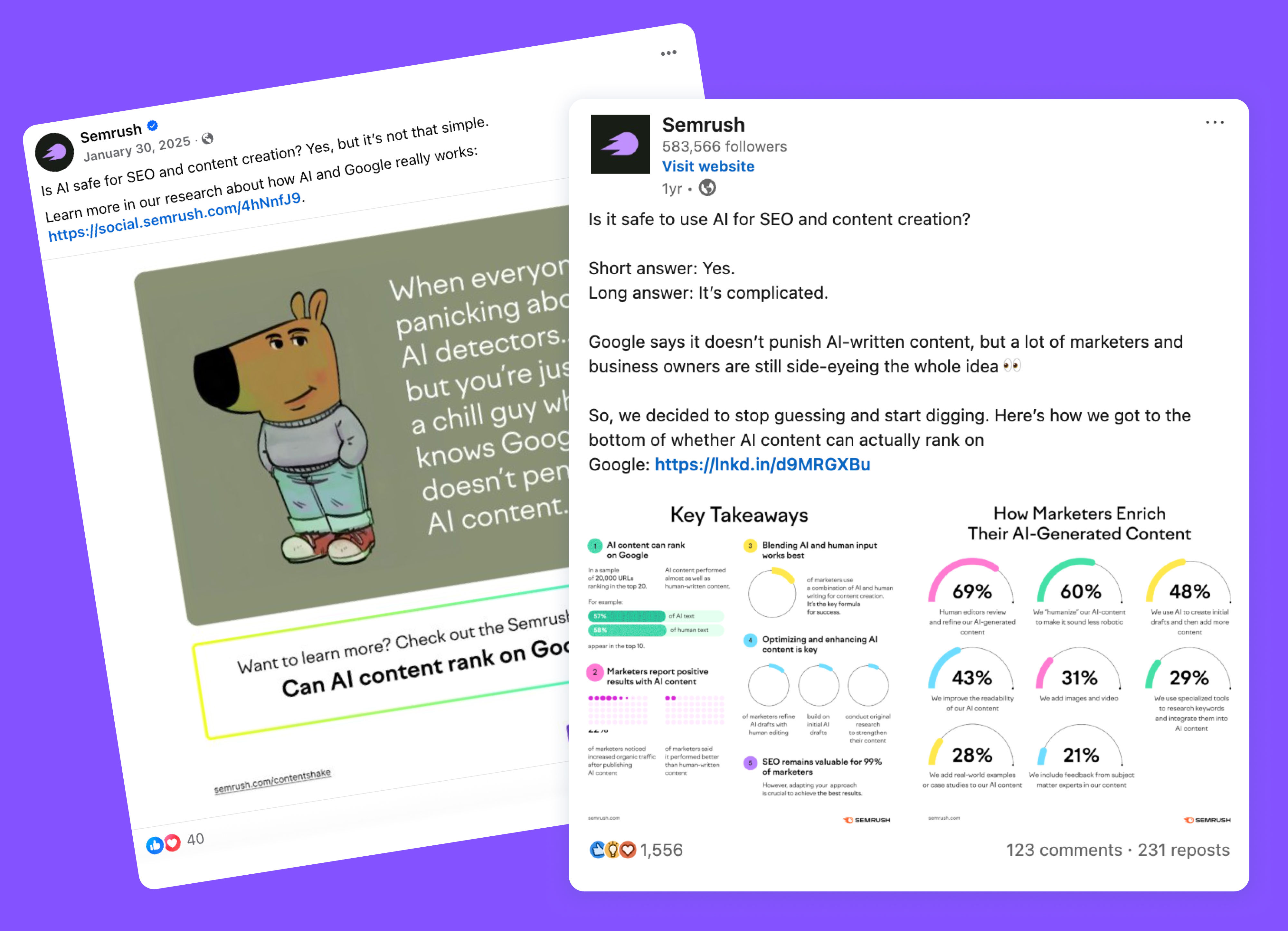
What did change was the format. On social media, the message landed best in lighter formats. Memes worked surprisingly well to introduce the idea or research finding, and from there, expanded with more data-driven details on landing pages and blog posts. Infographics also performed well. Detailed, step-by-step product explanations didn't resonate much on social.
Email was a different story. Product-focused content performed much better there than on social. Step-by-step walkthroughs and feature-focused flows drove significantly stronger trial conversions compared to social media.
For users coming from organic search, the audience was much colder and less familiar with our product. Our team developed several free writing tools targeting writing queries, and while they generated significant traffic, conversion was more challenging. For this segment, messaging was significantly simplified, relying on in-tool tips and banners to introduce the product.
Scott: What's your favorite piece of content you've created to promote the product and why?
Liliya: My favorite piece of content was our research report, “Can AI Content Rank?” It addressed a major concern that emerged once AI tools became mainstream: whether search engines might penalize AI-generated content, leading to traffic loss.
The topic was validated through an email survey, and 60% of respondents confirmed this was one of their biggest concerns around AI and SEO. The report combined ranking data and expert insight. We analyzed 20,000 URLs in the top 20 search results and found that AI-assisted content can rank at nearly the same rate as human-written content. We also surveyed 700+ marketers, many of whom reported positive results using AI in their workflows.
I supported the decision to release the report ungated. Since we weren't planning to involve the sales team, collecting emails alone wouldn't necessarily translate into revenue. In this case, maximizing reach and authority was more valuable than lead capture. Keeping it open allowed the report to gain broader visibility. It was featured in Google's AI Overviews for relevant queries and cited by LLMs in AI-generated answers, which significantly extended its reach beyond our owned channels.
The report was promoted through email campaigns, in-product banners, social media, and employee advocacy. Selecting a highly relevant topic contributed to strong open rates and social engagement. Inside the report, I proposed we include contextual banners and a time-limited discount, which helped convert readers into paying users without direct sales involvement.
Go-to-market execution & overcoming objections
We take this interview home by discussing the go-to-market stage of product development. What did Semrush do to cut through the noise? How did they build trust with a cautious audience? Here's what Liliya shared.
Scott: When bringing an AI product to market right now, there is a lot of noise. What marketing tactics, angles, or buzzwords did you intentionally avoid using, and why?
Liliya: One thing I decided to intentionally avoid was the “fast and cheap content” angle. When I analyzed the market, most AI writing tools were positioned around speed and volume, just phrased differently. More articles, faster output, lower cost. From the start, that felt unsustainable. Speed improves across the entire category over time, so it's hard to build long-term differentiation there. If you compare positioning of many AI tools from 2023 to now, you'll see how often messaging shifted once that promise stopped standing out.
The second narrative I avoided was “replace your writer with AI.” That didn't align with our team's product vision. We never saw AI as a substitute for human expertise, especially in high-quality SEO-driven content. Quality, strategy, and judgment still require a human layer. So instead of pushing a fast automation-first message, we focused on AI as support. A tool that helps experts work better and faster, not one that replaces them. That positioning felt more realistic and long-term for our SMB audience.
Scott: What was the biggest customer objection you anticipated before launch, and what specific messaging or feature did you intentionally highlight to overcome it?
Liliya: One of the most significant objections I anticipated was simple: “Why this tool and not the other one?” The AI writing space was growing fast; it is a crowded category. It felt like a new player launched every month. I saw variations of the same concern in sales calls, interviews, and churn surveys:
“I already use another tool.”
“How is yours better?”
“What makes your content higher quality?”
Instead of avoiding the comparison, we leaned into it. We shortlisted the tools most frequently mentioned and built transparent, feature-by-feature comparison pages. These pages performed exceptionally well in the lower funnel.
Scott: How did you determine where and how to launch the product?
Liliya: To determine where and how to launch, it was essential first to assess the broader company context. Since the tool was part of Semrush, a leading SEO platform, we had a strong advantage: an existing audience that was already creating content and highly relevant to the product.
Because we were still validating the concept, I started with small tests across different channels to see what we could realistically scale later. It quickly became clear what was gaining traction and what simply wasn’t worth the investment. Those early learnings shaped our launch plan and influenced our marketing priorities for the months that followed.
Scott: With so much skepticism around the quality of AI-generated content, how did you market the tool in a way that built genuine trust and authenticity with your audience?
Liliya: To create strong positioning, we made sure it was grounded in the product itself. Marketing collaborated closely with the product team during pre-launch research, and one of our key differentiators became clear: the tool was powered by Semrush's SEO data, which directly improved content quality and ranking potential.
This allowed us to position the product as an AI content tool specifically built for SEO performance, not just generic AI writing. To strengthen this positioning, we worked closely with our internal organic team to better understand ranking factors and continuously improve output quality.
From a marketing perspective, the strategy leaned heavily into thought leadership. Educational YouTube series, blog posts, and research pieces like “Can AI Content Rank?” were published alongside a curated newsletter covering AI content trends and Google updates, led by the Content Lead. The objective was to position the brand as a trusted guide in the evolving AI content landscape. Educating the market, explaining industry shifts, and showing how to extract real value from the product.
Scott: What is one strategic thing you would do differently in the launch for your next product?
Liliya: Looking back, I would start working on the monetization strategy much earlier in the launch process. Pricing often becomes a “set it and forget it” decision. Teams launch with one structure and then spend months trying to push volume instead of optimizing the revenue model itself. But pricing is as strategic as the product.
One challenge is that ownership of pricing often sits in a grey zone between product, marketing, and finance. For the next launch, I would define clear ownership early and treat pricing as an ongoing strategic initiative rather than a one-time decision.
Practically, that means planning pricing research, and experiments alongside the product roadmap and giving them the same priority as feature development. This would include structured testing of packaging, willingness to pay, and discount strategy, with a clear understanding of when discounts are appropriate and what specific goal they are meant to achieve, whether acquisition, activation, or expansion.
Overall, I would elevate pricing to the same strategic importance as product development from day one.
About Lilya: Liliya is a Product Marketing Manager at Semrush with 8 years of experience in marketing. She began her career at a digital marketing agency before moving into PMM roles at Semrush. During her first 3 years at Semrush, she led go-to-market strategy and growth for their AI content generation tool. Currently, she focuses on product marketing for the Semrush SEO toolkit. She is particularly passionate about research-driven marketing and turning insights into actionable strategies and measurable growth.
You probably fall into one of two camps. You’re either trying to build your own software with AI, or you’re reading posts about other people who are building their software with AI.
It’s exciting, it’s noisy, everyone is scared, people are posting pics of MRR as if they’re birthday photos and nobody knows what is happening.
So, to find out what it actually takes to successfully build and market an AI-powered product, I spoke with Liliya Roshchenko, a Product Marketing Manager at Semrush.
Liliya has eight years of marketing experience, and has led the go-to-market strategy and growth for their AI content generation tool within their Content Toolkit. Liliya has been at the forefront of research, positioning, and launching an AI-powered product to an audience where some users were initially cautious about AI, making her the perfect person to share all her product marketing struggles, successes and secrets. We like secrets.
Key takeaways
Authenticity beats speed: Marketers are highly protective of their brand voice. AI tools need to offer control and authenticity, not just fast content generation.
AI is becoming a baseline skill: The industry has shifted from skepticism to daily application. AI is no longer an experiment. It's becoming an expected part of the standard content creation workflow.
Position around performance, not replacement: When launching an AI-powered marketing product, avoid the “replace your X” or “fast and cheap” narratives. Focus on how AI supports human expertise and drives measurable results.
Treat pricing as a strategic initiative: Don't leave monetization to the end of your launch. Treat pricing research and testing with the same priority as feature development from day one.
Uncovering the audience & the AI mindset
I’m a sucker for a good story and so that means taking things back to the very beginning. I wanted to explore the initial research phase, product validation and understanding the differences between how engineers view AI and how marketers actually feel about using it. Here is what Liliya had to share on the topic.
Scott: When you first started researching the market for this AI content generation tool, what did you discover about marketers' true attitudes toward AI?
Liliya: When our team started building our AI content tool, this was pre-ChatGPT hype. AI wasn't a must-have yet. Semrush had strong content optimization tools for years, but generating articles with AI was a new direction.
The overall attitude I heard from marketers was curious but, in some cases, cautious. Most feedback about AI was consistent: short-form content like headlines or product descriptions was usable, but long-form content often lacked depth, included irrelevant information, or required heavy editing. Trust in AI tools was low, especially when accuracy and brand voice were at stake.
For the initial research and product validation, I teamed up closely with the Product Owner and UX designer. We used a structured validation framework to prioritize updates based on patterns rather than opinions. Working on interviews together was especially valuable. It meant that product, UX, and marketing were aligned from the beginning, making planning feature updates and future launches much smoother.
Scott: During those early conversations or research processes, were there specific fears or misconceptions about AI content creation that genuinely surprised you?
Liliya: What became clear early on was that one of the biggest concerns around AI wasn’t speed or even quality — it was sameness. Many users felt that once you start using AI, content begins to sound generic and indistinguishable. That was a real risk, especially for small business owners and solopreneurs whose brand voice is a key differentiator.
Several users told me they avoided AI tools because they didn’t want their content to lose its uniqueness. They weren’t rejecting AI itself — they were rejecting the idea of sounding like everyone else.
It was important for us to address that directly. Instead of expecting users to adapt to AI, we built a Brand Voice feature that allows them to upload their own writing samples. The AI then learns their tone, vocabulary, and stylistic nuances.
One influencer who tested the feature was genuinely surprised that the tool picked up specific phrases he frequently uses. That reaction confirmed we were solving the right problem — helping users scale content without sacrificing identity.
Brand Voice feature by Semrush
Scott: How have you seen your audience's mindset shift regarding AI from over the last year? How do you think attitudes will evolve over the next year?
Liliya: Before late 2022, AI adoption was cautious. Even in 2024, our research, Think Big with AI, showed that 31% of marketers were concerned about originality, and 30% questioned the quality of AI-generated content. Legal risks and ranking concerns were also common objections.
After generative AI tools became publicly accessible, the mindset shifted quickly. Curiosity began to replace hesitation. Business owners were openly experimenting and sharing new use cases. AI became part of the everyday workflow for numerous businesses.
The biggest shift was around time. One user shared that AI removed time constraints, making expertise the real bottleneck. That’s a meaningful change. Speed is now expected.
A significant part of our AI tool audience has always been content writers, and for them, the rules changed as well. According to recent Semrush research on shifts in content marketing job listings, mentions of “writing” dropped by 28% since 2023, while “content creation” increased by 209%, reflecting growing demand for multi-format output. AI is also becoming a baseline expectation rather than a niche skill. About 34% of senior roles and 19% of non-senior roles now mention AI, but highly specific skills like prompt engineering still appear in less than 1% of listings.
In my opinion, these numbers show that AI is no longer treated as an experiment. It is becoming embedded in the standard definition of a content role.
The beta phase & crafting the strategy
Okay, so we have some insight now into early AI attitudes and product validation at Semrush, but how do we take this information and ensure it becomes engrained in the product? Liliya and I explored the operational side of launch planning, cross-functional collaboration, and using early feedback to shape messaging and positioning.
Scott: How did you approach the beta launch? Who did you intentionally invite to test it, and what were you specifically hoping to learn from them before a wider rollout?
Liliya: For the beta launch, my focus was primarily on messaging validation and understanding how the product would land with real users. From the product side, the team was testing output quality and the tool's flow. My role was to observe how users reacted and what language they used. I wanted to understand how they described the value in their own words and what outcomes mattered most to them. That input was critical for shaping landing pages, emails, and positioning.
For the beta launch, small business owners, content marketers, and selected influencers were invited. Loyal users tend to give honest, constructive feedback. Influencers, on the other hand, often provide more strategic insights since they regularly interact with similar audiences and understand common pain points.
We conducted structured beta interviews across key audience segments to validate messaging and product perception before launch. That made it much easier to sharpen the messaging and prioritize what truly mattered before going live to a wider audience.
Scott: Can you share an example of how a specific piece of feedback or a use-case from beta testing directly influenced your final go-to-market product or product marketing?
Liliya: One piece of feedback that really shaped go-to-market efforts came from solopreneurs in the beta group. This was particularly interesting because it was one of the first Semrush tools built specifically for solopreneurs, not experienced in-house marketers. In many ways, this was a newer audience for Semrush, and I was excited to understand them better.
Although we target SMB broadly, SEO knowledge varies significantly within that segment. When speaking with solopreneurs, I learned that many choose blog topics based on personal expertise or intuition rather than keyword volume. Some were intentionally creating content that wasn't optimized for a specific query. Metrics such as search volume, keyword difficulty, and readability scores weren't top priorities, and blog performance wasn't always consistently measured.
This insight influenced both the product experience and my messaging strategy. In communication, our focus was more on ideation and simplifying content. The tool still offers data, but it doesn't overwhelm users who don't want it.
Scott: What's the hardest part of crafting a value proposition for a new AI-powered product?
Liliya: When AI writing tools first flooded the market, they all sounded the same. Every landing page promised some version of “write 10X faster” or “generate articles in seconds.” Speed was the headline. AI was framed as a shortcut to scale output.
Our team chose not to compete there. As a company built on SEO data, we had years of evidence showing that speed alone doesn't drive performance. Publishing more content doesn't automatically increase rankings. Articles that win are aligned with search intent, built around the right keywords, structured strategically, and continuously optimized. I knew positioning around speed would be short-lived because it ignores what actually moves traffic and conversions.
That prediction played out quickly. Between 2023 and 2026, AI tools became dramatically faster and better. Speed became table stakes. When everyone can generate content instantly, it ceases to be a differentiator.
Our tool focused on hybrid, high-quality content combining Semrush SEO insights, AI generation, and human expertise. That positioning shaped not only the product but also our messaging, campaigns, and overall content strategy. Speed was easy to replicate. Performance wasn't.
Scott: Did you find that your core marketing message needed to adapt depending on the medium (e.g., did you speak differently about the tool on social media versus a webinar or email campaign)?
Liliya: Our core messaging stayed consistent across channels. I made sure our assets continuously reinforced one main idea: high-quality, data-backed content over fast, generic AI output. That didn't change.
What did change was the format. On social media, the message landed best in lighter formats. Memes worked surprisingly well to introduce the idea or research finding, and from there, expanded with more data-driven details on landing pages and blog posts. Infographics also performed well. Detailed, step-by-step product explanations didn't resonate much on social.
Email was a different story. Product-focused content performed much better there than on social. Step-by-step walkthroughs and feature-focused flows drove significantly stronger trial conversions compared to social media.
For users coming from organic search, the audience was much colder and less familiar with our product. Our team developed several free writing tools targeting writing queries, and while they generated significant traffic, conversion was more challenging. For this segment, messaging was significantly simplified, relying on in-tool tips and banners to introduce the product.
Scott: What's your favorite piece of content you've created to promote the product and why?
Liliya: My favorite piece of content was our research report, “Can AI Content Rank?” It addressed a major concern that emerged once AI tools became mainstream: whether search engines might penalize AI-generated content, leading to traffic loss.
The topic was validated through an email survey, and 60% of respondents confirmed this was one of their biggest concerns around AI and SEO. The report combined ranking data and expert insight. We analyzed 20,000 URLs in the top 20 search results and found that AI-assisted content can rank at nearly the same rate as human-written content. We also surveyed 700+ marketers, many of whom reported positive results using AI in their workflows.
I supported the decision to release the report ungated. Since we weren't planning to involve the sales team, collecting emails alone wouldn't necessarily translate into revenue. In this case, maximizing reach and authority was more valuable than lead capture. Keeping it open allowed the report to gain broader visibility. It was featured in Google's AI Overviews for relevant queries and cited by LLMs in AI-generated answers, which significantly extended its reach beyond our owned channels.
The report was promoted through email campaigns, in-product banners, social media, and employee advocacy. Selecting a highly relevant topic contributed to strong open rates and social engagement. Inside the report, I proposed we include contextual banners and a time-limited discount, which helped convert readers into paying users without direct sales involvement.
Go-to-market execution & overcoming objections
We take this interview home by discussing the go-to-market stage of product development. What did Semrush do to cut through the noise? How did they build trust with a cautious audience? Here's what Liliya shared.
Scott: When bringing an AI product to market right now, there is a lot of noise. What marketing tactics, angles, or buzzwords did you intentionally avoid using, and why?
Liliya: One thing I decided to intentionally avoid was the “fast and cheap content” angle. When I analyzed the market, most AI writing tools were positioned around speed and volume, just phrased differently. More articles, faster output, lower cost. From the start, that felt unsustainable. Speed improves across the entire category over time, so it's hard to build long-term differentiation there. If you compare positioning of many AI tools from 2023 to now, you'll see how often messaging shifted once that promise stopped standing out.
The second narrative I avoided was “replace your writer with AI.” That didn't align with our team's product vision. We never saw AI as a substitute for human expertise, especially in high-quality SEO-driven content. Quality, strategy, and judgment still require a human layer. So instead of pushing a fast automation-first message, we focused on AI as support. A tool that helps experts work better and faster, not one that replaces them. That positioning felt more realistic and long-term for our SMB audience.
Scott: What was the biggest customer objection you anticipated before launch, and what specific messaging or feature did you intentionally highlight to overcome it?
Liliya: One of the most significant objections I anticipated was simple: “Why this tool and not the other one?” The AI writing space was growing fast; it is a crowded category. It felt like a new player launched every month. I saw variations of the same concern in sales calls, interviews, and churn surveys:
“I already use another tool.”
“How is yours better?”
“What makes your content higher quality?”
Instead of avoiding the comparison, we leaned into it. We shortlisted the tools most frequently mentioned and built transparent, feature-by-feature comparison pages. These pages performed exceptionally well in the lower funnel.
Scott: How did you determine where and how to launch the product?
Liliya: To determine where and how to launch, it was essential first to assess the broader company context. Since the tool was part of Semrush, a leading SEO platform, we had a strong advantage: an existing audience that was already creating content and highly relevant to the product.
Because we were still validating the concept, I started with small tests across different channels to see what we could realistically scale later. It quickly became clear what was gaining traction and what simply wasn’t worth the investment. Those early learnings shaped our launch plan and influenced our marketing priorities for the months that followed.
Scott: With so much skepticism around the quality of AI-generated content, how did you market the tool in a way that built genuine trust and authenticity with your audience?
Liliya: To create strong positioning, we made sure it was grounded in the product itself. Marketing collaborated closely with the product team during pre-launch research, and one of our key differentiators became clear: the tool was powered by Semrush's SEO data, which directly improved content quality and ranking potential.
This allowed us to position the product as an AI content tool specifically built for SEO performance, not just generic AI writing. To strengthen this positioning, we worked closely with our internal organic team to better understand ranking factors and continuously improve output quality.
From a marketing perspective, the strategy leaned heavily into thought leadership. Educational YouTube series, blog posts, and research pieces like “Can AI Content Rank?” were published alongside a curated newsletter covering AI content trends and Google updates, led by the Content Lead. The objective was to position the brand as a trusted guide in the evolving AI content landscape. Educating the market, explaining industry shifts, and showing how to extract real value from the product.
Scott: What is one strategic thing you would do differently in the launch for your next product?
Liliya: Looking back, I would start working on the monetization strategy much earlier in the launch process. Pricing often becomes a “set it and forget it” decision. Teams launch with one structure and then spend months trying to push volume instead of optimizing the revenue model itself. But pricing is as strategic as the product.
One challenge is that ownership of pricing often sits in a grey zone between product, marketing, and finance. For the next launch, I would define clear ownership early and treat pricing as an ongoing strategic initiative rather than a one-time decision.
Practically, that means planning pricing research, and experiments alongside the product roadmap and giving them the same priority as feature development. This would include structured testing of packaging, willingness to pay, and discount strategy, with a clear understanding of when discounts are appropriate and what specific goal they are meant to achieve, whether acquisition, activation, or expansion.
Overall, I would elevate pricing to the same strategic importance as product development from day one.
About Lilya: Liliya is a Product Marketing Manager at Semrush with 8 years of experience in marketing. She began her career at a digital marketing agency before moving into PMM roles at Semrush. During her first 3 years at Semrush, she led go-to-market strategy and growth for their AI content generation tool. Currently, she focuses on product marketing for the Semrush SEO toolkit. She is particularly passionate about research-driven marketing and turning insights into actionable strategies and measurable growth.
Scott is an experienced marketer, copywriter, podcaster and consultant with expertise spanning everything from performance marketing and UX to data analytics and AI strategy. He loves exploring the intricacies of marketing and turning complex, technical subjects into user friendly content.