We’re all looking for seamlessness in life. In a busy world, we’re happy to pay for peace of mind and convenience. In the world of ad tracking and attribution, Birch Hub is our solution for achieving this clarity.
There are three big headaches advertisers suffer from with respect to ad tracking:
Getting robust ad tracking in place for the first time.
Fixing existing, disjointed ad tracking.
Tearing your hair out when someone asks you “Why is this reporting this when this is reporting THIS?”
Increased use of ad blockers, updates to privacy laws and the phasing out of third-party cookies have changed the tracking landscape.
Birch Hub is our direct response to this new privacy-first era of advertising. It is a proprietary, server-side tracking solution built on Meta's Signals Gateway technology that simplifies these complex aspects of tracking advertising. In essence, it’s a universal data gateway that makes your Meta ad data first-party, accurate, and resilient, giving you the clean complete data you rely on to confidently scale campaigns while respecting user privacy choices.
In this article, we’ll take a birds-eye view (no pun intended) of why it’s about to become such an important solution in your advertising tech stack.
Key takeaways
Here’s why Birch Hub exists and the practical difference it makes for performance marketers:
Fixing data loss: Our client case studies reveal that 30-40% of conversion data was lost due to tracking obstacles related to browser restrictions and ad blockers.
One centralised platform: Manage the entire Meta ad data flow in one user-friendly platform. Shifting your focus from hours of miserable Excel cleanups and emails back and forth with developers, to one centralised, intuitive interface that you can control.
Future-proofed ad-scaling: Leverage first-party, server-side data, which is essential as platforms look likely to make this tracking method mandatory for conversion campaigns.
The current challenge: flying blind with incomplete data
Repeat after me, tracking inefficiencies are one the biggest obstacles that prevent creative advertisers from scaling successful ads or campaigns. At the heart of this modern struggle is a collapsing data pipeline.
The tracking pain advertisers are dealing with right now
Data quality is declining: The classic, client-side Meta pixel is a third-party script. It’s easily blocked by ad blockers, and major mobile operating systems and browsers are increasingly restricting third-party cookies. As our CEO, Mikhail Trofimov notes, “Overall, data quality for most advertisers is declining as they are struggling to adapt to tracking changes and requirements. So this problem needs to be solved.” AI relies on constant, high-quality feedback. With major ad platforms now using AI to drive their ad algorithms, when it loses a significant portion of user data, it simply can’t optimize your ads effectively.
It’s impossible to become an AI-informed advertiser if your data isn’t captured accurately.
The technical barrier is too high: The widely-known solution for Meta server-side ad tracking is via Conversions API (CAPI). The catch? It typically requires a complex, multi-day setup of gateway servers and a lot of developer hours. This is not feasible for most marketing teams.
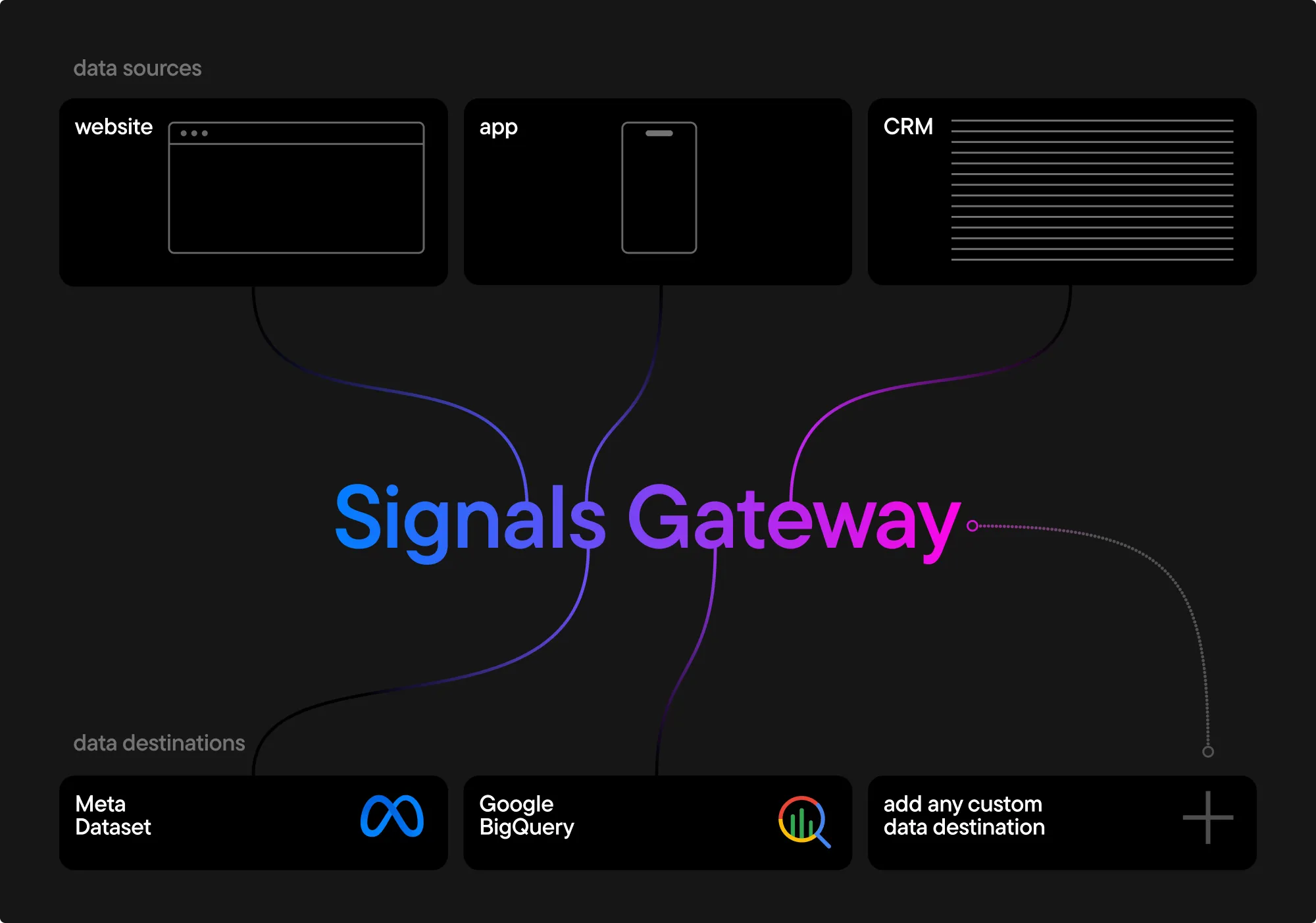
Platform fragmentation: If you’re a marketer running ad campaigns across multiple-platforms like Meta, TikTok, and Google, you’re juggling multiple pixels, separate event gateways, and fragmented data sources. The less centralised your data sources, the more risk there is of data loss.
Our CEO, Mikhail, sums up the potential cost of fragmented ad tracking:
“We've seen from one of our client case studies an estimated 30 to 40% advertising efficiency loss. Basically, if a business spends $10,000 a month on ads, then $4,000 of that is spent inefficiently without server-side tracking.”
Mikhail Trofimov, CEO & Co-founder of Birch.
To get around these technical barriers, we currently see teams struggling to adopt one of three imperfect solutions:
Building custom server-side setups: This involves tasking a development team to build and maintain a bespoke Conversions API connection. While effective, it burns through expensive engineering hours and requires constant updates whenever platforms change their APIs.
Wrestling with Google Tag Manager: While GTM is the industry standard for client-side tracking, setting up server-side containers adds a layer of complexity that often requires specialist knowledge to debug and maintain.
The "Spreadsheet of Doom": The fallback for many is the manual grind. This means exporting data from Meta, exporting from your CRM or backend, and spending hours knitting the rows together in Excel to find the truth. It is slow, prone to human error, and means you are always analyzing data that is days or weeks old.
Our solution: A seamless system for server-side data
Birch Hub was built to remove the friction and eliminate the need for an engineering team to manage ad tracking implementation. Our long term goal is to make the complex process of ad management as simple as providing the core inputs: creative, budget, and goals, and letting a unified system handle the rest. This starts with improved Meta advertising tracking.
Why first-party should be your new favorite type of party
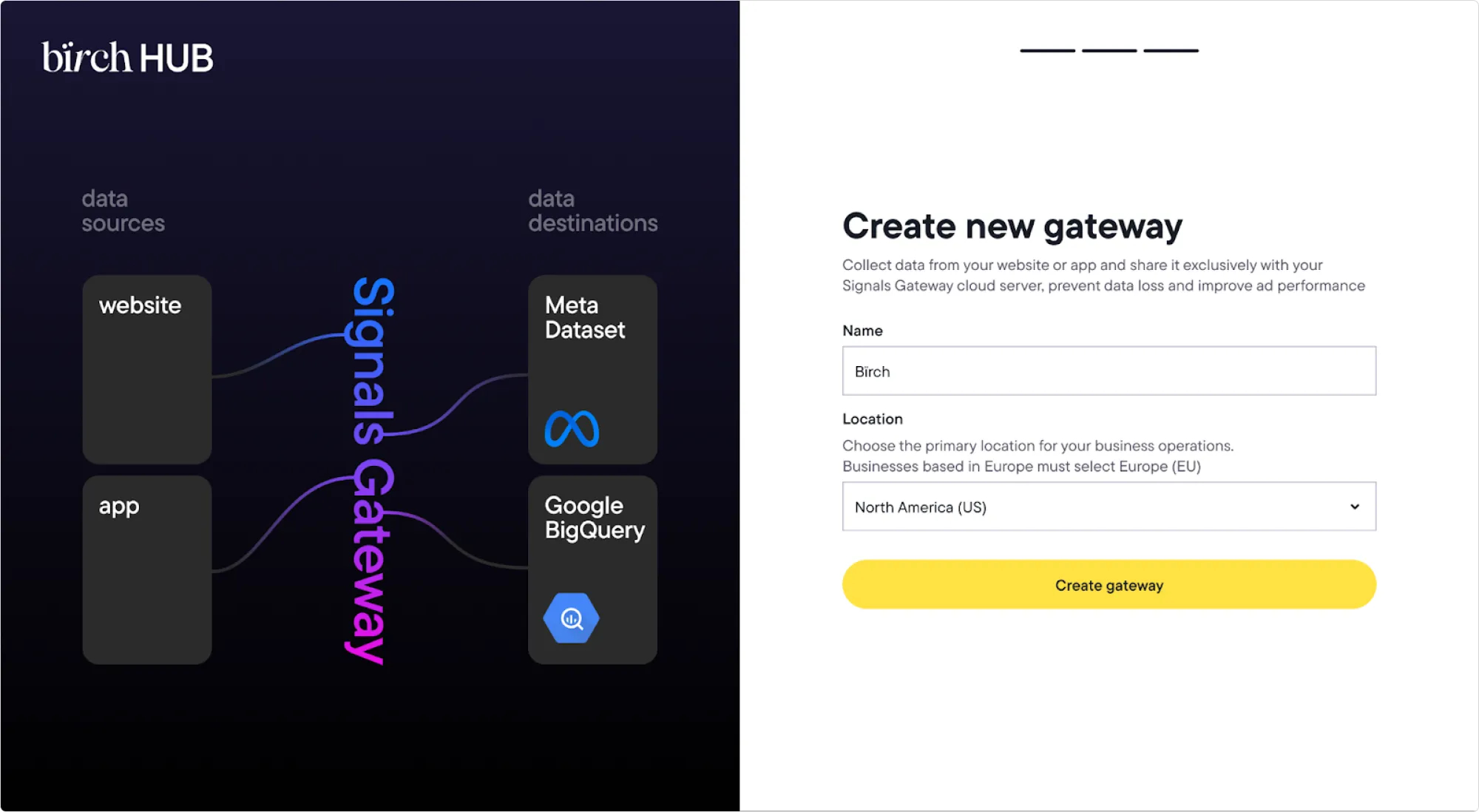
Birch Hub is built on the core of Meta’s Signals Gateway. This is the key that moves you from vulnerable third-party tracking to resilient first-party tracking:
The classic Meta pixel connects directly to Meta’s servers and is therefore considered third-party data.
The Signals Gateway pixel, as implemented in Birch Hub, is completely first party, it works entirely locally and doesn't send any data to Meta’s servers.
Our team focused on making the whole technology convenient and simple to set up.
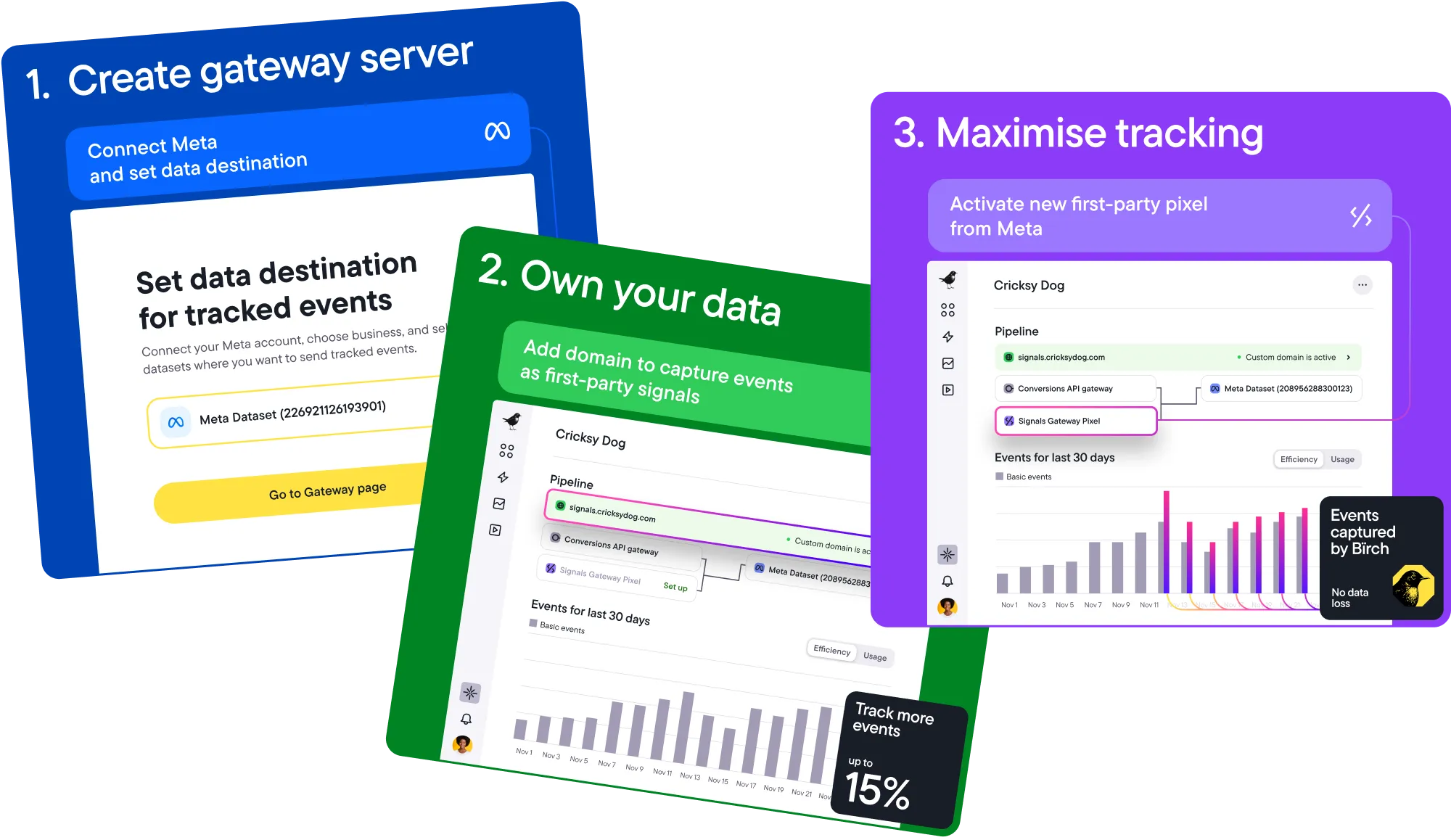
In practice, the full server-side tracking setup via Birch Hub comes down to three quick steps:
Connect your account and dataset: This simple step already enables the Conversion API gateway, which will significantly improve your data quality by comparison to the classic Meta pixel.
Connect your domain: Add one line in your hosting/domain provider settings. This ties the server to your own domain and makes the data truly first party.
Add the new pixel: Drop the Birch Hub pixel code on your site. There’s no event configuration needed. If you already have events configured to work with the classic pixel, these will work with the updated pixel you use to implement Birch Hub.
The power of squeaky clean data
The proof is in the performance. Our client Pawz.rs is an e-commerce business selling animal food, care items and accessories across eight different European websites. Facing many of the challenges detailed in this article, they used Birch Hub to set up separate server-side tracking for each of their sites, improving the flow of Meta advertising data.
Their post-implementation Meta ad results included:
A 40% increase in tracked events.
A 30% decrease in CPA.
A 35% increase in conversions.
“We started seeing results within a few days of setting up Signal Gateways, and in a couple of weeks, the improvements in CPA, conversions, and event tracking became evident.”
András Vargyas, Founder and CEO of CricksyDog
A universal engine
The Birch Hub you use today is the first step in our broader vision to build a central performance engine for your entire marketing team.
Wave goodbye to fragmentation (we hate that word)
Simplifying Meta ad tracking via Birch Hub is just the start. Our product team is driving toward a universal solution:
“Our goal is that this new pixel can send events to TikTok, Pinterest, Snapchat, and all other ad platforms as well. We want advertisers to be able to reliably connect new advertising platforms in just one click.”
Mikhail Trofimov, CEO
Our product team is already in contact with the TikTok Conversions API team. Watch this space for that potential integration!
An inevitable future
We see Birch Hub as a solution for both advertising survival and evolution. It deals with the challenges advertisers are facing right now, but also provides a foundation for navigating the challenges the near future likely has to offer. Mikhail predicts that as major technology and advertising companies continue to phase our third-party cookies, these platforms will likely make server-side tracking mandatory for any advertiser running conversion-based campaigns.
“We believe this first-party data processing platform is the future. It's inevitable [that more changes are coming] and we can be the product that makes these changes easier for all advertisers to navigate.”
Mikhail Trofimov, CEO
We’re all looking for seamlessness in life. In a busy world, we’re happy to pay for peace of mind and convenience. In the world of ad tracking and attribution, Birch Hub is our solution for achieving this clarity.
There are three big headaches advertisers suffer from with respect to ad tracking:
Getting robust ad tracking in place for the first time.
Fixing existing, disjointed ad tracking.
Tearing your hair out when someone asks you “Why is this reporting this when this is reporting THIS?”
Increased use of ad blockers, updates to privacy laws and the phasing out of third-party cookies have changed the tracking landscape.
Birch Hub is our direct response to this new privacy-first era of advertising. It is a proprietary, server-side tracking solution built on Meta's Signals Gateway technology that simplifies these complex aspects of tracking advertising. In essence, it’s a universal data gateway that makes your Meta ad data first-party, accurate, and resilient, giving you the clean complete data you rely on to confidently scale campaigns while respecting user privacy choices.
In this article, we’ll take a birds-eye view (no pun intended) of why it’s about to become such an important solution in your advertising tech stack.
Key takeaways
Here’s why Birch Hub exists and the practical difference it makes for performance marketers:
Fixing data loss: Our client case studies reveal that 30-40% of conversion data was lost due to tracking obstacles related to browser restrictions and ad blockers.
One centralised platform: Manage the entire Meta ad data flow in one user-friendly platform. Shifting your focus from hours of miserable Excel cleanups and emails back and forth with developers, to one centralised, intuitive interface that you can control.
Future-proofed ad-scaling: Leverage first-party, server-side data, which is essential as platforms look likely to make this tracking method mandatory for conversion campaigns.
The current challenge: flying blind with incomplete data
Repeat after me, tracking inefficiencies are one the biggest obstacles that prevent creative advertisers from scaling successful ads or campaigns. At the heart of this modern struggle is a collapsing data pipeline.
The tracking pain advertisers are dealing with right now
Data quality is declining: The classic, client-side Meta pixel is a third-party script. It’s easily blocked by ad blockers, and major mobile operating systems and browsers are increasingly restricting third-party cookies. As our CEO, Mikhail Trofimov notes, “Overall, data quality for most advertisers is declining as they are struggling to adapt to tracking changes and requirements. So this problem needs to be solved.” AI relies on constant, high-quality feedback. With major ad platforms now using AI to drive their ad algorithms, when it loses a significant portion of user data, it simply can’t optimize your ads effectively.
It’s impossible to become an AI-informed advertiser if your data isn’t captured accurately.
The technical barrier is too high: The widely-known solution for Meta server-side ad tracking is via Conversions API (CAPI). The catch? It typically requires a complex, multi-day setup of gateway servers and a lot of developer hours. This is not feasible for most marketing teams.
Platform fragmentation: If you’re a marketer running ad campaigns across multiple-platforms like Meta, TikTok, and Google, you’re juggling multiple pixels, separate event gateways, and fragmented data sources. The less centralised your data sources, the more risk there is of data loss.
Our CEO, Mikhail, sums up the potential cost of fragmented ad tracking:
“We've seen from one of our client case studies an estimated 30 to 40% advertising efficiency loss. Basically, if a business spends $10,000 a month on ads, then $4,000 of that is spent inefficiently without server-side tracking.”
Mikhail Trofimov, CEO & Co-founder of Birch.
To get around these technical barriers, we currently see teams struggling to adopt one of three imperfect solutions:
Building custom server-side setups: This involves tasking a development team to build and maintain a bespoke Conversions API connection. While effective, it burns through expensive engineering hours and requires constant updates whenever platforms change their APIs.
Wrestling with Google Tag Manager: While GTM is the industry standard for client-side tracking, setting up server-side containers adds a layer of complexity that often requires specialist knowledge to debug and maintain.
The "Spreadsheet of Doom": The fallback for many is the manual grind. This means exporting data from Meta, exporting from your CRM or backend, and spending hours knitting the rows together in Excel to find the truth. It is slow, prone to human error, and means you are always analyzing data that is days or weeks old.
Our solution: A seamless system for server-side data
Birch Hub was built to remove the friction and eliminate the need for an engineering team to manage ad tracking implementation. Our long term goal is to make the complex process of ad management as simple as providing the core inputs: creative, budget, and goals, and letting a unified system handle the rest. This starts with improved Meta advertising tracking.
Why first-party should be your new favorite type of party
Birch Hub is built on the core of Meta’s Signals Gateway. This is the key that moves you from vulnerable third-party tracking to resilient first-party tracking:
The classic Meta pixel connects directly to Meta’s servers and is therefore considered third-party data.
The Signals Gateway pixel, as implemented in Birch Hub, is completely first party, it works entirely locally and doesn't send any data to Meta’s servers.
Our team focused on making the whole technology convenient and simple to set up.
In practice, the full server-side tracking setup via Birch Hub comes down to three quick steps:
Connect your account and dataset: This simple step already enables the Conversion API gateway, which will significantly improve your data quality by comparison to the classic Meta pixel.
Connect your domain: Add one line in your hosting/domain provider settings. This ties the server to your own domain and makes the data truly first party.
Add the new pixel: Drop the Birch Hub pixel code on your site. There’s no event configuration needed. If you already have events configured to work with the classic pixel, these will work with the updated pixel you use to implement Birch Hub.
The power of squeaky clean data
The proof is in the performance. Our client Pawz.rs is an e-commerce business selling animal food, care items and accessories across eight different European websites. Facing many of the challenges detailed in this article, they used Birch Hub to set up separate server-side tracking for each of their sites, improving the flow of Meta advertising data.
Their post-implementation Meta ad results included:
A 40% increase in tracked events.
A 30% decrease in CPA.
A 35% increase in conversions.
“We started seeing results within a few days of setting up Signal Gateways, and in a couple of weeks, the improvements in CPA, conversions, and event tracking became evident.”
András Vargyas, Founder and CEO of CricksyDog
A universal engine
The Birch Hub you use today is the first step in our broader vision to build a central performance engine for your entire marketing team.
Wave goodbye to fragmentation (we hate that word)
Simplifying Meta ad tracking via Birch Hub is just the start. Our product team is driving toward a universal solution:
“Our goal is that this new pixel can send events to TikTok, Pinterest, Snapchat, and all other ad platforms as well. We want advertisers to be able to reliably connect new advertising platforms in just one click.”
Mikhail Trofimov, CEO
Our product team is already in contact with the TikTok Conversions API team. Watch this space for that potential integration!
An inevitable future
We see Birch Hub as a solution for both advertising survival and evolution. It deals with the challenges advertisers are facing right now, but also provides a foundation for navigating the challenges the near future likely has to offer. Mikhail predicts that as major technology and advertising companies continue to phase our third-party cookies, these platforms will likely make server-side tracking mandatory for any advertiser running conversion-based campaigns.
“We believe this first-party data processing platform is the future. It's inevitable [that more changes are coming] and we can be the product that makes these changes easier for all advertisers to navigate.”
No, but the classic Meta pixel is technically considered to be a third-party data script and is a victim of declining data quality due to ad blockers, third-party cookie restrictions, and operating system updates. This means Meta’s powerful ad optimization AI is starved of necessary data to do its best work, forcing it to guess and leading to higher CPAs and lower ROAS.
Is Birch Hub only for conversion events?
No. A core benefit is that Birch Hub is built to send all user events server-side, not just conversions. This is essential because the Meta algorithm needs a complete signal of user events to optimize your entire funnel.
What platforms does Birch Hub support today, and what is the plan for the future?
Today, Birch Hub is a robust solution for Meta advertising, using the Meta Conversions API and Signals Gateway. We see a future where Birch Hub integrates with TikTok, Snapchat, Pinterest and other ad platforms to become a single, universal data engine.
Okay, so what’s the price for Birch Hub?
You can use the Birch Hub free plan which allows tracking for your first 10,000 events. This should be plenty for most businesses to effectively test the software, so you can see for yourselves that this isn’t just all chirp chirp chirp.
Scott Colenutt
Scott is an experienced marketer, copywriter, podcaster and consultant with expertise spanning everything from performance marketing and UX to data analytics and AI strategy. He loves exploring the intricacies of marketing and turning complex, technical subjects into user friendly content.





.jpg)