Talk
 with
your
Birch data
from
with
your
Birch data
from
 Claude
 Chat GPT
your AI tool
Chat GPT
your AI tool
with
your
Birch data
from
Claude
Chat GPT
your AI tool
Birch MCP brings your rule setup, execution logs, and account structure to the AI tools you work with
How to connect Birch to your AI tool

Claude.ai
Claude.ai

ChatGPT
Claude Code

Codex
Claude.ai
ChatGPT
Claude Code
Codex
1. Open connector settings
On Pro and Max, go to Customize → Connectors. On Team and Enterprise, go to Organization settings → Connectors.
2. Add a custom connector
Click + → Add custom connector. Name it Birch and paste the URL: https://mcp.bir.ch/mcp. Click Connect.
3. Sign in to connect
Sign in with your Birch account.
1. Turn on Developer mode
In ChatGPT Web, open Settings → Plugins and switch on Developer mode.
2. Add a custom connector
Go to Plugins and create a new one. Name it Birch and paste the URL: https://mcp.bir.ch/mcp. Choose OAuth, click Create.
3. Sign in to connect
Sign in with your Birch account.
1. Run one command
Add Birch as a remote MCP server. No API key or bearer token needed.
2. Sign in to connect
In an interactive session, run /mcp, select birch, and choose Authenticate.
1. Run one command
Add Birch as a remote MCP server. No API key or bearer token needed.
2. Sign in to connect
The login command opens the Birch authorization flow. Sign in, approve access, then start a new Codex session.
Analyze your automation the way you analyze everything else
Use Cases
Connect it to the rest of your workflow
Birch MCP is one of the tools Claude can reach. Ask a question that pulls your automation data alongside your analytics, your project tracker, your planning docs — whatever else you've connected. The context lives in one conversation instead of four tabs.
Pressure-test 100 rules in 7 words
Ask "Audit my automations — what's actually working?" Claude reads every rule on the account, checks execution history, and classifies them: firing usefully, running but never matching, erroring silently, or sitting disabled. Every mature account accumulates zombie rules — find them before they cost you.
Know what happened before your first call
Let Claude read your execution logs and trace which rule fired, what triggered it, and how rules interacted — the investigation that used to mean opening Birch and piecing it together yourself. Now it's a question in the same conversation where you're already planning your day. Schedule it for a regular check-in.
Ask anything
Hold to pause auto-switching
Use Cases
Connect it to the rest of your workflow
Used:


 Birch MCP · Analytics · Linear
- Birch — "Scale winners" fired 6× on Q4 Prospecting
- Analytics — paid sessions +38%, checkout flat
- Linear — "New PDP layout" shipped Tuesday
Your scaling rule reacted to Tuesday's launch, but conversions didn't follow. Want me to pull possible metrics to use in a safeguard rule?
Ask anything
Use Cases
Pressure-test 100 rules in 7 words
Used:
Birch MCP
| Status | Rules |
|---|---|
| 🟢 Firing usefully | 41 |
| ⚪ Never matching | 23 |
| 🔴 Erroring silently | 5 |
| ⚫ Disabled | 18 |
28 are dead weight or broken — plus 2 pairs quietly fighting over the same budgets. Want me to pull them up?
Ask anything
Use Cases
Know what happened before your first call
Used:
Birch MCP
Overnight digest:
- 12 rules ran, 3 acted — 6 ad sets paused, 4 budgets adjusted
- "Pause underperformers" fired 4× vs its usual 1
- 2 errors — sheet-sync rule lost permission
- Budget guardrails held at 90% of target
Nothing on fire — but the extra pauses and that sync error are worth a look before your day starts.
Ask anything
Hold to pause auto-switching
Tool directory
6 tools · Write
Rule management
Manage existing rules across Meta, Google, TikTok, and Snapchat: enable or disable, rename, duplicate, move between folders, change ad accounts, and replace entity filters.
6 tools · Read-only
Rules & logs
The core of the read surface. List a workspace's automation rules (with optional folder filtering) and their folder structure, pull one rule's full logic in prose (conditions, schedule, filters, targeted entities), inspect available entity filters, then list its execution history and drill into one run to see exactly which entities matched, what fired, and any errors.
2 tools · Read-only
Workspace & accounts
List the workspaces the connected user can access, then the ad accounts under a workspace for a given platform.
1 tool · Read-only
Metrics catalog
Search Birch's metric catalog by description to find metric IDs, labels, platforms, and features.
3 tools · Read-only
Stage (creative pipeline)
Check Stage task status (upload vs. create, progress, failure reason), see which files a task uploaded and their platform media IDs, and list the ads a create task actually produced.
1 tool · Read-only
Help
Keyword/semantic search over the Birch help center, so an AI client can answer product questions from real docs instead of guessing.
Rules & logs
list_automation_rules
Lists rules on an ad account — ID, name, level, enabled, check interval, folder. Filterable by folder
Rules & logs
get_rule_details
Full rule logic: tasks (action + condition as prose), schedule, filters, targeted entities
Rules & logs
list_rule_logs
Execution log summaries — when the rule ran, entities evaluated/acted on/errored
Rules & logs
get_rule_log
Detailed per-entity outcomes — actions applied, status changes, condition results, errors. Filterable
Rules & logs
list_rule_folders
Folder tree for automation rules — ID, name, parent_id for subfolders
Rules & logs
get_rule_filter_options
Lists available entity filter options for a rule.
Workspace & accounts
list_workspaces
Lists all workspaces the user can access, with IDs and currency
Workspace & accounts
list_ad_accounts
Lists ad accounts in a workspace — Birch ID, name, currency, timezone, access status
Stage
list_stage_tasks
Stage tasks — status, progress counts, error messages. Filterable by status and task type
Stage
list_stage_uploads
Creative files uploaded by a Stage task — file name and platform media ID
Stage
list_stage_created_ads
Ads created by a Stage task — ad name, platform ad/adset IDs, creation time
Metrics catalog
search_metrics
Natural-language search of Birch's metric catalog — metric ID, label, platform, feature
Help
search_help
Keyword search across Birch Help Center articles
Rule management · Write
set_rule_status
Enable or disable an existing rule.
Rule management · Write
set_rule_ad_accounts
Replace the ad accounts a rule runs on.
Rule management · Write
rename_rule
Rename an existing rule.
Rule management · Write
move_rule
Move a rule into a folder or to the top level.
Rule management · Write
duplicate_rule
Copy a rule within or across workspaces.
Rule management · Write
set_rule_filters
Replace a rule's full entity filter setup.
Two ways to work with your automation
Birch AI
Explore →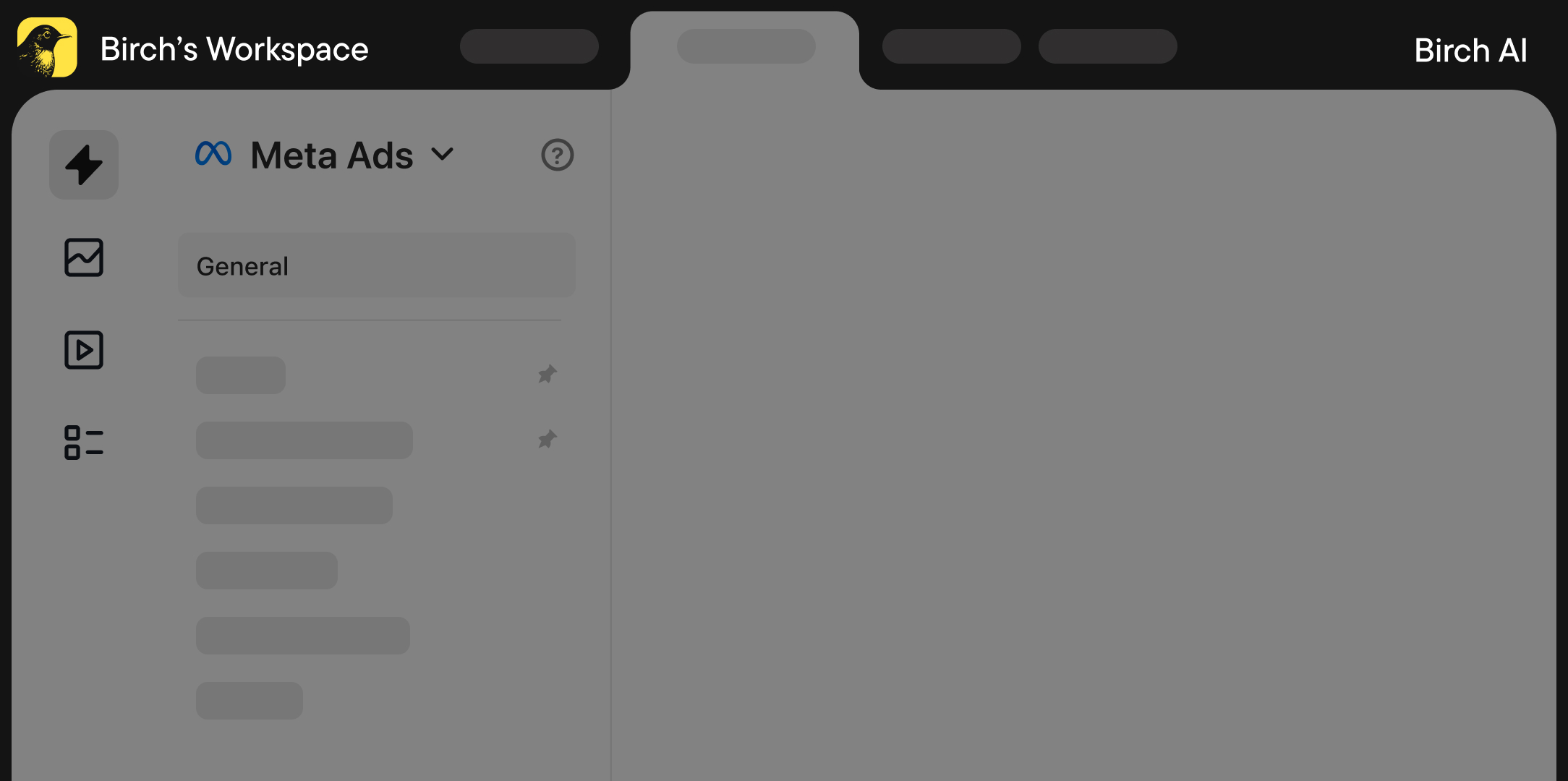
New chat
Create a rule to Pause ad sets: 3-day spend over $100 and cost per purchase above $40
Got it. Here’s a rule based on your conditions:
Pause ad sets — high spend, low efficiency
Conditions ›
Review and set live rule
Ask anything
Assistant inside the Birch product. It reads your rules and account data and helps you work faster without leaving Birch.
Birch MCP
Explore →


Brings your real data to Claude and other AI clients. Use it when you’re already working in Claude — alongside your other connected tools. You don’t have to switch to Birch to understand what your automation did.



Learn the difference
A breakdown across six workflows — auditing rules, reading logs, building automation, benchmarking, and more.
Already in progress

Rule creation and editing
Ask your AI to adjust a threshold, update a condition, or disable a stale rule — and approve the change before it takes effect

Ad creation
Ask your AI to upload creatives and create ads across Meta, TikTok, and Snapchat using Stage.
FAQ
What is MCP?
MCP stands for Model Context Protocol — an open standard that lets AI tools connect to external systems and work with their data. Birch MCP uses it to give AI clients read access to your automation rules, execution logs, and account structure.
Where can I use Birch MCP?
Anywhere that supports the MCP standard. Claude is the most common client, but any MCP-compatible tool can connect. You add Birch MCP as a connector in your tool's settings, sign in, and it becomes available in that conversation — no need to pick a specific AI client to use it.
How is this different from Meta MCP?
They read different things. Meta MCP reads campaign data and reporting from Meta directly. It also has access to Meta Ads library and Meta Help Center. Birch MCP reads your automation rules — the logic that governs how those campaigns are managed inside Birch. You can use both in the same conversation for different stages of your workflow.
Do I need technical skills to set it up?
No. You add Birch MCP in your AI client's connector settings, sign in with your Birch account, and you're connected. No API keys, no code.
Can Birch MCP change my rules or my account?
Birch MCP can manage existing rules: enable or disable them, rename, duplicate, move them between folders, change their ad accounts, and replace entity filters. It cannot create new rules, edit budgets or rule conditions, or change other account settings.
What data does Birch MCP see when I connect?
Your workspaces, ad accounts, rule configurations (conditions, thresholds, schedules, actions), execution logs, folder structure, and Stage task metadata. It doesn't see your creative content, billing information, or personal data beyond what's already visible in your Birch workspace.
I already use Birch AI. Why would I also use the MCP?
Birch AI works inside the Birch product. Birch MCP works inside your own AI client — where you might already be talking to your analytics, your project tracker, or your team chat. If your daily workflow lives outside Birch, the MCP brings your automation context to where you already are. They're complementary.
Your rules, logs, and accounts — known by your AI tool
Pressure-test your automation, diagnose what happened overnight, and find the gaps — all from one conversation.