When choosing between ad automation platforms, the decision often comes down to how each one handles campaign logic. In that space, Birch vs Madgicx is one of the more common comparisons, since both take different approaches to how automation is built and managed.
Madgicx is built around AI-assisted workflows and predesigned structures, while Birch lets you automate decisions using the data and strategic logic your team actually trusts. Understanding where each tool excels makes it easier to choose a setup that matches your team’s structure, spend, and workflow.
Feature-by-feature comparison
The table below shows a simple breakdown of Birch vs Madgicx key features and differences.
Performance cycle
Workflow step
Birch
Madgicx
Launch
Creative testing
Builds structured creative tests and lets teams customize and set setups in bulk to match their testing approach
A/B testing through Ad Launcher with automated variations
Automate
Rules/optimization
Custom rules built from any metric, time window, or data source, with cross-channel triggers and multi-step logic
Automation rules supported by AI models reacting to real-time performance
Scaling behavior
Scaling tied to defined metrics across multiple platforms
Scaling guided by AI that adapts delivery within Meta
Analyze
Creative insights
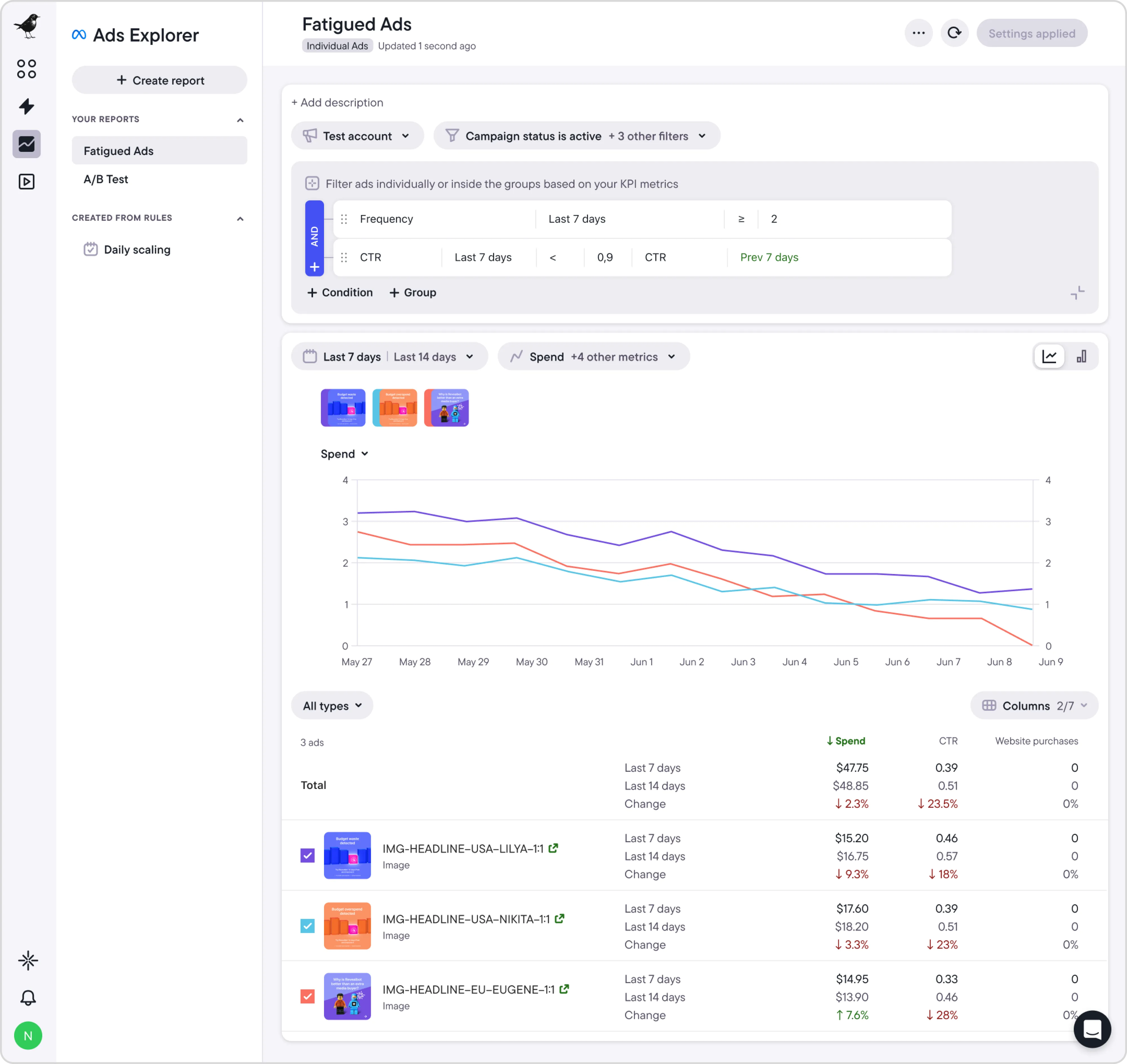
Explorer evaluates Meta ads and assets using your KPIs and naming logic
Creative Matrix and Creative Insights for Meta assets
Reporting
Custom cross-channel dashboards with Slack and email delivery
Funnel dashboards with white-labeled PDF exports
Performance visibility
Unified view across Meta, Google, TikTok, and Snapchat
Meta-focused analytics with optional external data viewing
Attribution tools
Tracking & attribution
Integrates with Hyros, AppsFlyer, Wicked Reports, Signals Gateway, and Adjust
Uses Cloud Tracking for server-to-server attribution
Reach and creative control
Birch
Your team controls how automation behaves across channels.
Lets you define triggers, metrics, and conditions that drive each action.
Offers predictable performance once logic is tuned, which helps when managing multiple Meta accounts in one structure.
Madgicx
Leans on Meta’s machine learning to automate optimization.
Adjusts budgets, audiences, and creatives dynamically based on live performance data.
In practice, Birch works best for teams managing multiple Meta accounts and building automation around their own metrics. It’s built for marketers who prefer to define their logic and scale it across complex account structures instead of relying on AI to decide for them.
Birch reports
Madgicx fits teams focused solely on Meta, where its AI handles delivery, scaling, and creative testing automatically through tools like Ad Launcher and Creative Insights.
Data visibility and performance insights
Birch
Connects Meta performance data with the revenue or attribution metrics your team relies on.
Uses automation tied to your source-of-truth data, which keeps optimization transparent and measurable.
Provides deeper creative visibility through Explorer, a Meta creative performance dashboard that evaluates assets using the data your team already relies on.
Madgicx
Turns campaign data into live funnel insights that show how your audiences move from impression to purchase
Automates optimization using in-platform performance signals to adjust spend and creative instantly
Birch fits growth teams managing several Meta accounts who need unified data and flexible reporting with their existing stack. It connects with tools your team already relies on, such as Google Sheets, Hyros, AppsFlyer, Wicked Reports, Slack, and Signals Gateway, which keeps workflows integrated.
Madgicx offers visual dashboards, PDF exports, and built-in AI features, making it a practical choice for teams that prioritize fast insights and clean, client-ready reporting within one environment.
Pricing and value: how Birch and Madgicx compare
Feature
Birch
Madgicx
Free trial
14 days
7 days
Base plan name(s)
Essential, Pro, Enterprise
Madgicx Pro Complete (with AI)
Pricing structure
Spend-based model that scales with monthly ad spend (entry tier up to $10K/mo)
Spend-based model that scales with monthly ad spend (entry tier up to $2.5K/mo)
Birch offers a lower-cost entry point at $49/month for ad spend of up to $10K, while Madgicx starts at $72/month for ad spend of up to $2.5K. Both platforms use spend-based pricing that scales with ad budgets, but Birch’s tiers allow more ad spend for the same price.
User feedback and overall perception
We reviewed feedback from Capterra, Trustpilot, and G2 to see how teams rate each platform in practice.
🟢 Birch pros:
Dependable automation that reduces hands-on campaign management
Strong reporting and helpful integration with Slack for team visibility
Some long-time users mention limited creative insights for Google and Snapchat
Occasional setup friction when building complex automation or linking multiple accounts
Pricing can feel high for smaller accounts or teams with limited use cases
🟢 Madgicx pros:
Provides AI-assisted automation that improves campaign speed and ROAS
Clear visual dashboards and structured funnel reporting
Generally smooth onboarding with responsive support
Frequent feature updates and visible product iteration
🟠 Madgicx cons:
Recurring complaints of billing and cancellation issues
Occasional bugs or automation misfires
Pricing is less flexible for short-term or seasonal users
How each platform approaches automation
The real distinction between Birch and Madgicx lies in how each system makes and applies decisions. Both automate campaign management, but the method behind that automation changes how teams build, monitor, and improve performance.
Birch: data-grounded automation
Birch strategies
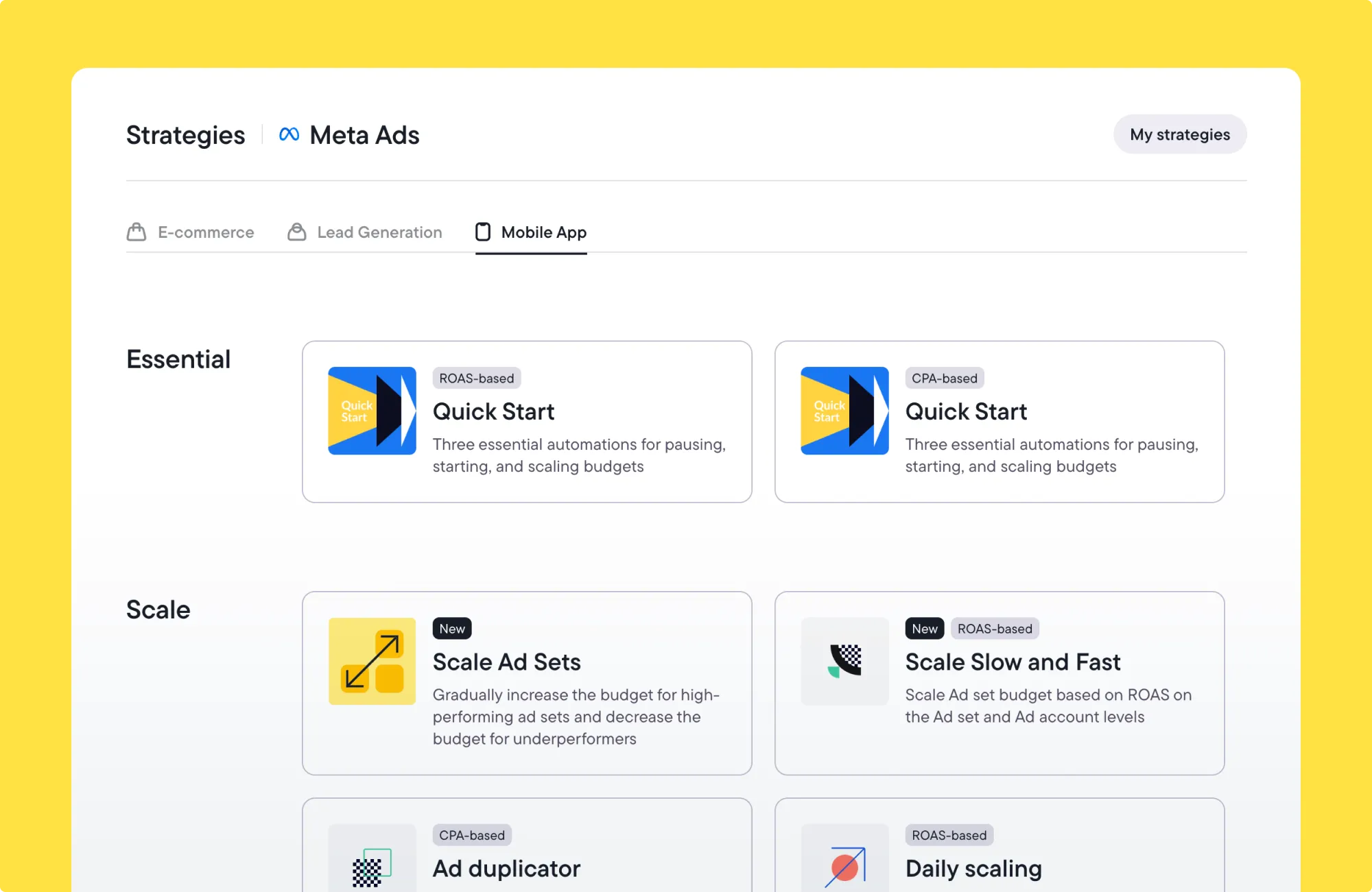
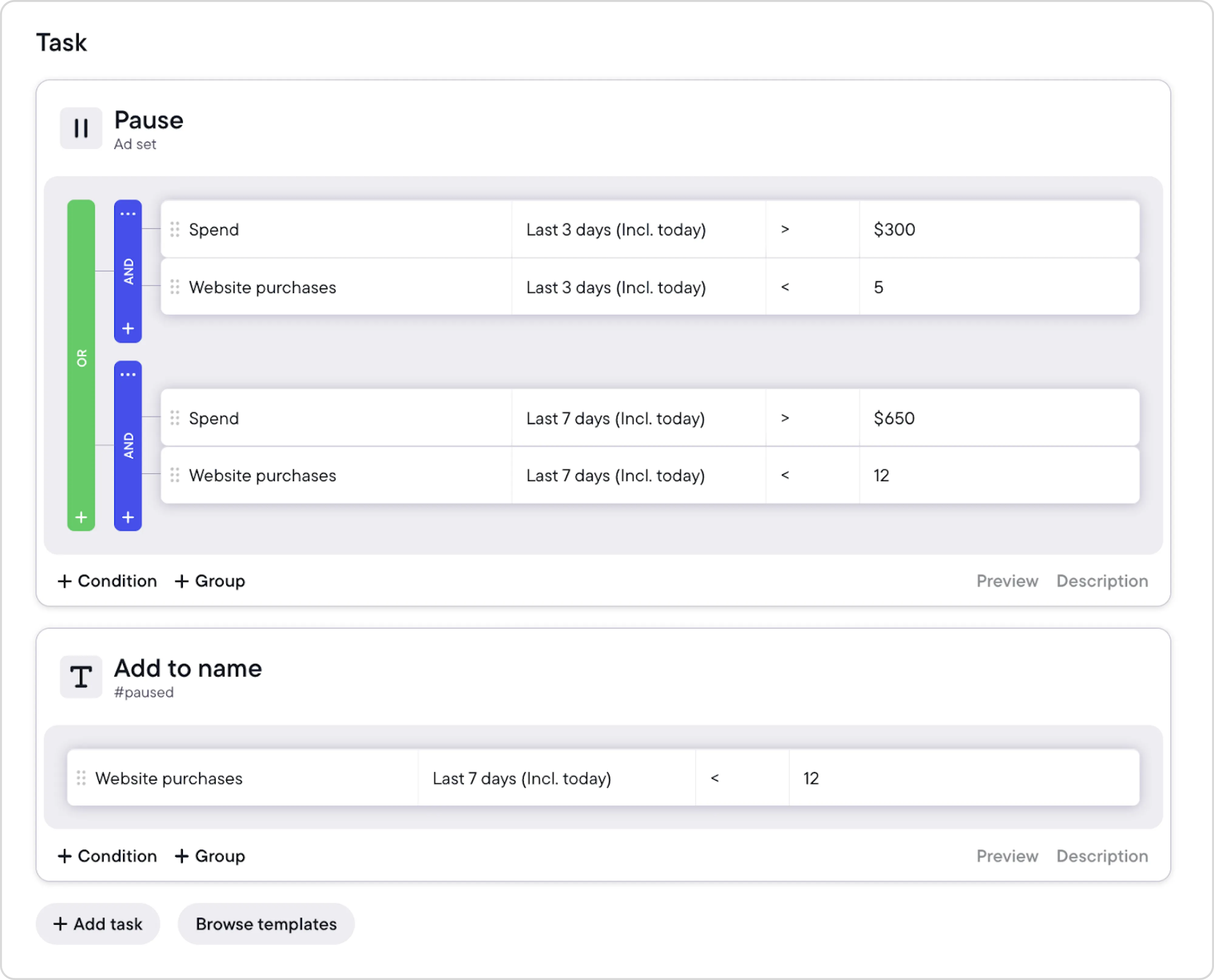
Birch approaches automation through logic you shape around your own data and strategy. Your rules run against the conditions and grouped logic you set, and that structure applies consistently across your Meta accounts.
This structure adds clarity in complex, multi-account setups because it reflects the way data-first teams already work. Many teams bring in metrics from their BI tools or Google Sheets, and that source-of-truth layer sits directly inside their rule logic. Each account still uses its own performance signals, but the broader framework stays aligned with how your team interprets results.
By turning your data and strategy into executable logic, Birch makes decisions scalable and traceable. Automation runs on schedule, records what it checked, and shows why actions triggered. You keep pace while staying close to the analytical reasoning behind every change. Birch AI builds on that foundation. It analyses your rule setup and ad account data to surface gaps in coverage, contradictions between rules, and patterns worth acting on. You review the suggestions and decide what to implement.
Madgicx: AI-assisted optimization within Meta
Madgicx automation tactics
Madgicx uses AI to automate and scale campaigns entirely within Meta’s ecosystem.
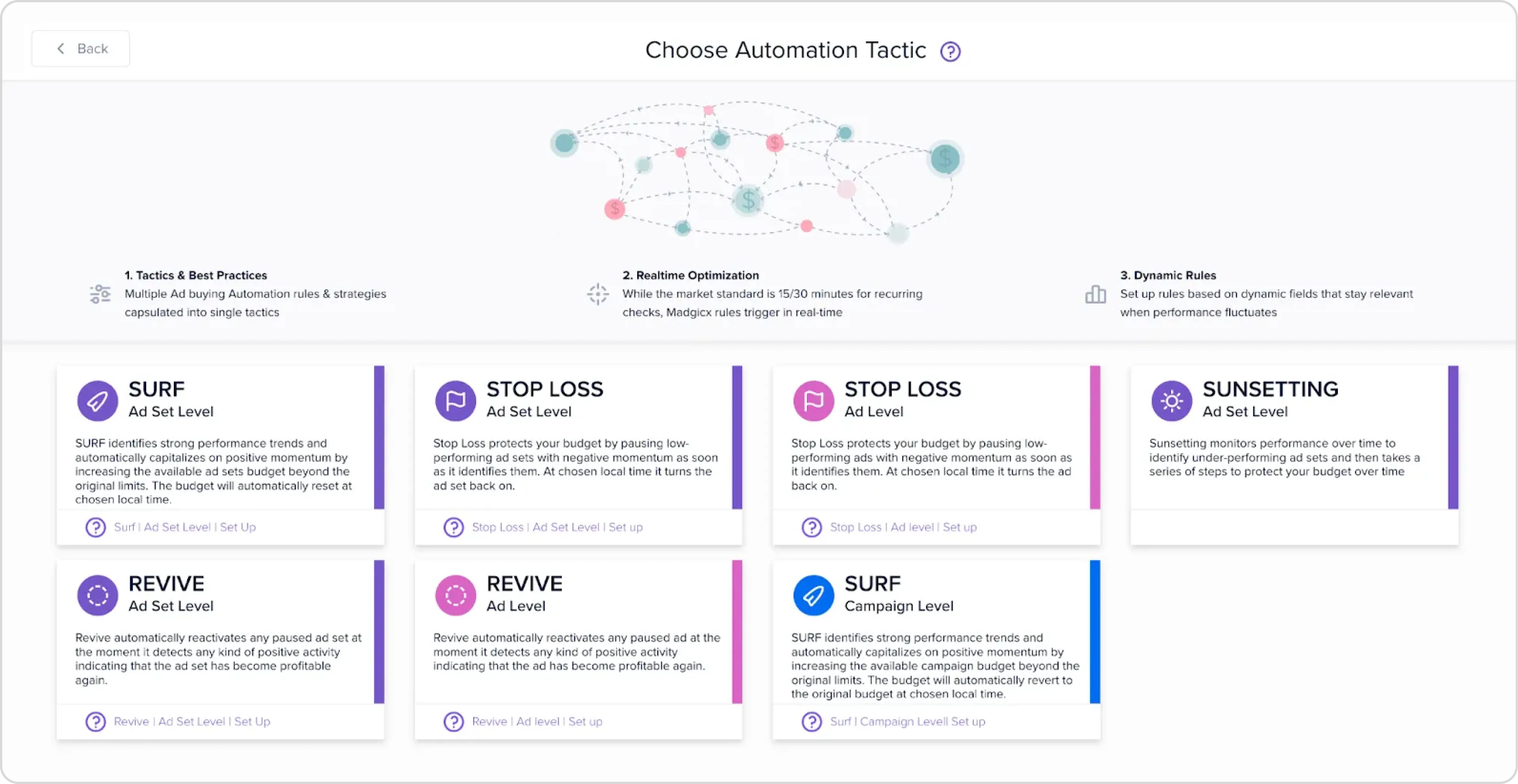
Its machine-learning models adjust budgets, manage audiences, and optimize creative delivery in real time. You define the goals and boundaries, and the platform interprets live data to determine how campaigns evolve. With continuous performance analysis, Madgicx reallocates spend toward stronger segments and fine-tunes delivery—all with minimal manual input from you.
Because all automation takes place inside Meta, the system brings together audience management, creative fatigue detection, and budget redistribution under one framework. For teams focused on Meta performance at scale, this setup streamlines execution and maintains consistency. The drawback is that it naturally offers less flexibility beyond Meta’s environment.
Choosing the right platform
The choice between Birch and Madgicx usually comes down to how your team builds and executes strategy. Both automate campaign management, but each one fits a different style of of decision-making around Meta performance.
When Birch makes the most sense
Birch is built for teams that shape their strategy around data. You ground decisions in your own analysis and internal performance signals, and you need automation to run on that same information so execution stays aligned with the logic that drives your results.
Birch automated rules
Birch gives you rule-based control that you can shape around your metrics and context. Some teams bring in external data to drive that logic. Others use Meta’s data but apply their own analytical framework. In both cases, you’re looking for decisions that update automatically based on the information your team already trusts.
Here’s what teams achieved after automating their Meta workflows in Birch.
AdParlor saved up to 52 hours a month on Meta campaign management, running more than 12,000 automation checks monthly and eliminating the weekend monitoring that slowed their workflow.
Cocosolis saved more than 100 hours a month by unifyinh automation across more than 20 ad accounts, using ROAS-based rules and custom schedules to protect profitability while scaling.
Keiki increased ad spend ten times using Birch’s purchase-based logic, reducing CPA by 16% and running three times more creative tests without adding manual work.
Loop Earplugs achieved 200% faster scaling after automating budget and bid adjustments in Birch, improving spend efficiency and extending the lifespan of high-potential ads through attribution-aware restarts.
When Madgicx fits better
Madgicx fits better when you want AI to handle most campaign decisions inside Meta.
Its AI responds to performance in real time—adjusting bids, juggling audiences, and managing fatigue so you don’t have to. Creative insights and reporting sit in the same workspace, which makes it easy for marketers to share results and keep clients moving.
Real-world examples show how that plays out:
MuteSix saw a 35% lift in ROAS and a 15% increase in CTR.
Negative Apparel doubled ROAS while growing their spend by 5 times in 4 months.
Glamcor reached a 12.7× retargeting ROAS after adding Madgicx tracking.
Strengthen your automation setup for 2026
In 2026, the best tool is the one that strengthens the setup you already run.
Birch fits growth teams that build their strategy on their own metrics and want automation to follow that structure. Madgicx suits teams that prefer an AI-led workflow inside Meta and want fast, client-ready visibility without managing deeper analytics.
Both platforms move automation forward in different ways, with Birch giving analytical teams a framework that scales as their account structure grows and keeps decisions grounded in the data they trust.
When choosing between ad automation platforms, the decision often comes down to how each one handles campaign logic. In that space, Birch vs Madgicx is one of the more common comparisons, since both take different approaches to how automation is built and managed.
Madgicx is built around AI-assisted workflows and predesigned structures, while Birch lets you automate decisions using the data and strategic logic your team actually trusts. Understanding where each tool excels makes it easier to choose a setup that matches your team’s structure, spend, and workflow.
Feature-by-feature comparison
The table below shows a simple breakdown of Birch vs Madgicx key features and differences.
Performance cycle
Workflow step
Birch
Madgicx
Launch
Creative testing
Builds structured creative tests and lets teams customize and set setups in bulk to match their testing approach
A/B testing through Ad Launcher with automated variations
Automate
Rules/optimization
Custom rules built from any metric, time window, or data source, with cross-channel triggers and multi-step logic
Automation rules supported by AI models reacting to real-time performance
Scaling behavior
Scaling tied to defined metrics across multiple platforms
Scaling guided by AI that adapts delivery within Meta
Analyze
Creative insights
Explorer evaluates Meta ads and assets using your KPIs and naming logic
Creative Matrix and Creative Insights for Meta assets
Reporting
Custom cross-channel dashboards with Slack and email delivery
Funnel dashboards with white-labeled PDF exports
Performance visibility
Unified view across Meta, Google, TikTok, and Snapchat
Meta-focused analytics with optional external data viewing
Attribution tools
Tracking & attribution
Integrates with Hyros, AppsFlyer, Wicked Reports, Signals Gateway, and Adjust
Uses Cloud Tracking for server-to-server attribution
Reach and creative control
Birch
Your team controls how automation behaves across channels.
Lets you define triggers, metrics, and conditions that drive each action.
Offers predictable performance once logic is tuned, which helps when managing multiple Meta accounts in one structure.
Madgicx
Leans on Meta’s machine learning to automate optimization.
Adjusts budgets, audiences, and creatives dynamically based on live performance data.
In practice, Birch works best for teams managing multiple Meta accounts and building automation around their own metrics. It’s built for marketers who prefer to define their logic and scale it across complex account structures instead of relying on AI to decide for them.
Birch reports
Madgicx fits teams focused solely on Meta, where its AI handles delivery, scaling, and creative testing automatically through tools like Ad Launcher and Creative Insights.
Data visibility and performance insights
Birch
Connects Meta performance data with the revenue or attribution metrics your team relies on.
Uses automation tied to your source-of-truth data, which keeps optimization transparent and measurable.
Provides deeper creative visibility through Explorer, a Meta creative performance dashboard that evaluates assets using the data your team already relies on.
Madgicx
Turns campaign data into live funnel insights that show how your audiences move from impression to purchase
Automates optimization using in-platform performance signals to adjust spend and creative instantly
Birch fits growth teams managing several Meta accounts who need unified data and flexible reporting with their existing stack. It connects with tools your team already relies on, such as Google Sheets, Hyros, AppsFlyer, Wicked Reports, Slack, and Signals Gateway, which keeps workflows integrated.
Madgicx offers visual dashboards, PDF exports, and built-in AI features, making it a practical choice for teams that prioritize fast insights and clean, client-ready reporting within one environment.
Pricing and value: how Birch and Madgicx compare
Feature
Birch
Madgicx
Free trial
14 days
7 days
Base plan name(s)
Essential, Pro, Enterprise
Madgicx Pro Complete (with AI)
Pricing structure
Spend-based model that scales with monthly ad spend (entry tier up to $10K/mo)
Spend-based model that scales with monthly ad spend (entry tier up to $2.5K/mo)
Birch offers a lower-cost entry point at $49/month for ad spend of up to $10K, while Madgicx starts at $72/month for ad spend of up to $2.5K. Both platforms use spend-based pricing that scales with ad budgets, but Birch’s tiers allow more ad spend for the same price.
User feedback and overall perception
We reviewed feedback from Capterra, Trustpilot, and G2 to see how teams rate each platform in practice.
🟢 Birch pros:
Dependable automation that reduces hands-on campaign management
Strong reporting and helpful integration with Slack for team visibility
Some long-time users mention limited creative insights for Google and Snapchat
Occasional setup friction when building complex automation or linking multiple accounts
Pricing can feel high for smaller accounts or teams with limited use cases
🟢 Madgicx pros:
Provides AI-assisted automation that improves campaign speed and ROAS
Clear visual dashboards and structured funnel reporting
Generally smooth onboarding with responsive support
Frequent feature updates and visible product iteration
🟠 Madgicx cons:
Recurring complaints of billing and cancellation issues
Occasional bugs or automation misfires
Pricing is less flexible for short-term or seasonal users
How each platform approaches automation
The real distinction between Birch and Madgicx lies in how each system makes and applies decisions. Both automate campaign management, but the method behind that automation changes how teams build, monitor, and improve performance.
Birch: data-grounded automation
Birch strategies
Birch approaches automation through logic you shape around your own data and strategy. Your rules run against the conditions and grouped logic you set, and that structure applies consistently across your Meta accounts.
This structure adds clarity in complex, multi-account setups because it reflects the way data-first teams already work. Many teams bring in metrics from their BI tools or Google Sheets, and that source-of-truth layer sits directly inside their rule logic. Each account still uses its own performance signals, but the broader framework stays aligned with how your team interprets results.
By turning your data and strategy into executable logic, Birch makes decisions scalable and traceable. Automation runs on schedule, records what it checked, and shows why actions triggered. You keep pace while staying close to the analytical reasoning behind every change. Birch AI builds on that foundation. It analyses your rule setup and ad account data to surface gaps in coverage, contradictions between rules, and patterns worth acting on. You review the suggestions and decide what to implement.
Madgicx: AI-assisted optimization within Meta
Madgicx automation tactics
Madgicx uses AI to automate and scale campaigns entirely within Meta’s ecosystem.
Its machine-learning models adjust budgets, manage audiences, and optimize creative delivery in real time. You define the goals and boundaries, and the platform interprets live data to determine how campaigns evolve. With continuous performance analysis, Madgicx reallocates spend toward stronger segments and fine-tunes delivery—all with minimal manual input from you.
Because all automation takes place inside Meta, the system brings together audience management, creative fatigue detection, and budget redistribution under one framework. For teams focused on Meta performance at scale, this setup streamlines execution and maintains consistency. The drawback is that it naturally offers less flexibility beyond Meta’s environment.
Choosing the right platform
The choice between Birch and Madgicx usually comes down to how your team builds and executes strategy. Both automate campaign management, but each one fits a different style of of decision-making around Meta performance.
When Birch makes the most sense
Birch is built for teams that shape their strategy around data. You ground decisions in your own analysis and internal performance signals, and you need automation to run on that same information so execution stays aligned with the logic that drives your results.
Birch automated rules
Birch gives you rule-based control that you can shape around your metrics and context. Some teams bring in external data to drive that logic. Others use Meta’s data but apply their own analytical framework. In both cases, you’re looking for decisions that update automatically based on the information your team already trusts.
Here’s what teams achieved after automating their Meta workflows in Birch.
AdParlor saved up to 52 hours a month on Meta campaign management, running more than 12,000 automation checks monthly and eliminating the weekend monitoring that slowed their workflow.
Cocosolis saved more than 100 hours a month by unifyinh automation across more than 20 ad accounts, using ROAS-based rules and custom schedules to protect profitability while scaling.
Keiki increased ad spend ten times using Birch’s purchase-based logic, reducing CPA by 16% and running three times more creative tests without adding manual work.
Loop Earplugs achieved 200% faster scaling after automating budget and bid adjustments in Birch, improving spend efficiency and extending the lifespan of high-potential ads through attribution-aware restarts.
When Madgicx fits better
Madgicx fits better when you want AI to handle most campaign decisions inside Meta.
Its AI responds to performance in real time—adjusting bids, juggling audiences, and managing fatigue so you don’t have to. Creative insights and reporting sit in the same workspace, which makes it easy for marketers to share results and keep clients moving.
Real-world examples show how that plays out:
MuteSix saw a 35% lift in ROAS and a 15% increase in CTR.
Negative Apparel doubled ROAS while growing their spend by 5 times in 4 months.
Glamcor reached a 12.7× retargeting ROAS after adding Madgicx tracking.
Strengthen your automation setup for 2026
In 2026, the best tool is the one that strengthens the setup you already run.
Birch fits growth teams that build their strategy on their own metrics and want automation to follow that structure. Madgicx suits teams that prefer an AI-led workflow inside Meta and want fast, client-ready visibility without managing deeper analytics.
Both platforms move automation forward in different ways, with Birch giving analytical teams a framework that scales as their account structure grows and keeps decisions grounded in the data they trust.
How does automation differ between Birch and Madgicx?
Birch uses rule-based automation powered by your own data and strategic logic. You define the triggers and actions, and they apply consistently across platforms. Madgicx blends rules with AI-led optimization that adjusts delivery and scaling inside Meta in real time.
Which tool is better for creative testing?
Both platforms handle creative testing differently. Birch handles structured tests through Launcher and gives you control over how ad sets are built. You can auto-generate one ad set per creative or customize the structure in bulk by setting the number of ad sets and applying your creatives or settings across them. Madgicx runs ongoing tests through its Ad Launcher and Creative Insights tools.
How do their analytics and reporting features compare?
Birch offers cross-platform analytics and customizable reports delivered directly to Slack and email. Explorer adds detailed Meta creative reporting with flexible ways to break down assets and compare performance. Madgicx focuses on Meta analytics through visual dashboards like Strategy Status Overview and Drilldown, with white-labeled PDF exports.
Is Birch or Madgicx more suitable for e-commerce teams?
Both are e-commerce friendly, but with different strengths. Birch ties automation to verified purchase data from the sources your strategy relies on, which keeps optimization linked to actual revenue signals. Madgicx uses Meta’s e-commerce setup and AI models to optimize toward high-intent buyers.
How do pricing models compare for Birch and Madgicx?
Both use spend-based pricing that scales with your monthly ad spend. Birch’s entry plan covers up to $10K/month starting at $49, while Madgicx starts at $72/month for up to $2.5K in spend.
What happened to Revealbot?
Revealbot has a new look and a new name—we’re now Birch! The change highlights our focus on bringing together the best of automation and creative teamwork.
Aurora Sandino
is a writer and SEO strategist focused on marketing, performance, and the digital landscape. She's a contributing writer for Birch, with a background in content strategy and client account management.