If you’re a Meta advertiser, you’ve likely dealt with low CTR at some point. Perhaps you’ve asked yourself, “What’s a good CTR for Facebook ads anyway.
A good CTR depends on factors like your industry, the audience you’re targeting, creative formats, and how often your ads have already been shown. That’s why comparing numbers to a single “ideal” benchmark can be unhelpful—you won’t always see the full picture.
CTR itself isn’t just a vanity metric. A low CTR often suggests your campaigns are falling flat due to ad fatigue, weak hooks, low-quality visuals, or off-targeting. You might see the drop right before you notice other performance metrics starting to decline.
To help you navigate this, we’ll break down how to look beyond simple CTR benchmarks and read CTR as a creative performance signal. We’ll also cover practical ways to sustain strong CTR over time and show how Bïrch can help you diagnose issues and pinpoint what to fix.
Key takeaways
- CTR is an indicator of creative health, signaling when ads are starting to lose attention before other metrics drop.
- There’s no single ideal CTR range, because it depends on the industry, target audience, and creative formats. The average click-through rate for Facebook ads for traffic campaigns across all industries is 1.71% in 2025.
- Most CTR drops are caused by creative friction—ad fatigue, weak hooks, and unclear messaging—rather than budget or delivery issues.
- Sustaining CTR over time requires systematic creative iteration, rotating hooks and formats based on performance signals.
- Bïrch Explorer makes CTR easier to diagnose by linking creative performance, fatigue, and benchmarks in one visual workflow.
CTR demystified: understanding click-through rate in depth
CTR (click-through rate) is an essential metric that measures how often people click on your ad after they see it.
Here’s the basic formula:
CTR = (clicks / impressions) × 100
For example, if 100 people see your ad (impressions) and only five click it, your CTR is 5%.
Think of it as a signal that tells you how your creative strategy is performing at the point of attention. Is your ad doing its first job—getting people to scroll and click? Or is it not quite hitting the mark?

A low CTR is usually associated with creative friction, which means people are seeing your ad, but it’s not persuading them to click.
However, there’s something important to point out here.
CTR only tells a part of the story. It doesn’t paint the full picture—so it’s best not to treat it as a final verdict on your campaign. A low CTR doesn’t automatically mean your campaign is ineffective, just like a high CTR doesn’t always equal strong conversions.
Chasing benchmarks blindly is a common mistake among advertisers. What’s considered a “good” CTR can vary widely depending on:
- Funnel stage (cold vs. warm audiences)
- Creative format
- Message complexity
- Platform placement
Watching how CTR changes at a creative level, not just at a campaign level, helps you spot ad fatigue on time and iterate faster before budget is wasted.
What is a “good” CTR? Context is everything
There’s no one-number-fits-all answer to what a good CTR is, because it varies widely by platform, industry, and creative type. CTRs look different across major social media platforms.
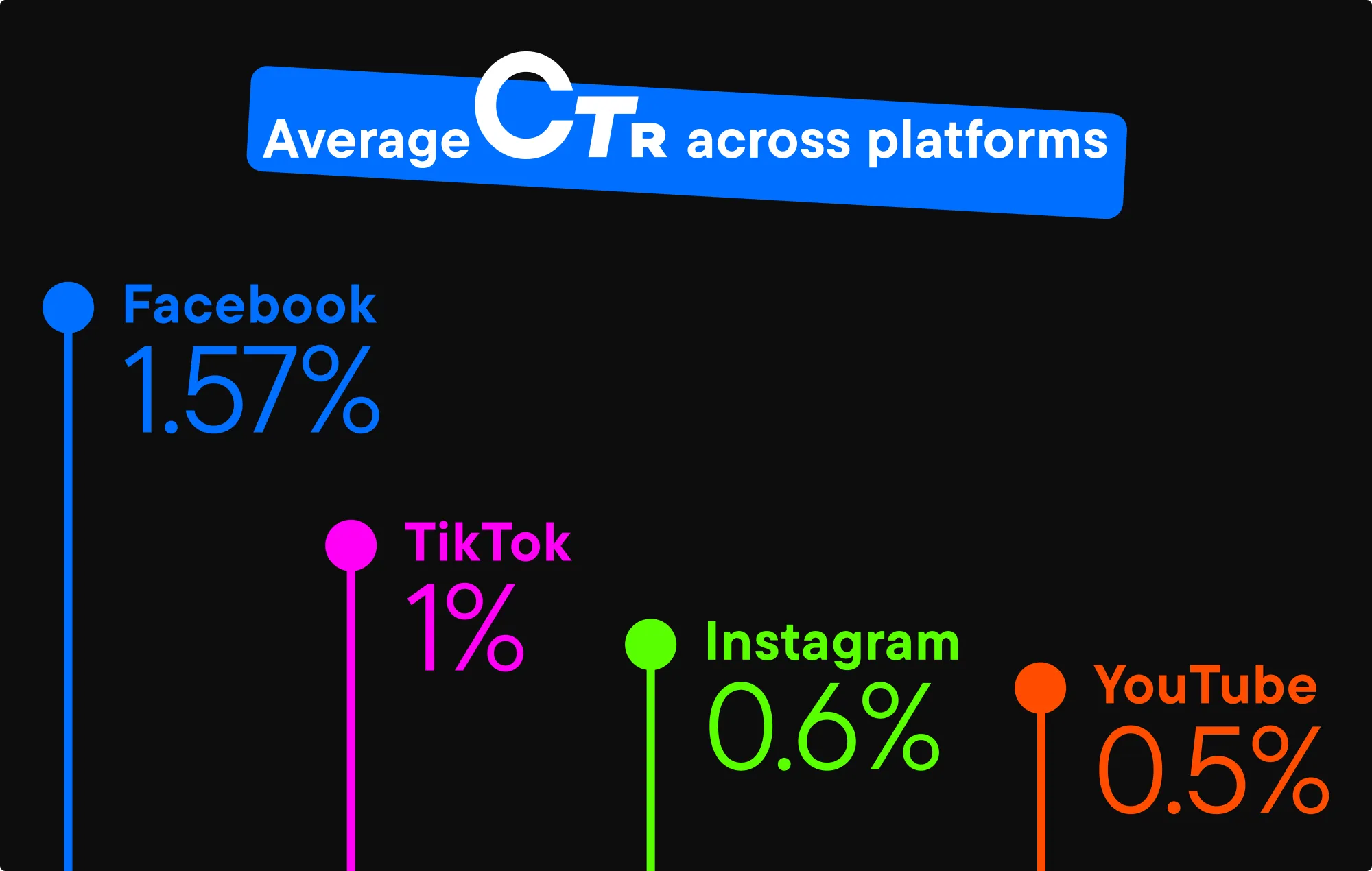
On Facebook (Meta), the average CTR sits around 1.57%, with Feed placements performing best. Facebook users are generally more open to clicking, especially when ads use UGC-style videos.
Instagram, while part of the same ecosystem, tells a slightly different story. CTRs here are usually lower—often around 0.6%, depending on placement. Reels can drive strong reach, but clicks are less consistent unless the creative feels native and fast-paced.
On TikTok, CTR typically sits just under 1%. People are more likely to continue scrolling rather than clicking on an ad.
YouTube generally sees the lowest CTRs, averaging around 0.5–0.6% for skippable video ads.
The following creative formats work best across platforms:
- UGC and creator-led ads consistently outperform polished brand creatives.
- Short-form video drives higher CTR than static formats when it feels native.
- Premium placements (like TikTok TopView or high-attention Feed placements) can deliver outsized results.
On Meta:
- Feed video remains the most reliable placement for CTR.
- Reels can underperform unless the creative feels organic.
- Creator-led Reels can jump well above average.
Industry context makes an even bigger difference. The average click-through rate in Facebook ads for traffic campaigns across all industries is 1.71%.
According to the Facebook advertising benchmarks for 2025, the three top industries with higher CTRs are shopping, collectibles, and gifts (4.13%), travel (2.76%), and sports and recreation (2.60%).
Meanwhile, the industries with the lowest CTRs were automotive-repair, services, and parts (0.80%), physicians and surgeons (0.83%), and finance and insurance (0.98%).
Purchase intent and emotional pull are what drive clicks. Industries like shopping, travel, and recreation are attractive anytime. People don’t need to be actively searching for a problem to feel tempted by a product, trip, or experience.
On the other hand, industries like automotive repair, healthcare, and finance operate very differently. Someone isn’t likely to engage with a car repair ad unless they need to, just as most people won’t click on insurance ads unless they are actively comparing options.
In these cases, high-quality visuals alone won’t significantly impact CTR.
The creative drivers that move CTR
Low CTR, in most cases, comes down to a few creative fundamentals that need a closer look.
Your hook does most of the heavy lifting. Users decide whether to keep watching or scroll past within 1–3 seconds. If nothing captures their attention, they won’t click.
Let’s look at this VSCO Facebook video ad as a reference.
The hook here is bold and instantly informative. The large on-screen text (“4 ways to get the bloom effect”) tells viewers what they will gain in the first second, while still driving curiosity to watch and learn how.

Bright kinetic text, high contrast, and fast pacing mean the message is hard to miss while scrolling.
This kind of hook works especially well for educational and product-led ads. Visual dominance helps stop the scroll and drive clicks.
After the hook, format and patterns are what keep CTR from dropping. Switching between formats—for example, using creator-style videos, raw phone footage, or motion graphics—helps your creatives feel fresh and less like ads.
This is also where messaging and audience come into play. A hook that works perfectly for a cold audience might fall flat with warm users, and vice versa. Cold audiences usually respond better to curiosity, pain points, and problem-aware messaging, while warm audiences are more likely to click when the message is clear and benefit-led.
CTR drops quickly when the message doesn’t match where your audience is in the funnel—even if the creative itself looks strong.
However, not all hooks rely on copy or video intros. Some hooks rely almost entirely on visuals—strong colors, contrast, or a clear offer—to grab attention without needing much copy.

The Dunkin’ ad is a good example. The hook here comes from bold visuals, high contrast colors, and an instantly recognizable offer. The bright pink background and large “$5 Promo Card” text grab attention right away, while the message is easy to understand at a glance.
There’s no confusion about what’s being offered or why you should click.
If creatives aren’t fresh, or they don’t resonate with your audience, ad fatigue will occur. Even strong hooks and formats lose impact when the same creative keeps showing to the same audience.
Creative testing is what ties all this together. When you test hooks, formats, and messaging variations consistently, patterns begin to show. You’ll learn which opening lines stop the scroll, which formats hold attention longer, and which creatives fatigue faster.
Diagnosing CTR drops with Bïrch Explorer
The next step is understanding why your CTR isn’t improving, and how to fix that with Bïrch Explorer.
Step 1: Analyze your creative performance metrics
Bïrch Explorer gives you a clear visual picture of how your ads are performing, so you can actually notice what’s working and what’s not.
Last Week’s Top Performing Creatives in the Top Assets report shows you the top performers of the last 7 days.
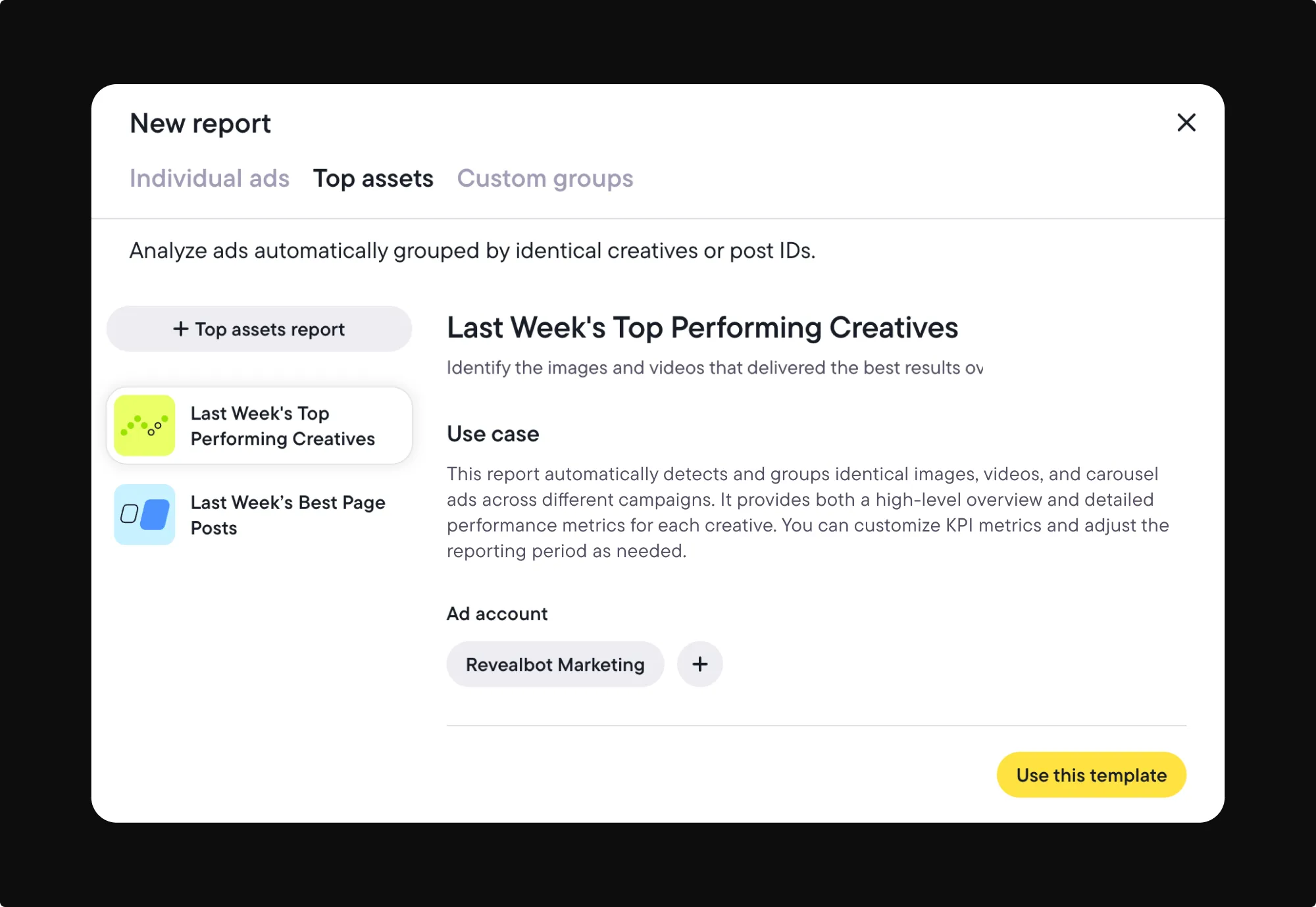
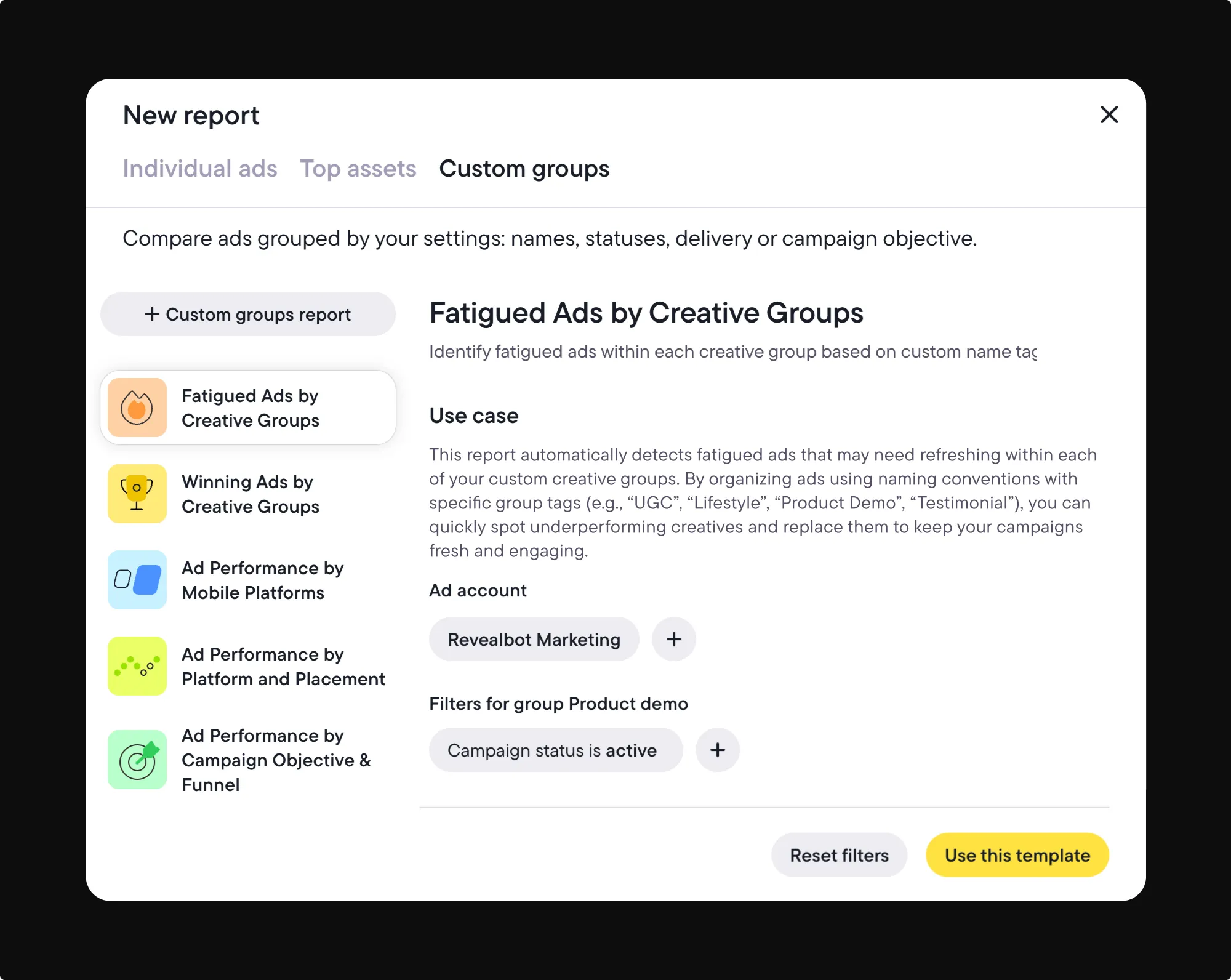
You can also find fatigue ads “on time” by switching to Fatigued Ads by Creative Groups in Custom groups.
Step 2: Identify weak hooks, formats, or messaging
Once you spot a potential issue, the next step is to find out what’s causing it.
With Explorer, creatives can be grouped by media asset, post ID, or naming conventions to see how different versions perform and compare them side-by-side. This makes it easier to identify which hooks, formats, or messaging are losing attention, compared to others.
Step 3: Benchmark against industry and platform norms
Explorer helps you benchmark creatives across industry expectations, so you can tell the difference between normal performance and genuine underperformance. A CTR that looks weak in isolation may actually be healthy for that industry or placement.
Step 4: Connect CTR issues to audience fit and fatigue
Exposure is a common reason for falling CTR. Engagement may naturally drop when the same creative keeps showing to the same audience, even if the ad initially performed well.
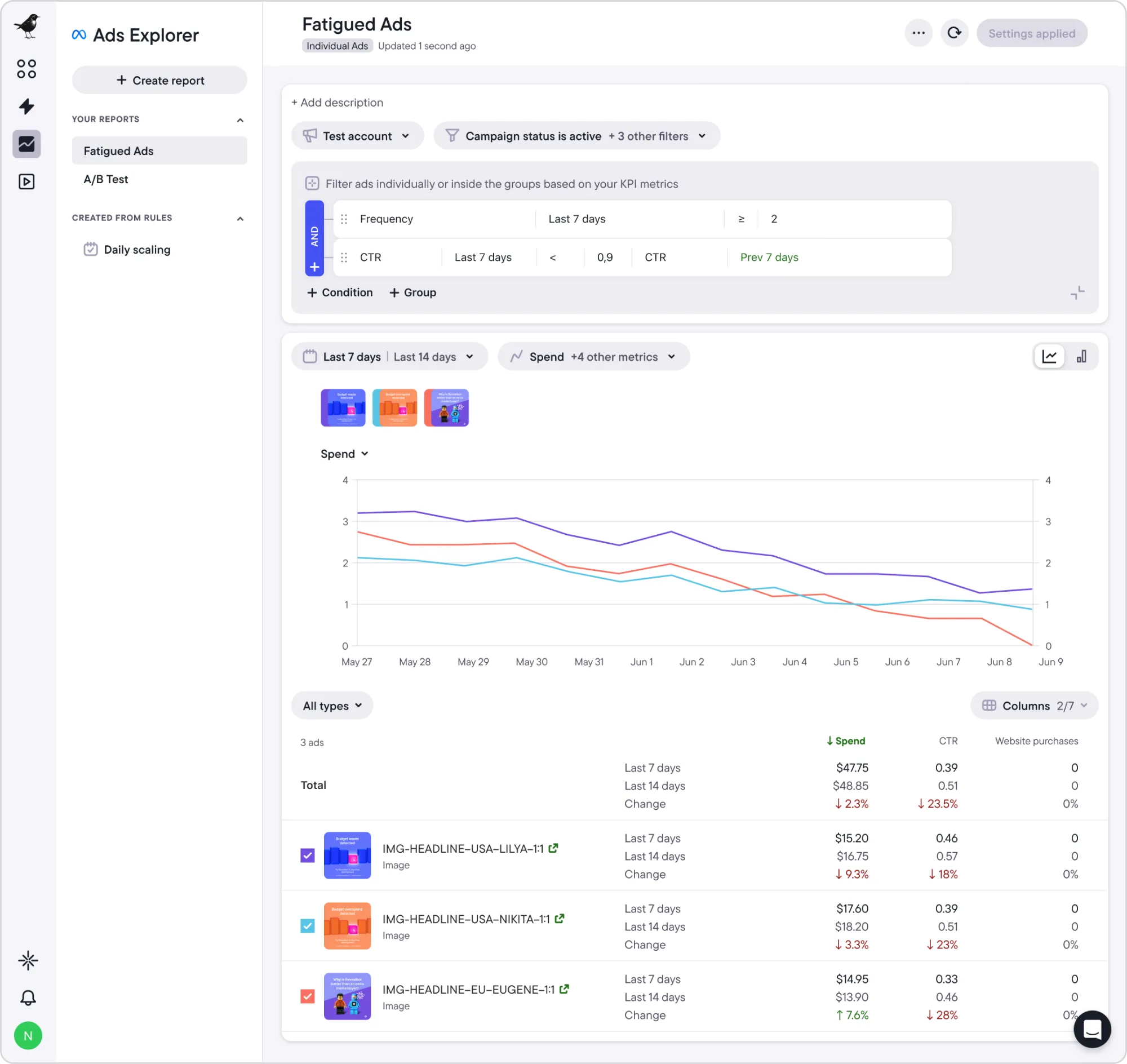
Explorer makes ad fatigue easier to spot by surfacing creatives that continue spending while CTR and downstream performance decline. This gives you an early warning to refresh, rotate, or pause ads before they drain your budget.
Fixing CTR with Bïrch: step-by-step
Now that you’ve figured out why your ads are underperforming, you have a shortlist of creatives that need attention.
You can translate the insights you get from Bïrch into high-quality, refreshed content. Use the same patterns from the ads that worked, while creating new variations and checking how CTR reacts in Explorer.
Formats and pattern interruptions often need refreshing, too. For example, if Explorer tells you static images are fatiguing faster, testing alternative formats will be a good approach—maybe short vertical videos or UGC-style content.
From there, check audience and placement fit. If a creative performs well in one segment or placement but not another, the message may be right, but the context isn’t. Explorer’s custom filters help you isolate where the drop is happening so you can adjust targeting in your ad platform or tailor new angles for specific segments.
Bïrch also helps close the loop. With custom groups, ranking conditions, and metric-based filters, you can track how refreshed variants perform against your top creatives. And if you want to automate some of the heavy lifting, rules can pause low-CTR creatives, surface fatigued assets earlier, or send alerts when performance starts slipping.
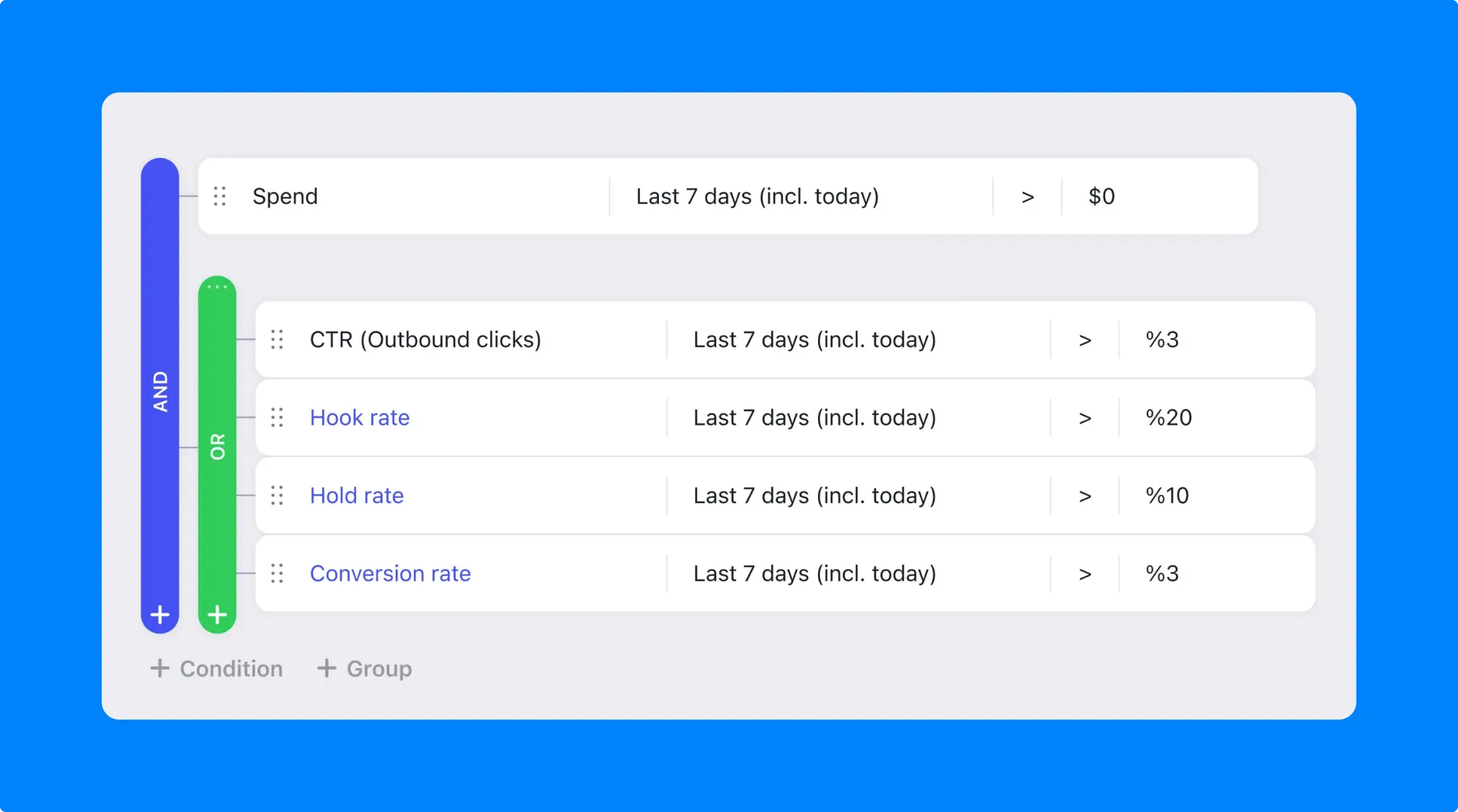
Finally, if you’re managing multiple ads and don’t have time for manual oversight, Ads Launcher and automated alerts make it easier to stay on top of new tests, track fatigue, and roll out replacements quickly.
Advanced strategies to sustain high CTR
When CTR starts to plateau or decline, these strategies help keep performance strong over time:
Run multi-format campaigns. Different users respond to different formats, and Meta’s delivery system will automatically show each person the format they’re most likely to engage with. Running a mix of video, static, and UGC-style creatives within the same campaign helps delay fatigue and maintain CTR.
Use performance patterns—not guesses—to guide new tests. Patterns often emerge when you review CTR alongside creative elements like hooks, formats, and placements.
For example:
- Certain opening lines consistently outperform on cold audiences.
- Some formats hold attention longer before fatiguing.
- Shorter, problem-led hooks often drive faster clicks than detailed explanations.
Your team can refresh creatives strategically, changing only what needs updating, based on what the data shows.
Evaluate CTR in context. A high click-through rate only matters if it supports your broader campaign goals. In some cases, a creative with a slightly lower CTR can outperform in terms of conversion rate, CPA, or revenue.
That’s why CTR is most useful when viewed alongside:
- CPC and CPM, to understand cost efficiency
- Conversion rate, to assess traffic quality
- CPA or ROAS, to measure real business impact
Measuring and iterating for continuous CTR growth
Bïrch Explorer makes it easy to monitor all your metrics, including CTR, without getting lost in endless tables and reports.
You can:
- Track CTR over time with line charts, revealing visual trends.
- Compare different metrics side by side in bar charts (for example, CTR vs. CPC vs. spend per creative).
- Filter campaigns, ad sets, and ads by the KPIs you actually care about using metric conditions.
This makes it easier to answer simple but important questions, like:
- “Did CTR drop after we increased the budget?”
- “Which creatives held their CTR the longest?”
- “Are some placements quietly dragging our CTR down?”
A/B testing is also useful when you want to validate specific creative elements. Change just one thing at a time—the hook, the first frame, the headline, or the format—and compare performance. Over time, this gives you a library of patterns your brand can rely on.
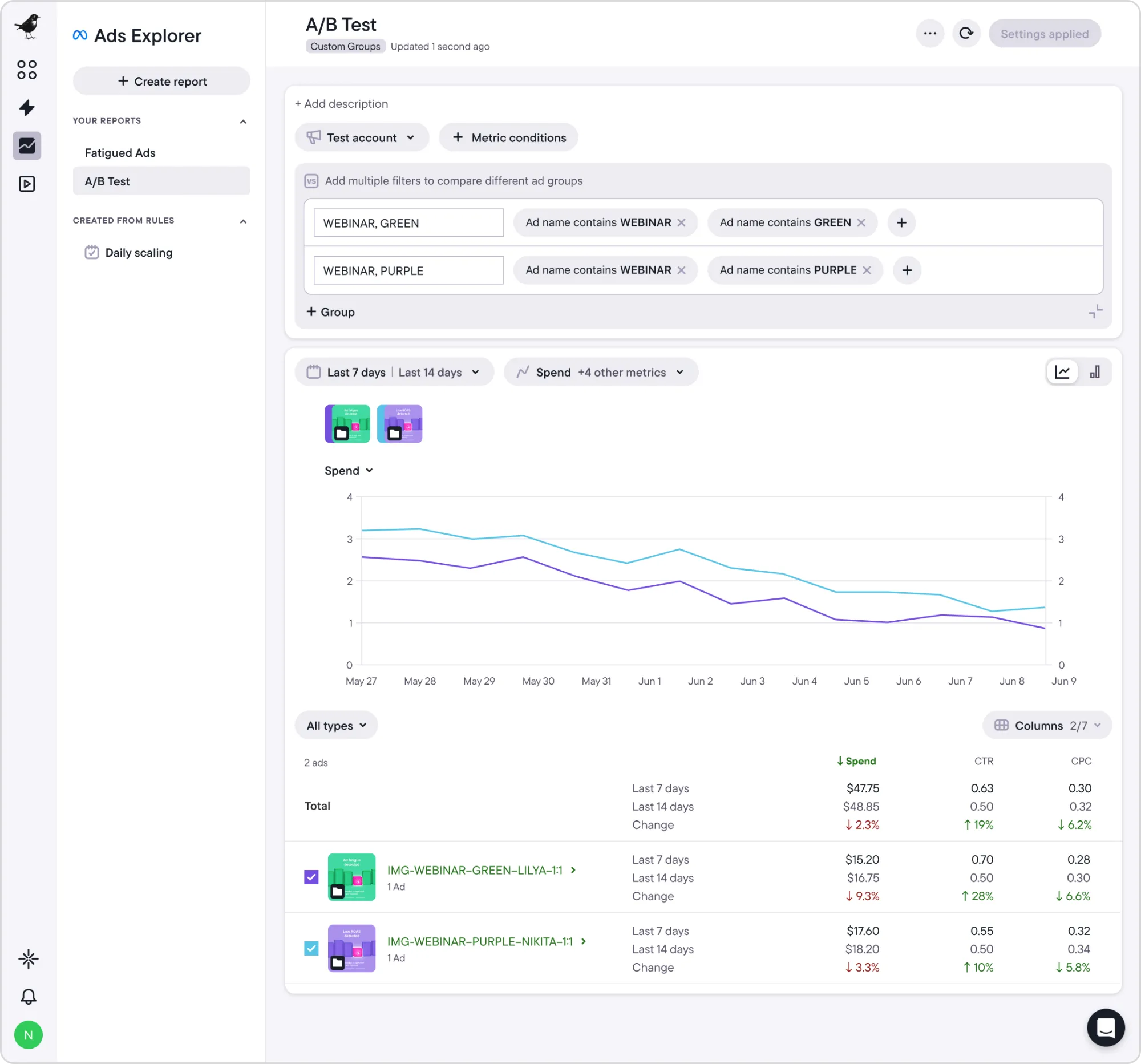
Through the Compare Creative Variations template, you can group ads by naming conventions or creative concepts (for example, different messaging angles, different hooks) and compare their performance side by side. When a variation continues spending, but its CTR trends downward, it’s a signal that fatigue is setting in.
However, CTR is never a perfectly straight line. Small ups and downs are normal, especially when budgets shift or new audiences are added.
What you’re looking for are meaningful changes, such as:
- A steady decline in CTR on a single creative—usually a sign of fatigue.
- A sudden drop right after a change in messaging or targeting—possible mismatch.
- A jump in CTR when you introduce a new hook or format—something worth scaling.
Mastering CTR as a creative metric
CTR is one of the quickest ways to understand if your ads are resonating with your audience. When it drops, it usually means fatigue, weak hooks, or misaligned messaging long before your CPA or ROAS start to slip.
The teams that improve fastest are those that treat CTR as a creative performance indicator—not a standalone metric. They read the pattern behind it. A dip tells them audience fit is weakening, fatigue is setting in, or a new angle is needed. With CTR as part of a broader creative feedback loop, you can iterate faster, spot issues earlier, and protect downstream metrics before they slip.
Bïrch Explorer gives you the visibility to do that. It shows how each creative behaves over time, surfaces fatigue early, and helps you compare variants side by side so you know exactly what to refresh, rotate, or scale. Paired with a consistent testing loop, CTR becomes predictable, actionable, and far easier to manage at scale.
FAQs
If you’re a Meta advertiser, you’ve likely dealt with low CTR at some point. Perhaps you’ve asked yourself, “What’s a good CTR for Facebook ads anyway.
A good CTR depends on factors like your industry, the audience you’re targeting, creative formats, and how often your ads have already been shown. That’s why comparing numbers to a single “ideal” benchmark can be unhelpful—you won’t always see the full picture.
CTR itself isn’t just a vanity metric. A low CTR often suggests your campaigns are falling flat due to ad fatigue, weak hooks, low-quality visuals, or off-targeting. You might see the drop right before you notice other performance metrics starting to decline.
To help you navigate this, we’ll break down how to look beyond simple CTR benchmarks and read CTR as a creative performance signal. We’ll also cover practical ways to sustain strong CTR over time and show how Bïrch can help you diagnose issues and pinpoint what to fix.
Key takeaways
- CTR is an indicator of creative health, signaling when ads are starting to lose attention before other metrics drop.
- There’s no single ideal CTR range, because it depends on the industry, target audience, and creative formats. The average click-through rate for Facebook ads for traffic campaigns across all industries is 1.71% in 2025.
- Most CTR drops are caused by creative friction—ad fatigue, weak hooks, and unclear messaging—rather than budget or delivery issues.
- Sustaining CTR over time requires systematic creative iteration, rotating hooks and formats based on performance signals.
- Bïrch Explorer makes CTR easier to diagnose by linking creative performance, fatigue, and benchmarks in one visual workflow.
CTR demystified: understanding click-through rate in depth
CTR (click-through rate) is an essential metric that measures how often people click on your ad after they see it.
Here’s the basic formula:
CTR = (clicks / impressions) × 100
For example, if 100 people see your ad (impressions) and only five click it, your CTR is 5%.
Think of it as a signal that tells you how your creative strategy is performing at the point of attention. Is your ad doing its first job—getting people to scroll and click? Or is it not quite hitting the mark?

A low CTR is usually associated with creative friction, which means people are seeing your ad, but it’s not persuading them to click.
However, there’s something important to point out here.
CTR only tells a part of the story. It doesn’t paint the full picture—so it’s best not to treat it as a final verdict on your campaign. A low CTR doesn’t automatically mean your campaign is ineffective, just like a high CTR doesn’t always equal strong conversions.
Chasing benchmarks blindly is a common mistake among advertisers. What’s considered a “good” CTR can vary widely depending on:
- Funnel stage (cold vs. warm audiences)
- Creative format
- Message complexity
- Platform placement
Watching how CTR changes at a creative level, not just at a campaign level, helps you spot ad fatigue on time and iterate faster before budget is wasted.
What is a “good” CTR? Context is everything
There’s no one-number-fits-all answer to what a good CTR is, because it varies widely by platform, industry, and creative type. CTRs look different across major social media platforms.

On Facebook (Meta), the average CTR sits around 1.57%, with Feed placements performing best. Facebook users are generally more open to clicking, especially when ads use UGC-style videos.
Instagram, while part of the same ecosystem, tells a slightly different story. CTRs here are usually lower—often around 0.6%, depending on placement. Reels can drive strong reach, but clicks are less consistent unless the creative feels native and fast-paced.
On TikTok, CTR typically sits just under 1%. People are more likely to continue scrolling rather than clicking on an ad.
YouTube generally sees the lowest CTRs, averaging around 0.5–0.6% for skippable video ads.
The following creative formats work best across platforms:
- UGC and creator-led ads consistently outperform polished brand creatives.
- Short-form video drives higher CTR than static formats when it feels native.
- Premium placements (like TikTok TopView or high-attention Feed placements) can deliver outsized results.
On Meta:
- Feed video remains the most reliable placement for CTR.
- Reels can underperform unless the creative feels organic.
- Creator-led Reels can jump well above average.
Industry context makes an even bigger difference. The average click-through rate in Facebook ads for traffic campaigns across all industries is 1.71%.
According to the Facebook advertising benchmarks for 2025, the three top industries with higher CTRs are shopping, collectibles, and gifts (4.13%), travel (2.76%), and sports and recreation (2.60%).
Meanwhile, the industries with the lowest CTRs were automotive-repair, services, and parts (0.80%), physicians and surgeons (0.83%), and finance and insurance (0.98%).
Purchase intent and emotional pull are what drive clicks. Industries like shopping, travel, and recreation are attractive anytime. People don’t need to be actively searching for a problem to feel tempted by a product, trip, or experience.
On the other hand, industries like automotive repair, healthcare, and finance operate very differently. Someone isn’t likely to engage with a car repair ad unless they need to, just as most people won’t click on insurance ads unless they are actively comparing options.
In these cases, high-quality visuals alone won’t significantly impact CTR.
The creative drivers that move CTR
Low CTR, in most cases, comes down to a few creative fundamentals that need a closer look.
Your hook does most of the heavy lifting. Users decide whether to keep watching or scroll past within 1–3 seconds. If nothing captures their attention, they won’t click.
Let’s look at this VSCO Facebook video ad as a reference.
The hook here is bold and instantly informative. The large on-screen text (“4 ways to get the bloom effect”) tells viewers what they will gain in the first second, while still driving curiosity to watch and learn how.

Bright kinetic text, high contrast, and fast pacing mean the message is hard to miss while scrolling.
This kind of hook works especially well for educational and product-led ads. Visual dominance helps stop the scroll and drive clicks.
After the hook, format and patterns are what keep CTR from dropping. Switching between formats—for example, using creator-style videos, raw phone footage, or motion graphics—helps your creatives feel fresh and less like ads.
This is also where messaging and audience come into play. A hook that works perfectly for a cold audience might fall flat with warm users, and vice versa. Cold audiences usually respond better to curiosity, pain points, and problem-aware messaging, while warm audiences are more likely to click when the message is clear and benefit-led.
CTR drops quickly when the message doesn’t match where your audience is in the funnel—even if the creative itself looks strong.
However, not all hooks rely on copy or video intros. Some hooks rely almost entirely on visuals—strong colors, contrast, or a clear offer—to grab attention without needing much copy.

The Dunkin’ ad is a good example. The hook here comes from bold visuals, high contrast colors, and an instantly recognizable offer. The bright pink background and large “$5 Promo Card” text grab attention right away, while the message is easy to understand at a glance.
There’s no confusion about what’s being offered or why you should click.
If creatives aren’t fresh, or they don’t resonate with your audience, ad fatigue will occur. Even strong hooks and formats lose impact when the same creative keeps showing to the same audience.
Creative testing is what ties all this together. When you test hooks, formats, and messaging variations consistently, patterns begin to show. You’ll learn which opening lines stop the scroll, which formats hold attention longer, and which creatives fatigue faster.
Diagnosing CTR drops with Bïrch Explorer
The next step is understanding why your CTR isn’t improving, and how to fix that with Bïrch Explorer.
Step 1: Analyze your creative performance metrics
Bïrch Explorer gives you a clear visual picture of how your ads are performing, so you can actually notice what’s working and what’s not.
Last Week’s Top Performing Creatives in the Top Assets report shows you the top performers of the last 7 days.

You can also find fatigue ads “on time” by switching to Fatigued Ads by Creative Groups in Custom groups.

Step 2: Identify weak hooks, formats, or messaging
Once you spot a potential issue, the next step is to find out what’s causing it.
With Explorer, creatives can be grouped by media asset, post ID, or naming conventions to see how different versions perform and compare them side-by-side. This makes it easier to identify which hooks, formats, or messaging are losing attention, compared to others.
Step 3: Benchmark against industry and platform norms
Explorer helps you benchmark creatives across industry expectations, so you can tell the difference between normal performance and genuine underperformance. A CTR that looks weak in isolation may actually be healthy for that industry or placement.
Step 4: Connect CTR issues to audience fit and fatigue
Exposure is a common reason for falling CTR. Engagement may naturally drop when the same creative keeps showing to the same audience, even if the ad initially performed well.

Explorer makes ad fatigue easier to spot by surfacing creatives that continue spending while CTR and downstream performance decline. This gives you an early warning to refresh, rotate, or pause ads before they drain your budget.
Fixing CTR with Bïrch: step-by-step
Now that you’ve figured out why your ads are underperforming, you have a shortlist of creatives that need attention.
You can translate the insights you get from Bïrch into high-quality, refreshed content. Use the same patterns from the ads that worked, while creating new variations and checking how CTR reacts in Explorer.
Formats and pattern interruptions often need refreshing, too. For example, if Explorer tells you static images are fatiguing faster, testing alternative formats will be a good approach—maybe short vertical videos or UGC-style content.
From there, check audience and placement fit. If a creative performs well in one segment or placement but not another, the message may be right, but the context isn’t. Explorer’s custom filters help you isolate where the drop is happening so you can adjust targeting in your ad platform or tailor new angles for specific segments.
Bïrch also helps close the loop. With custom groups, ranking conditions, and metric-based filters, you can track how refreshed variants perform against your top creatives. And if you want to automate some of the heavy lifting, rules can pause low-CTR creatives, surface fatigued assets earlier, or send alerts when performance starts slipping.

Finally, if you’re managing multiple ads and don’t have time for manual oversight, Ads Launcher and automated alerts make it easier to stay on top of new tests, track fatigue, and roll out replacements quickly.
Advanced strategies to sustain high CTR
When CTR starts to plateau or decline, these strategies help keep performance strong over time:
Run multi-format campaigns. Different users respond to different formats, and Meta’s delivery system will automatically show each person the format they’re most likely to engage with. Running a mix of video, static, and UGC-style creatives within the same campaign helps delay fatigue and maintain CTR.
Use performance patterns—not guesses—to guide new tests. Patterns often emerge when you review CTR alongside creative elements like hooks, formats, and placements.
For example:
- Certain opening lines consistently outperform on cold audiences.
- Some formats hold attention longer before fatiguing.
- Shorter, problem-led hooks often drive faster clicks than detailed explanations.
Your team can refresh creatives strategically, changing only what needs updating, based on what the data shows.
Evaluate CTR in context. A high click-through rate only matters if it supports your broader campaign goals. In some cases, a creative with a slightly lower CTR can outperform in terms of conversion rate, CPA, or revenue.
That’s why CTR is most useful when viewed alongside:
- CPC and CPM, to understand cost efficiency
- Conversion rate, to assess traffic quality
- CPA or ROAS, to measure real business impact
Measuring and iterating for continuous CTR growth
Bïrch Explorer makes it easy to monitor all your metrics, including CTR, without getting lost in endless tables and reports.
You can:
- Track CTR over time with line charts, revealing visual trends.
- Compare different metrics side by side in bar charts (for example, CTR vs. CPC vs. spend per creative).
- Filter campaigns, ad sets, and ads by the KPIs you actually care about using metric conditions.
This makes it easier to answer simple but important questions, like:
- “Did CTR drop after we increased the budget?”
- “Which creatives held their CTR the longest?”
- “Are some placements quietly dragging our CTR down?”
A/B testing is also useful when you want to validate specific creative elements. Change just one thing at a time—the hook, the first frame, the headline, or the format—and compare performance. Over time, this gives you a library of patterns your brand can rely on.

Through the Compare Creative Variations template, you can group ads by naming conventions or creative concepts (for example, different messaging angles, different hooks) and compare their performance side by side. When a variation continues spending, but its CTR trends downward, it’s a signal that fatigue is setting in.
However, CTR is never a perfectly straight line. Small ups and downs are normal, especially when budgets shift or new audiences are added.
What you’re looking for are meaningful changes, such as:
- A steady decline in CTR on a single creative—usually a sign of fatigue.
- A sudden drop right after a change in messaging or targeting—possible mismatch.
- A jump in CTR when you introduce a new hook or format—something worth scaling.
Mastering CTR as a creative metric
CTR is one of the quickest ways to understand if your ads are resonating with your audience. When it drops, it usually means fatigue, weak hooks, or misaligned messaging long before your CPA or ROAS start to slip.
The teams that improve fastest are those that treat CTR as a creative performance indicator—not a standalone metric. They read the pattern behind it. A dip tells them audience fit is weakening, fatigue is setting in, or a new angle is needed. With CTR as part of a broader creative feedback loop, you can iterate faster, spot issues earlier, and protect downstream metrics before they slip.
Bïrch Explorer gives you the visibility to do that. It shows how each creative behaves over time, surfaces fatigue early, and helps you compare variants side by side so you know exactly what to refresh, rotate, or scale. Paired with a consistent testing loop, CTR becomes predictable, actionable, and far easier to manage at scale.
FAQs
A good CTR for Facebook ads typically falls around 1.57% for traffic campaigns. However, this depends on the industry, audience, placement, and creative format. Feed placements and UGC-style videos perform better, while highly competitive or high-consideration industries may see lower average.
YouTube CTRs are usually lower than on social platforms. For skippable video ads, a CTR of 0.5–0.6% is considered healthy.
This depends on the network. For Google Search ads, a good CTR is often 3–5%, especially for branded or high-intent keywords. For Google Display ads, CTRs are much lower, often 0.5–1%.
On TikTok, CTR is typically under 1% for most campaigns. Some formats, like creator-style content, can push CTR higher—but clicks are less common compared to Meta.
There’s no universal benchmark. A “good” click-through rate depends on a few factors. However, the best way to judge CTR is to compare it against your platform and industry average—not a single global number.
Revealbot has a new look and a new name—we’re now Bïrch! The change highlights our focus on bringing together the best of automation and creative teamwork.