It’s easy to let advertising schedules dictate the flow of your day. The advertising ecosystem does not sleep, and this can force us, as media buyers, to feel the need to be always on.
This is especially true if you are managing high-spend accounts or targeting audiences across multiple time zones.
Domantė Janulytė, a media buyer at growth agency Nothink, knows this struggle intimately. Before integrating automation into her ad management workflows, her team’s approach was highly manual, requiring constant monitoring that inevitably bled into her evenings and weekends.
By building a structured automation playbook in Birch, she automated her daily hygiene tasks, built a financial safety net for out-of-hours, and created systems to instantly scale ad winning ads.
The result? She saves hours every week and no longer spends her Saturdays glued to Meta Ads Manager. In this article we share the specific workflows she uses to protect her budget and reclaim her time.
Key Takeaways
Reclaim your weekends with automated hygiene. Stop spending your Saturdays combing through ad-level data. Implementing automated rules to evaluate the previous week’s performance allows Birch to systematically pause underperforming creatives before you even open your laptop.
Create a round-the-clock safety net for global campaigns. Managing campaigns across massive time zone differences shouldn't mean sacrificing sleep. Deploying automated budget-decrease rules based on target CPA and campaign spend thresholds creates a reliable out-of-hours financial guardrail.
Capitalize on winning creatives instantly. Creative windows of opportunity are short and require rapid reactions. Use automated vertical scaling to lift budgets on consolidated accounts, or horizontal scaling to instantly increase budgets when same-day creative tests flash a strong early conversion signal.
Build trust safely using the keyword method. Handing over financial control to an automated machine can be nerve-wracking. Safely test aggressive scaling rules by restricting them to a single campaign using a specific naming convention keyword before scaling.
Invest in the ROI of human performance. The ultimate return on ad automation is recovered mental space. Reducing your weekly manual workload means your ad accounts can scale up while your team winds down.
Automating the “morning hygiene” routine
One of the most time-consuming aspects of ad management is the daily account sweep. Logging in to evaluate the previous day's performance, combing through ad-level data to manually decide the best ways to reduce wasted ad spend and scale top performing ads.
Domantė, like most marketers, struggled with this exact bottleneck every single day. The manual workload was actively taking time away from higher-leverage strategic work and limiting the flexibility of her schedule.
“Before [using Birch], it was more manual. We optimize at ads level and it takes 20 minutes for each campaign. You need time to really double check if ads are worth turning on, off, increasing or reducing budget.”
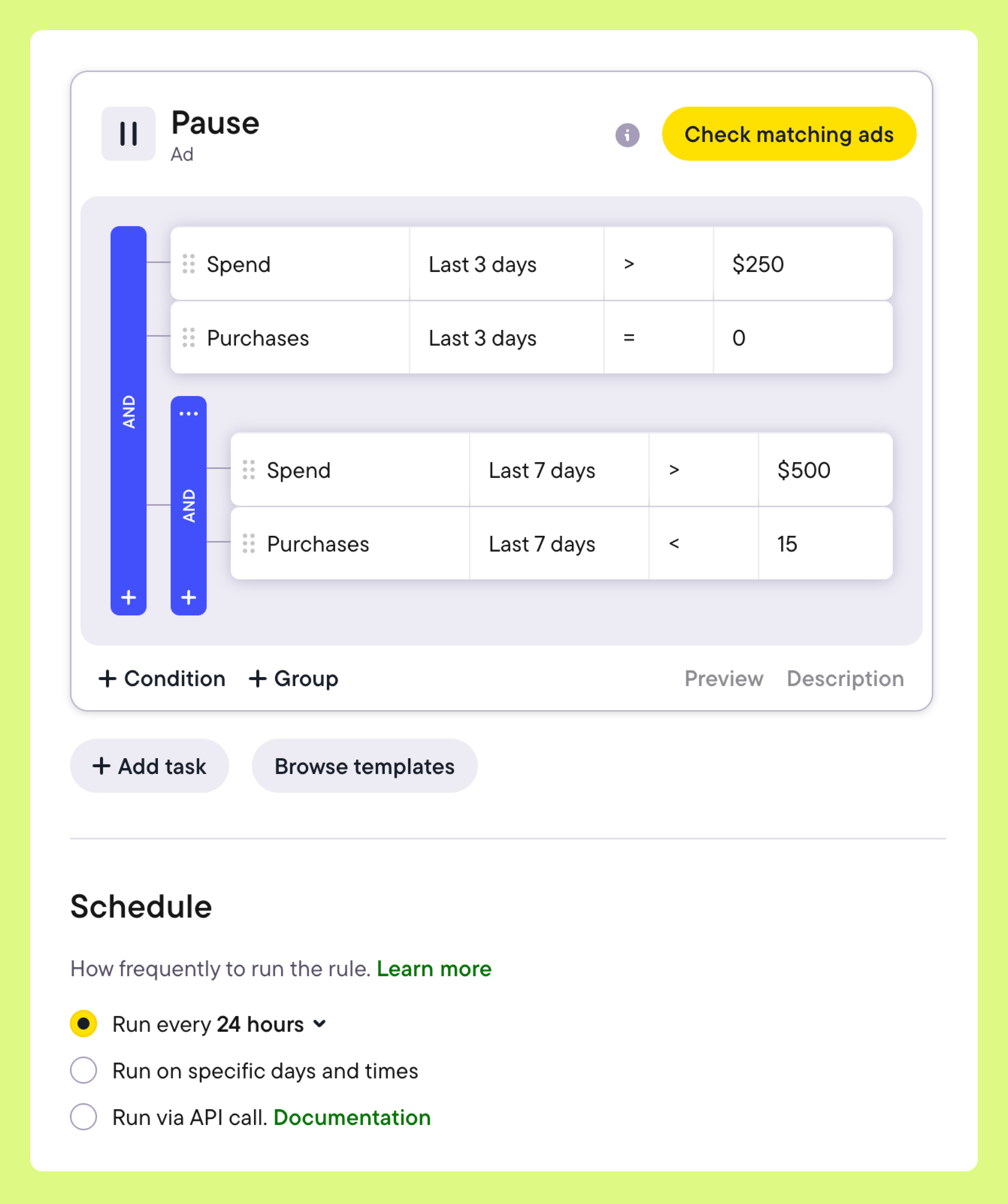
To solve this, she implemented a set of Birch rules to automatically evaluate performance based on the last three and seven days of data. This simple hygiene rule handles the morning cleanup before she even opens her laptop, evaluating the metrics and pausing underperformers systematically.
The real value of this automation is not just in the paused ads, but in the time reallocated to work that actually moves the needle for the business.
“Even those 20 minutes a day, it gives me time to do other more important things. I can sit and think about funnel strategy, I can tweak ads and work more closely with our creative team. That's been a great help.”
The night shift
Managing global campaigns presents a unique set of challenges. For Domantė and her team based in Europe, managing campaigns targeted at the United States meant dealing with an eight-hour time difference.
Without automation, peak conversion hours happen while the team is asleep. This leaves media buyers with a difficult choice: sacrifice sleep to optimize performance, miss out on peak performance windows, or risk waking up to unprofitable overspend.
“Our target audience is in the U.S., so for us, it's very important to optimize for the peak activities in those time zones. Because we work in a different time zone, like eight hours different, [without automation] it would require us to potentially miss out on being able to make optimization improvements at the right times.”
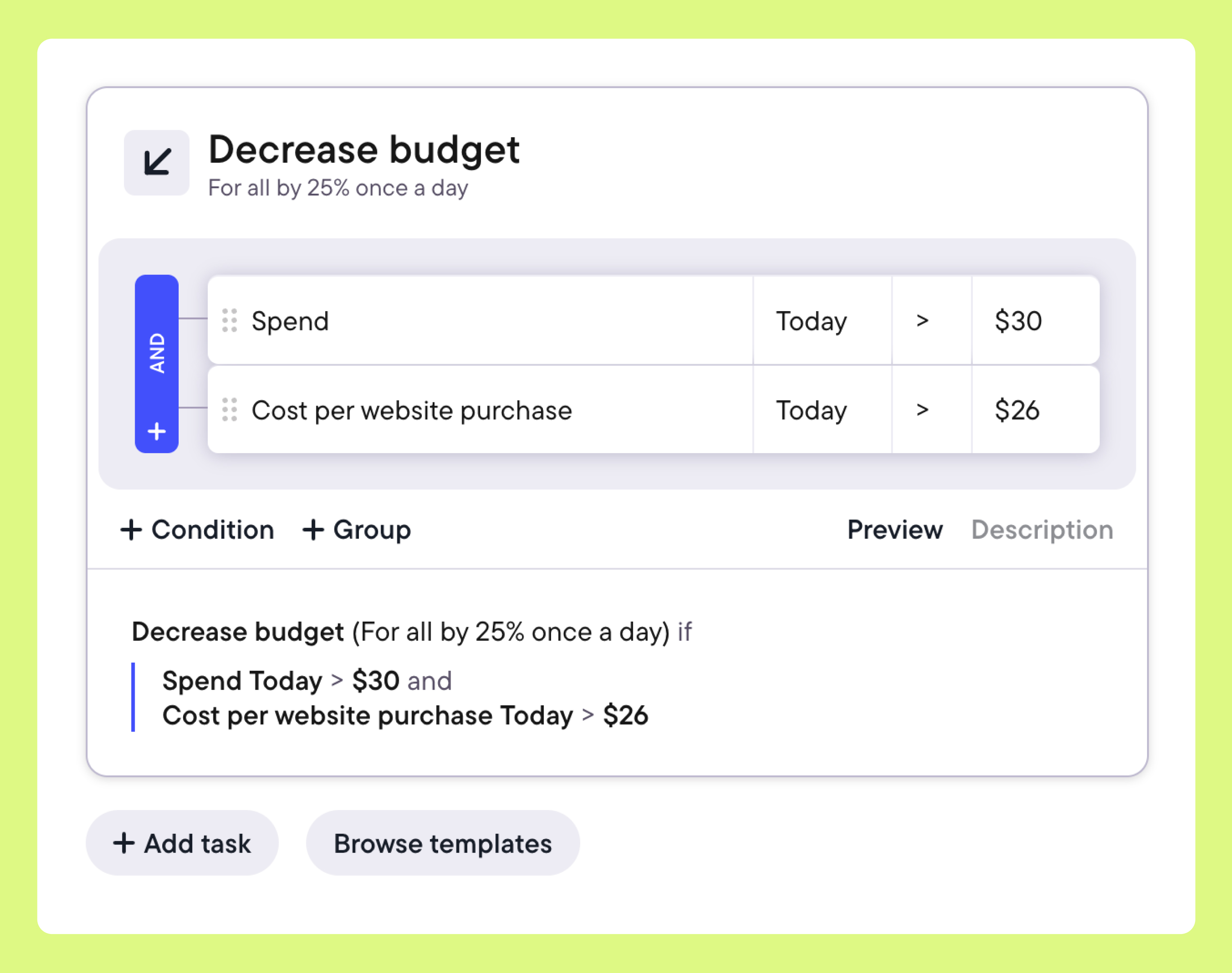
To navigate this, her team implemented strict budget decrease rules that run through the night in Europe. These rules use a percentage of the target CPA plus the proportion of total campaign spend in combination as a performance guardrail.
This creates a reliable bidding safety net that monitors the account while the team rests.
“For now our main concern was overspending on things that don't perform. So we are really focusing our rules to help us reduce potential overspend on underperforming ads. For us, it's been a great help to take off that manual labor part of the job, and also manage our account during the night.”
Scaling what works (without being glued to the screen)
Effective ad automation is not just about playing defense and pausing underperformers. It is equally about playing offense and capitalizing on winning ads. The window of opportunity to scale a high-performing creative can be short, requiring fast reactions.
“If a campaign is performing really well, we need to ensure we have the opportunity to capitalize on this during the day. The rules we’ve configured allow us to quickly push certain ads once they’re performing well, so it really increases our reaction speed.”
Domantė’s team manages two distinct account structures, and they use different rule setups for each. For their consolidated accounts, they rely purely on vertical scaling, adjusting budgets upward on existing ad sets that are performing well.
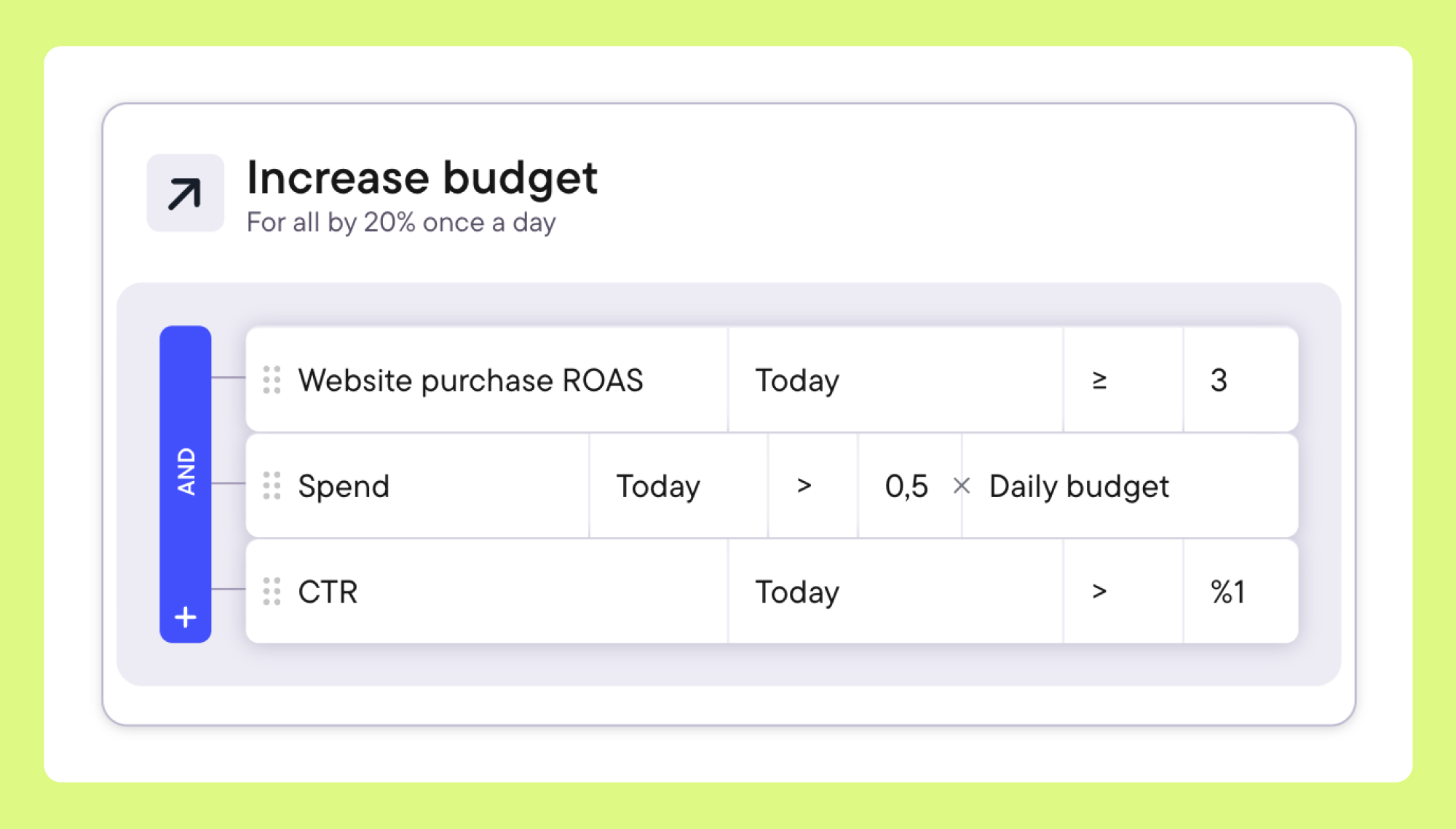
However, for accounts utilizing a same-day testing setup, they deploy horizontal scaling. They use a classic creative test scaling approach, so that when a new ad shows a strong early conversion signal, the automated rules take action.
“One sale, you immediately double the budget or triple or so on. The rules can step in and ensure we do not miss important opportunities to scale. Even if we’re offline during the night.”
How to trust the machine
It is completely normal to feel hesitant about handing over control to an automated system. Trusting anything automated to manage your ad budget, especially with rules designed to aggressively scale spend, can be nerve-wracking for seasoned advertisers who are used to manual control.
Domantė recognized this friction when setting up new workflows.
“The main challenge in executing automated systems is that at first, you're not sure how much you can trust the automated rules. You don't want to leave these systems unattended because you worry about the negative impact.”
To test new automations safely, she developed a low-risk framework using a special keyword method. By adding a specific keyword to both the Birch rule and the Meta Ads Manager naming convention, she restricts new, unproven scaling rules to a single campaign. This restricts brand-new rules from doing anything unexpected during its first few days.
Once the rule has run, she relies heavily on log verification to build trust.
“What works super well is checking the logs. So I still regularly check the logs to see what’s happening at a high level and make sure everything looks as expected.”
Regularly checking the logs provides the necessary transparency to confirm the logic is sound before rolling the rules out to the broader account.
The ROI of time
By establishing these hygiene, scaling, and safety-net workflows, Nothink has significantly improved their CPA efficiency. Ads that hit a 30% higher CPA are automatically paused, eliminating wasted budget and keeping their baseline profitable.
But perhaps the most valuable return on investment is the mental space and time recovered. You don't need to spend your entire weekend checking, refreshing, and double-checking your campaigns.
“I would definitely say at least every week, [we save] like three, four hours maybe. This also includes weekends. On weekends, I can leave the account and only log in maybe once. Which is huge. Reducing time checking ad accounts on weekends has been a massive help.”
With the right structures in place, ad automations can not only help improve marketing performance, but they can help human performance by ensuring your ads can still scale up while you wind down.
It’s easy to let advertising schedules dictate the flow of your day. The advertising ecosystem does not sleep, and this can force us, as media buyers, to feel the need to be always on.
This is especially true if you are managing high-spend accounts or targeting audiences across multiple time zones.
Domantė Janulytė, a media buyer at growth agency Nothink, knows this struggle intimately. Before integrating automation into her ad management workflows, her team’s approach was highly manual, requiring constant monitoring that inevitably bled into her evenings and weekends.
By building a structured automation playbook in Birch, she automated her daily hygiene tasks, built a financial safety net for out-of-hours, and created systems to instantly scale ad winning ads.
The result? She saves hours every week and no longer spends her Saturdays glued to Meta Ads Manager. In this article we share the specific workflows she uses to protect her budget and reclaim her time.
Key Takeaways
Reclaim your weekends with automated hygiene. Stop spending your Saturdays combing through ad-level data. Implementing automated rules to evaluate the previous week’s performance allows Birch to systematically pause underperforming creatives before you even open your laptop.
Create a round-the-clock safety net for global campaigns. Managing campaigns across massive time zone differences shouldn't mean sacrificing sleep. Deploying automated budget-decrease rules based on target CPA and campaign spend thresholds creates a reliable out-of-hours financial guardrail.
Capitalize on winning creatives instantly. Creative windows of opportunity are short and require rapid reactions. Use automated vertical scaling to lift budgets on consolidated accounts, or horizontal scaling to instantly increase budgets when same-day creative tests flash a strong early conversion signal.
Build trust safely using the keyword method. Handing over financial control to an automated machine can be nerve-wracking. Safely test aggressive scaling rules by restricting them to a single campaign using a specific naming convention keyword before scaling.
Invest in the ROI of human performance. The ultimate return on ad automation is recovered mental space. Reducing your weekly manual workload means your ad accounts can scale up while your team winds down.
Automating the “morning hygiene” routine
One of the most time-consuming aspects of ad management is the daily account sweep. Logging in to evaluate the previous day's performance, combing through ad-level data to manually decide the best ways to reduce wasted ad spend and scale top performing ads.
Domantė, like most marketers, struggled with this exact bottleneck every single day. The manual workload was actively taking time away from higher-leverage strategic work and limiting the flexibility of her schedule.
“Before [using Birch], it was more manual. We optimize at ads level and it takes 20 minutes for each campaign. You need time to really double check if ads are worth turning on, off, increasing or reducing budget.”
To solve this, she implemented a set of Birch rules to automatically evaluate performance based on the last three and seven days of data. This simple hygiene rule handles the morning cleanup before she even opens her laptop, evaluating the metrics and pausing underperformers systematically.
The real value of this automation is not just in the paused ads, but in the time reallocated to work that actually moves the needle for the business.
“Even those 20 minutes a day, it gives me time to do other more important things. I can sit and think about funnel strategy, I can tweak ads and work more closely with our creative team. That's been a great help.”
The night shift
Managing global campaigns presents a unique set of challenges. For Domantė and her team based in Europe, managing campaigns targeted at the United States meant dealing with an eight-hour time difference.
Without automation, peak conversion hours happen while the team is asleep. This leaves media buyers with a difficult choice: sacrifice sleep to optimize performance, miss out on peak performance windows, or risk waking up to unprofitable overspend.
“Our target audience is in the U.S., so for us, it's very important to optimize for the peak activities in those time zones. Because we work in a different time zone, like eight hours different, [without automation] it would require us to potentially miss out on being able to make optimization improvements at the right times.”
To navigate this, her team implemented strict budget decrease rules that run through the night in Europe. These rules use a percentage of the target CPA plus the proportion of total campaign spend in combination as a performance guardrail.
This creates a reliable bidding safety net that monitors the account while the team rests.
“For now our main concern was overspending on things that don't perform. So we are really focusing our rules to help us reduce potential overspend on underperforming ads. For us, it's been a great help to take off that manual labor part of the job, and also manage our account during the night.”
Scaling what works (without being glued to the screen)
Effective ad automation is not just about playing defense and pausing underperformers. It is equally about playing offense and capitalizing on winning ads. The window of opportunity to scale a high-performing creative can be short, requiring fast reactions.
“If a campaign is performing really well, we need to ensure we have the opportunity to capitalize on this during the day. The rules we’ve configured allow us to quickly push certain ads once they’re performing well, so it really increases our reaction speed.”
Domantė’s team manages two distinct account structures, and they use different rule setups for each. For their consolidated accounts, they rely purely on vertical scaling, adjusting budgets upward on existing ad sets that are performing well.
However, for accounts utilizing a same-day testing setup, they deploy horizontal scaling. They use a classic creative test scaling approach, so that when a new ad shows a strong early conversion signal, the automated rules take action.
“One sale, you immediately double the budget or triple or so on. The rules can step in and ensure we do not miss important opportunities to scale. Even if we’re offline during the night.”
How to trust the machine
It is completely normal to feel hesitant about handing over control to an automated system. Trusting anything automated to manage your ad budget, especially with rules designed to aggressively scale spend, can be nerve-wracking for seasoned advertisers who are used to manual control.
Domantė recognized this friction when setting up new workflows.
“The main challenge in executing automated systems is that at first, you're not sure how much you can trust the automated rules. You don't want to leave these systems unattended because you worry about the negative impact.”
To test new automations safely, she developed a low-risk framework using a special keyword method. By adding a specific keyword to both the Birch rule and the Meta Ads Manager naming convention, she restricts new, unproven scaling rules to a single campaign. This restricts brand-new rules from doing anything unexpected during its first few days.
Once the rule has run, she relies heavily on log verification to build trust.
“What works super well is checking the logs. So I still regularly check the logs to see what’s happening at a high level and make sure everything looks as expected.”
Regularly checking the logs provides the necessary transparency to confirm the logic is sound before rolling the rules out to the broader account.
The ROI of time
By establishing these hygiene, scaling, and safety-net workflows, Nothink has significantly improved their CPA efficiency. Ads that hit a 30% higher CPA are automatically paused, eliminating wasted budget and keeping their baseline profitable.
But perhaps the most valuable return on investment is the mental space and time recovered. You don't need to spend your entire weekend checking, refreshing, and double-checking your campaigns.
“I would definitely say at least every week, [we save] like three, four hours maybe. This also includes weekends. On weekends, I can leave the account and only log in maybe once. Which is huge. Reducing time checking ad accounts on weekends has been a massive help.”
With the right structures in place, ad automations can not only help improve marketing performance, but they can help human performance by ensuring your ads can still scale up while you wind down.
Scott is an experienced marketer, copywriter, podcaster and consultant with expertise spanning everything from performance marketing and UX to data analytics and AI strategy. He loves exploring the intricacies of marketing and turning complex, technical subjects into user friendly content.