Over the past year, most SaaS companies have either shipped AI features or have them on the roadmap. And Birch is one of them. In mid-2026, AI might seem essential, obvious, even inevitable. But when it comes to product development and delivering real value to customers, it ain’t that easy.
For months, different team members across Birch were exploring what AI is actually capable of when it comes to serving performance marketing needs. Together, we looked at it from different angles: C-level vision, the product team’s iterations, first customers’ reactions, and how all of that makes up Birch AI.
It starts, as these things do, with the CEO. Presented with the new vision, the product team matched customer pains with the new opportunities AI offered. In this interview, Birch’s CEO, Mike and product manager, Alla will walk us through the details.
Mike first, because everything below happened after he walked into the office with a new vision.
It completely blew my mind
I remember back in 2023, when I first tried ChatGPT, it completely blew my mind, and I realized that this is the future. This is the future not only of software but of our lives. And I started talking about AI with everyone. I remember we had a meeting in Berlin and I was presenting this future to our team. I was talking about AI analysts, AI performance marketers, and AI creative strategists — and some people were quite skeptical. But I started thinking that this is the future.
It didn’t work well
We started experimenting with LLMs the same year. I had an idea that you’re just providing your website, and from this URL, you're getting ready-to-use creatives and creative briefs. And actually, it didn’t work well — in 2023, LLMs weren’t good enough to generate good creatives or creative briefs. But then we started implementing the agent in our core product, and that’s when I realized we could actually provide real value to our customers.
Secret question
I asked everyone in this interview the same question: what’s one thing AI does extremely well — end-to-end, bringing you a real result — in your personal life?
Actually, I have a secret. I started doing physics last year, and I’ve developed my own theory of gravity using AI. AI is extremely good at mathematics, and I believe I’m quite good at physics intuition. But it’s a different story.
In my personal life, I’m trying to use AI for every task. I believe that AI is extremely good at any kind of task, because I think that AI works very similarly to a human brain.
Competition from Claude and ChatGPT
New product vision in hand, but every founder on the market has one now. I asked what his bets are on surviving the competition.
I see much stronger competition from Claude and ChatGPT itself. Because people are trying to vibe-code their own solutions, they’re connecting different MCP servers and doing tasks directly in Claude and ChatGPT. And I think that instead of fighting with that, we have to be part of the ecosystem, and that’s the reason why we’ve built our own MCP server. We’re building our own agent, tailored to performance marketing tasks.
That’s the view from above. Now, let’s see how it landed. Alla was there.
I can start from the beginning, with how Mike introduced the AI concept.
He’s showing all of us in the office this “spaceship”: you have an input line on the screen. All the customer has to do is briefly describe the campaign they want to create, provide their website URL, and click “Approve.” That’s it. And everything that happens in the background, the customer doesn’t configure it. And for me, back then, it was, first of all, really exciting. It felt like you’re sitting at the controls of a spacecraft, all you have is an “Approve” button, and that’s it.
But at the same time, I had fear that this would be very hard to implement in that form. At that moment, we didn’t have anyone who understood how to build this. Back then, there was no Cursor or Claude Code, no one built their own agents, and nobody knew the word MCP.
An experiment, the three of us
We started it just as an experiment. We had a small squad, limited resources: me and two developers, so the three of us. And that added a bit of “well, what can we even do?” — we had to think in a very limited scope. It quickly became clear that creating a campaign right away was impossible. You need to start with a base. To build the base layer, you need to collect a lot of analytics data and parameterize all the data we have. And then gradually move further, after the analytics base, to some actions people could take. We didn’t think it would turn into a really big AI capability within the product — one without which, it seems to me, you can’t imagine any decent software today.
We started by investigating: what data sources we have, how we store them in the database, which parameters we save, which layers there are, which services are currently available, and what RAG is. That was a new word for me. So I was learning right in the field — for me, it was all like a dark forest, and at first I understood nothing at all. But then we started drawing some diagrams, just to schematically understand how it all works, to bring it down to reality: here’s the agent; in the process, a call to the tools is invoked. We understood that we need to build different tools for different tasks, that there’s a framework for how the agent processes a request, and the result gets delivered to the user.
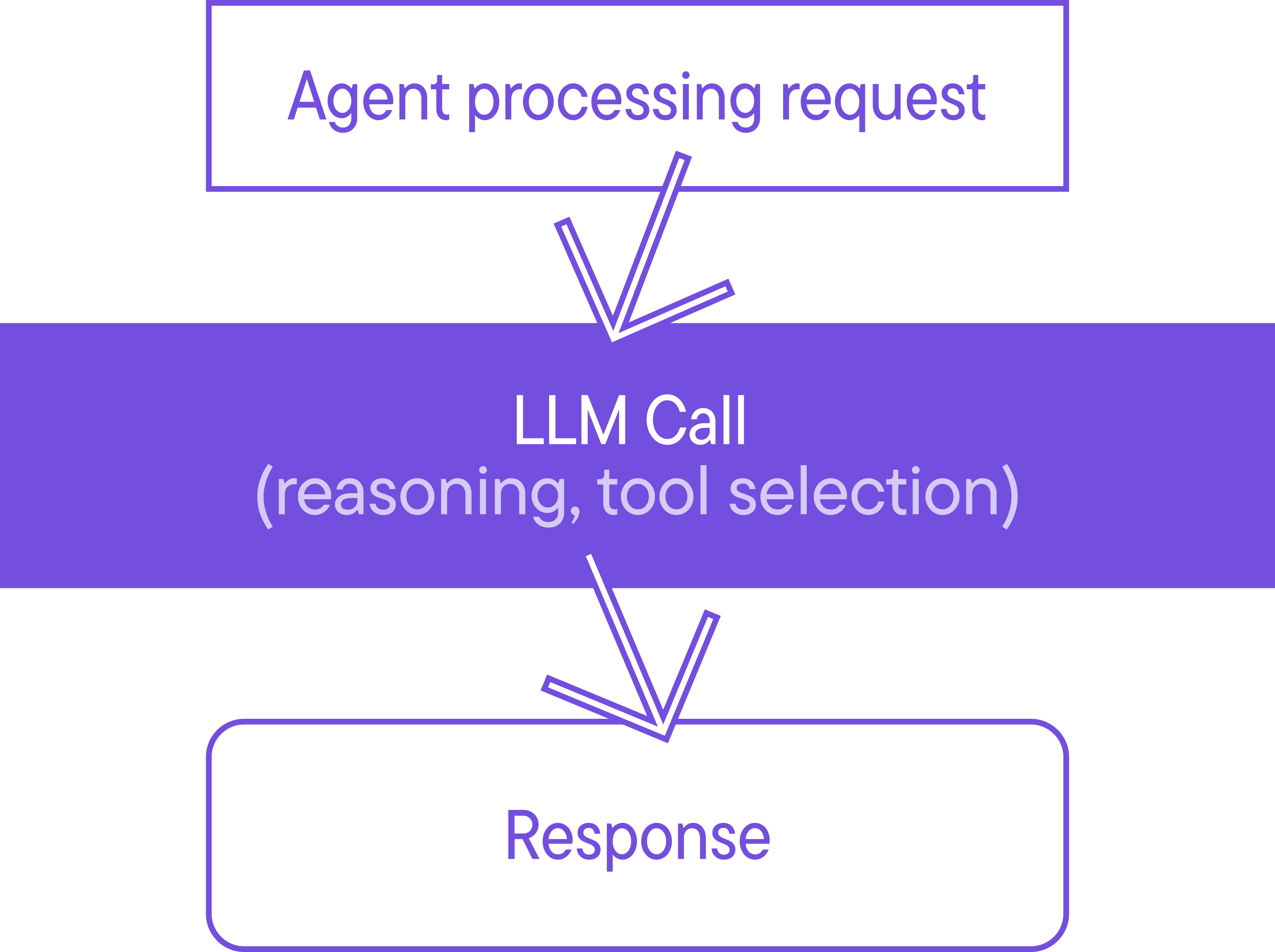
And the first thing we did was our first NotebookLM. We launched all of this in a sandbox, internally, on Google’s stack. And we started asking simple questions about analytics, and answers would come back. And that became, I think, the first aha moment for me: that we managed to build a system like that — even just a sandbox, but it was already producing something. It seems impossible to build something like that with so few people. But we did.
A needle in a haystack (validation)
That’s the technical part. But how did you validate that any of this is actually needed by the user, the marketer?
First, I wrote to someone I know, a marketing analyst, and we did the first interview. He highlighted a common pain point in marketing: there are lots of tabs open in Google Sheets, and people are constantly searching through their parameters, metrics, and campaigns. A search is like a needle in a haystack: it’s a lot of data, and you need to find clear answers to a specific question about a specific campaign.
So our first bet was precisely on analytics: the marketer’s problem is a large amount of data, a large number of tabs. They need to get information about their campaign fast, and it needs to be specific and precise. Or, for example, find patterns in behavior: half a year of the ads running, look at the dynamics, what dips there were, or the growth of a specific metric. Collecting all of that, even on a dashboard, takes time. And here you can just hook your database up to AI and get your answers fast.
We already understood back then that analytics alone wasn’t enough, so we set a goal: this is an assistant that analyzes performance and suggests actions.
The turning point: screenshots by hand
And then a turning point came when we spoke with our customer success team. They told us about a recent case they’ve been running into: enterprise-level teams who have a lot of automated rules set up don’t always understand to what extent those rules are implemented or how much of their potential they’re using. That’s the first case. And the second one: since there are many rules, it’s hard to track whether there are conflicting rules, duplicate rules, or rules that were never triggered. So, we’re talking about monitoring and audit.
Our CS team was doing rule analysis manually, together with AI: what rules could be worth creating, what’s missing, and whether there are conflicting situations. They prepared presentations with the results for customers.
This could easily be solved on our side because we already have the rule data; you need to package it well and hand it to the agent so the agent can do the analysis. At that moment, our basic analytics was ready. And we decided: this is our first focus and the MVP we will launch.
System prompt (what’s inside the agent)
Besides that, we needed to design a system prompt. I made the first version. And there you had to think carefully: what use cases could there be, what data do we need, which use cases do we want the agent to handle?
It’s a huge instruction for our agent. It defines the role, what it should do, where it should get data from, how Birch products work, and how it should use them, and the metrics and strategies for different industries.
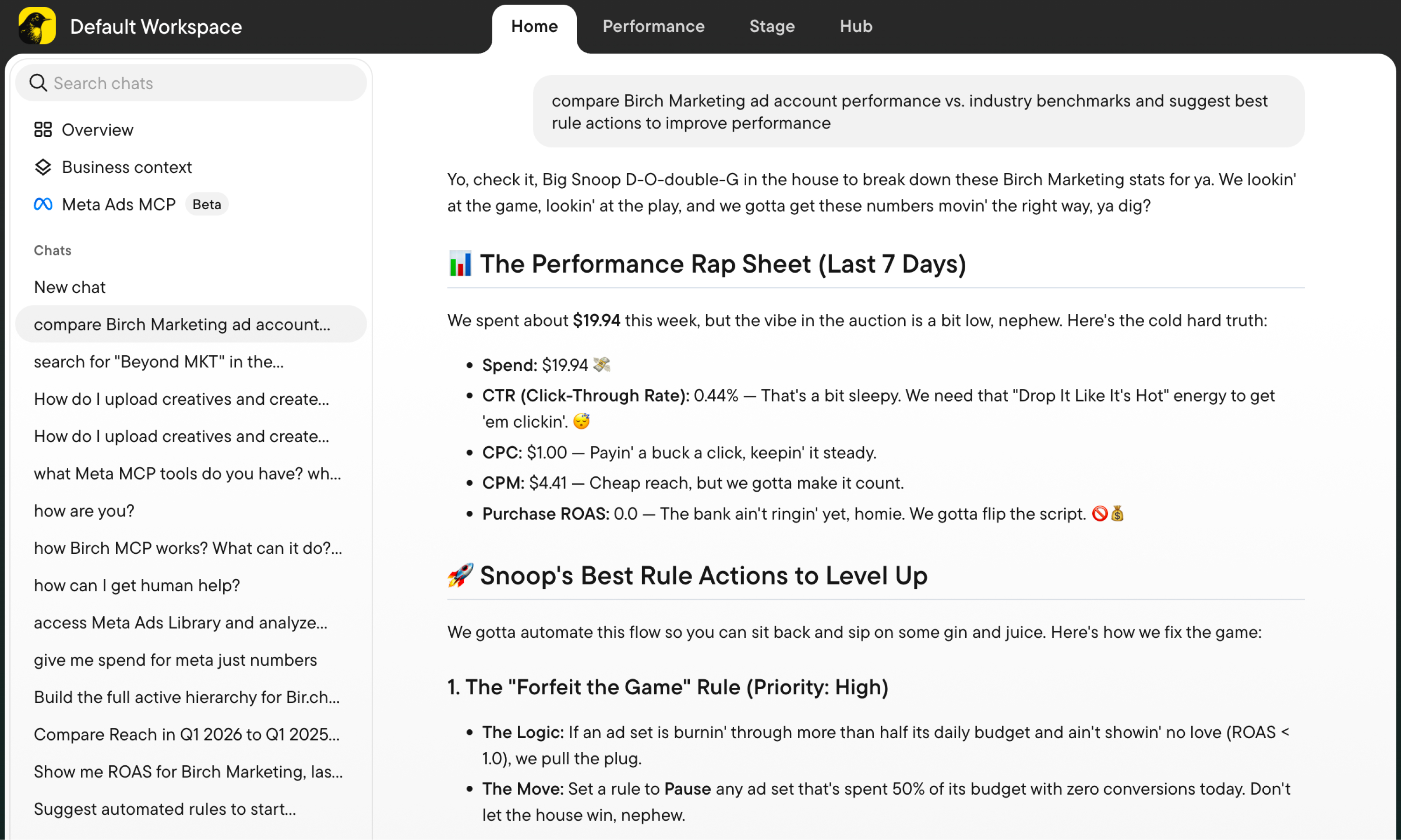
Birch AI works with the client’s business context: we invite the customer to tell us what the business goal is, what the metrics are. Any specific details, tactics, or configuration logic. And you can set the tone of voice, like “talk to me like Snoop Dogg,” for example.
One of the frequent questions raised at All Hands this year — how is Birch AI better than an agent a marketer could build for themselves in Claude or another environment? How will we compete with self-service solutions?
As Birch’s CTO Mike put it:
The battle between self-service and a provider is not new; both solutions have their cons and pros. And the difference was always in the answer to the question, “Who will be working on an urgent fix for the issue that popped up in the marketing platform on Saturday at 8pm?”
Milan, Birch’s Head of Product, added:
AI is hot and will continue to be so as people try to leverage it to get promotions, start businesses, sell products, etc. It’s the modern day gold rush. As a byproduct of that, we will see people who want to “succeed with AI” because it offers not just cost savings but also personal gratification.
What we need to do here is solve problems very well unconventionally. This essentially means we find ways to provide by adding additional logic or enabling people to do more within Birch, leveraging all of our products.
What most people (even technical) find out is that the time and cost commitment go beyond the “week of vibe coding” due to API changes and bugs, as well as that their opportunity cost (not working on the apps that bring them money) is too large.
The beta and the second aha moment
Coming back to the use cases you worked through — those are the ones you launched in the beta. What did the beta show?
The beta, first of all, confirmed that people are genuinely interested in rule analysis; we received a lot of questions and requests about it. Another hypothesis was about evaluating effectiveness, so how much the rules affect their performance. And that was confirmed, too. All in all, all our hypotheses genuinely hold up.
During the beta, when I saw the first 10 companies creating rules with Birch AI, I had my second aha moment. These were active rules — they don’t switch them off; they trigger and are fully viable.
Overall, I still have a bit of that feeling.. Looking at the timeline and given our small team, we managed to build a working product that people are genuinely using now. We started with just a sandbox, asking some questions about performance. It’s surprising, it’s cool, and interesting.

Secret question: learning Arabic
Is there a task in your personal life that AI handles well from start to finish, delivering a result you’re happy with?
Yes, it’s helping me with learning Arabic. Arabic has a three-letter root system. If you know the root, you can guess what a word with the same root roughly means. So what my agent does well is choosing a root as a topic for study, finding related words, and taking a topic related to Arab history or literature. It finds ways to make it easier to remember new words and recommends related content that can be useful.
The future: write tools and the return to the spaceship
Coming back to the future of Birch AI, not in the form where you press one button and off it goes. What will it do genuinely well and for whom, delivering a stable result from start to finish of a specific task?
I would split it into two subproducts: the agent inside our application and the MCP.
Among the nearest plans is a fairly deep rule analysis. So that people understand how the rules affect campaign metrics: the effectiveness of the rules themselves, and their frequency. And this is, most of all, for savvy, advanced enterprise-level clients who have a lot of data, including many rules. It’s not for beginner marketers or small budgets.
A broader plan for the next three months enables the agent to create, edit, and make bulk changes to rules. For example, I advertise different products, have many rules set up, and each product has its own folder with related rules. I want to copy them to a new product: I copied the folder and need to change the ad account for all of them. Instead of spending ages on doing it by hand, I want to be able to say: change the ad account for all rules in this folder.
In the near future, we’ll also add the ability to read data on campaign creation done with Birch’s Stage: which creatives were uploaded, upload volume, what errors were there, and what was launched.
And if you look half a year out, we’ll combine it into campaign creation through the agent.
And here we are, back to Mike’s vision.



.jpg)