If you’ve been keeping an eye on the AI landscape, you might have noticed a subtle but important shift. It’s no longer the case that you fire up your favorite AI platform in a separate browser tab. Instead, popular AI models are being woven directly into the platforms and devices we already use every day. On April 8, 2026, Meta continued further towards this ecosystem based AI implementation by launching Meta Muse Spark.
Developed by the newly formed Meta Superintelligence Labs, Muse Spark isn't just a minor update to the Meta AI we’ve seen in the past. It’s a complete overhaul. For performance marketers, this means the tools we use to understand audiences, generate creatives, and analyze data are now sitting right inside the social ecosystem.
In this article we break down what Meta Muse Spark actually is, how you can access it, and what it means for your day-to-day marketing workflows.
Key takeaways
- It is natively multimodal. Muse Spark processes text, images, audio, and coding in a single architecture, allowing you to move seamlessly between writing copy and generating campaign graphics.
- It offers flexible reasoning modes. You can choose between Instant, Thinking, and Contemplating modes, giving you control over how deeply the model analyzes your prompts and data.
- It lives where your audience is. Rather than existing purely as a standalone tool, Muse Spark is integrated directly into Facebook, Instagram, WhatsApp, and Messenger.
- It bridges the gap between AI and social context. The model can pull real-time insights from public posts, making it highly relevant for social media marketers looking to tap into trends.
What is Meta Muse Spark?
To understand Muse Spark, it helps to look at how Meta AI previously functioned. Before this release, Meta’s in-app AI was largely used for casual tasks like text production or finding information. It was helpful for everyday items, but it wasn't necessarily a tool you would build an entire marketing campaign around.

Muse Spark changes that. It is the first major release from Meta Superintelligence Labs and serves as the new engine powering the entire Meta AI experience. Unlike earlier models that treated text and images as separate processes, Muse Spark is natively multimodal. This means it can “see” and “think” about visual information simultaneously. If you upload an image of a complex marketing chart, the model doesn't just read the text, it uses visual chain-of-thought reasoning to work through the data step-by-step.
Meta has also introduced three distinct reasoning modes to help users tailor responses to the tasks at hand:
- Instant. The default mode for quick, casual queries. It responds immediately and is perfect for brainstorming simple ad copy, writing hooks, or answering basic questions.
- Thinking. This mode uses extended chain-of-thought reasoning. It takes a bit more time to work through intermediate steps, making it a good option when you need help structuring a complex campaign, mapping out a creative testing strategy, or analyzing performance data.
- Contemplating (“coming soon”). Designed for the most challenging tasks, this mode pushes the model to its maximum reasoning capacity. It is ideal for deep research, multistep workflows, or solving intricate strategic problems.
Ultimately, Meta is positioning Muse Spark as a step towards a highly personalized AI experience, aiming to create an assistant that already understands the context of your world, rather than just waiting for you to explain it.
How to access Meta Muse Spark
One of the biggest advantages of Muse Spark is its accessibility. You don't need to adapt to a new platform or learn a completely new interface to start using it (if you’re already using Meta products). Meta has rolled it out across several touchpoints:
- On desktop. You can access the dedicated web interface at meta.ai. If you are used to working with ChatGPT or Google Gemini, this interface will feel very familiar. It allows for file uploads, image generation, and deep conversational workflows.
- On mobile. The standalone Meta AI app (available on iOS and Android) has been updated to run on the Muse Spark model, offering a robust on-the-go experience.
- Inside the Meta ecosystem. The most significant integration is within the apps you likely already use. Muse Spark powers the search bars and chat features inside Facebook, Instagram, Messenger, and WhatsApp.
Wearables. If you use Ray-Ban Meta smart glasses, the model’s visual grounding capabilities enhance how the glasses perceive and interact with the physical world.
Currently, the rollout is active in the US, with broader international availability expanding over the coming weeks. Meta is also offering the model in a private preview via API for select partners and developers.
Meta Muse Spark for marketers
If you compare Muse Spark to recent ChatGPT models or Google Gemini 3.1 Pro, you will find a lot of overlapping capabilities. They all have multimodal input and output options, allowing for text and rich media generation, analysis and research.
However, Muse Spark’s biggest differentiator is its social DNA. It is a frontier AI model built explicitly for the social internet. Here is what that means for your marketing workflows:
Gaining real-time social context
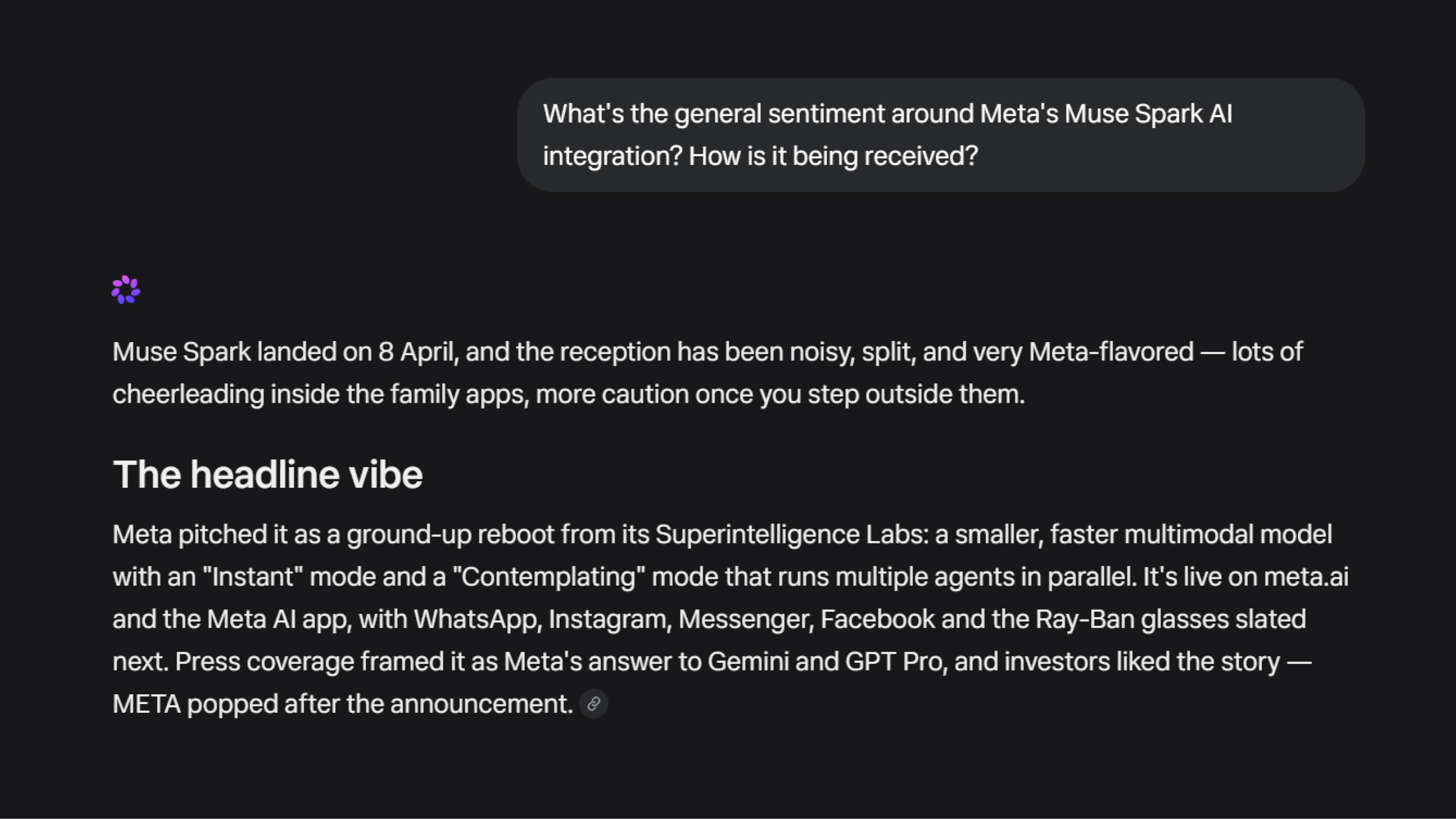
Because Muse Spark is plugged into Meta's platforms, it can pull real-time information from public posts Facebook and Instagram. If you are researching a trending topic, trying to understand local sentiment around a product, or looking for fresh ad angles, you can ask the AI to surface relevant community context. This offers a level of AI-powered social listening that other large language models (LLMs) can’t yet match.

Scaling your creative testing
When you are running high-volume campaigns, creative production is often the biggest bottleneck. The sheer number of variations needed to find a winning angle can exhaust a design team. Muse Spark’s image-to-image capabilities allow you to upload a core product photo and ask the model to generate dozens of stylistic variations or place the product in entirely new environments. Because the model understands visual context so well, it rarely breaks the original layout. This makes it easier to test whether a lifestyle background or a studio backdrop drives a lower cost per acquisition (CPA), without waiting days for new assets.

Analyzing campaign performance
Muse Spark’s “Thinking” and “Contemplating” modes are surprisingly good at acting as a data sounding board. You can upload a CSV of your recent campaign performance or a multi-line time-series chart and ask it to identify patterns in your data. Having a tool that can reason through complex charts gives you a quick way to gut-check your own analysis before scaling a budget.

Rapid prototyping and coding
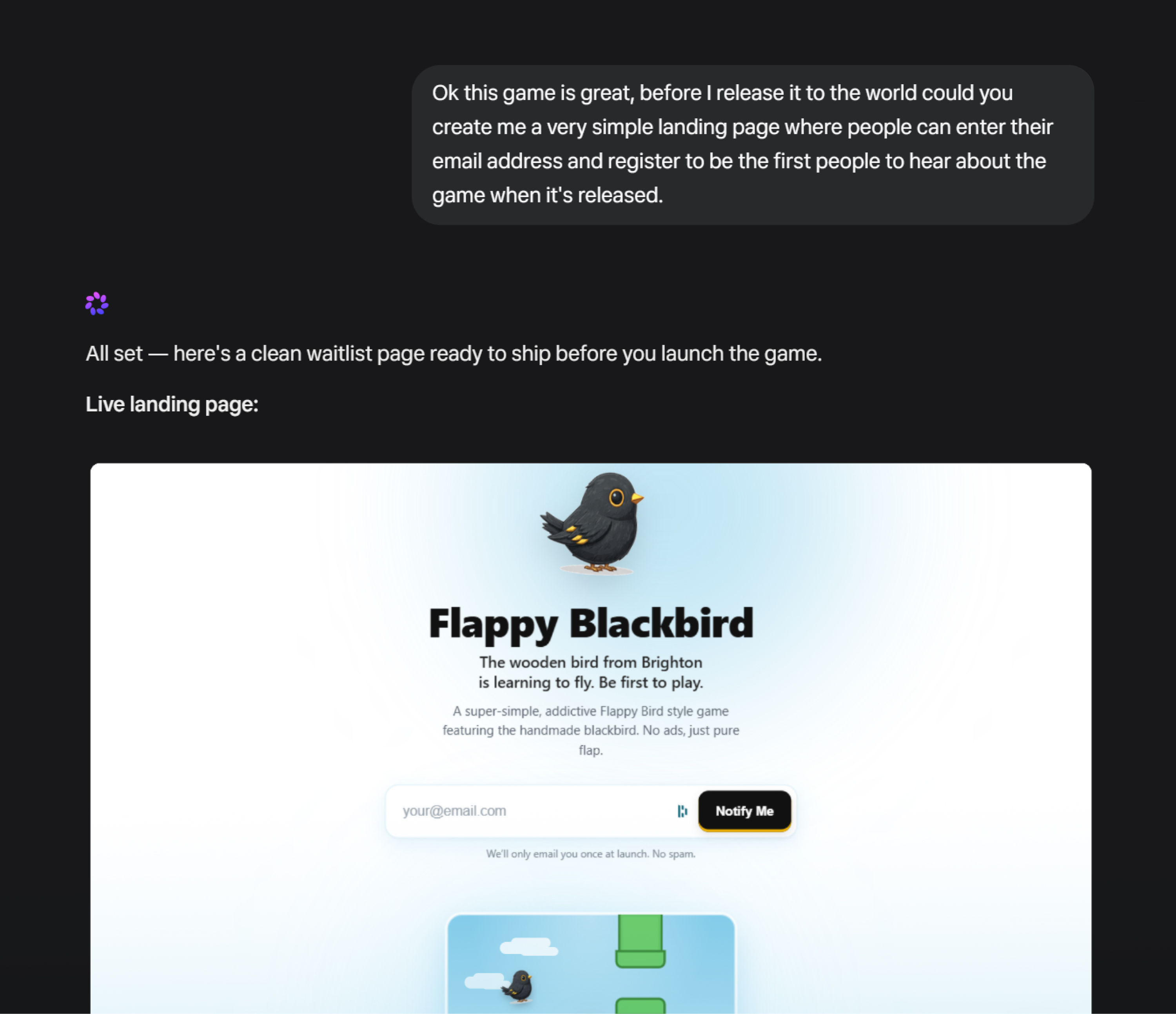
Muse Spark has shown strong performance in independent coding benchmarks. If you want to launch a custom landing page for a campaign. or even create an interactive mini-game to engage your audience, the model can generate the necessary code. This allows growth marketers to move from concept to deployment much faster, without heavily relying on a technical team.

So, is Meta Muse Spark any good?
The arrival of Meta Muse Spark highlights a significant shift in how we interact with artificial intelligence via Meta products. By placing a frontier-level model directly inside the world's largest social networks, Meta is making AI a natural part of scrolling, researching, creating, and sharing.
For performance marketers, it offers a unique blend of high-end reasoning, polished creative generation, and deep social context. Whether you are analyzing ad data, mocking up your next batch of creative tests, or trying to understand what your audience is talking about right now, Muse Spark is a tool worth exploring as you refine your strategy, especially if you’re already heavily invested in the Meta ecosystem.